
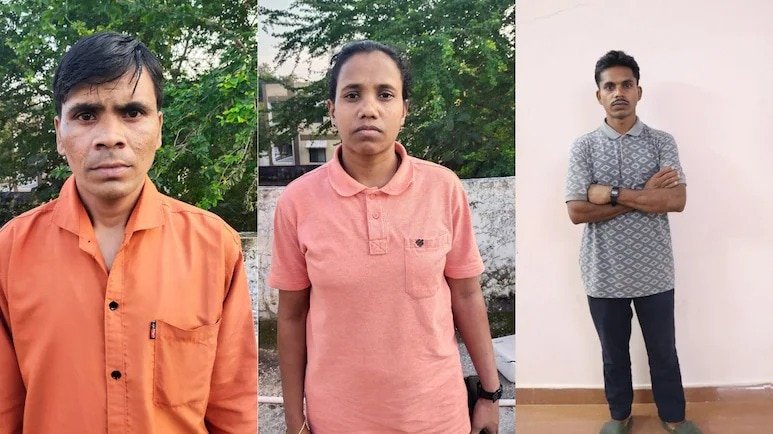
In Bastar, where for years the sound of guns has been part of life in the forest, three former Maoist cadres have chosen another sound — that of pages turning and pens moving across paper.
Geeta Narote, Arjun Oyam and Santosh Anchla once lived within the Maoist organisation. Today, they are students again.
After surrendering and returning to civilian life, the three have cleared the Class 10 examination conducted through the Chhattisgarh State Open School. All three secured first division. Their achievement is part of a larger effort by former Maoists to return to education and build a life beyond the organisation.
The examination was held in August and the results were declared this month. Eight surrendered cadres from the Bastar division cleared the examination, according to the latest reports.
Seven of them had been part of a group of 210 Maoists who surrendered in October 2025. Three of the successful candidates secured first division.
For the three whose names now appear on a Class 10 result sheet, the road to that classroom was not an ordinary one.
GEETA: FROM THE FOREST TO THE BOOKS
Geeta Narote, 35, left school after Class 6. Her childhood was marked by the death of her father and the responsibility of looking after her mother and younger sisters. She later became associated with the Maoist movement and spent nearly two decades with the organisation.
Within the organisation, she worked with its medical team. She treated injured cadres, stitched wounds, administered injections and provided medicines. She became known as “Dr Champa”.
Narote eventually surrendered in Jagdalpur as part of the group that returned to the mainstream last year. With her return came another decision — to resume the education she had left behind.
“I am very happy that I got an opportunity to study again. I always wanted to study,” she told reporters. She now wants to complete her higher education and pursue nursing.
The government provided her Rs 50,000 under the surrender policy. Some of that money went towards books. She said most of her preparation was through self-study, with some guidance from a teacher. The group followed a timetable and practised previous years’ question papers before appearing for the examination.
For a woman who once spent her days in the forest, the examination hall offered a different kind of test.
ARJUN: THE TEACHER WHO WANTS TO RETURN HOME
Arjun Oyam, 32, comes from Todka village in Bijapur district. His interest in education began before he entered the Maoist organisation, but the conflict in his region altered the course of his childhood.
During the years of Salwa Judum, his house was burnt and his books were lost, according to his account. As Maoist activity deepened in his area, schooling became difficult. He later joined the organisation in 2010 and was sent to Abujhmaad.
Even there, education did not entirely leave him.
Oyam studied at a Maoist political school and later taught basic mathematics, Hindi and environmental studies there. He has said that he wanted to return to a government school, but was discouraged from doing so because of the fear of arrest.
After surrendering, the classroom became his destination once more.
He now wishes to continue his studies and return to his village as a teacher. The ambition is modest: to encourage children to remain in school and to help them seek a future beyond the limits that once surrounded his own childhood.
SANTOSH: ANOTHER LIFE BEYOND THE FOREST
Santosh Anchla, 31, was also among those who resumed formal education after surrendering. He had been an area committee member of the Maoist organisation before returning to civilian life in October last year.
The years spent away from formal schooling had left a gap, but not an end to his education.
Anchla cleared Class 10 and now wishes to continue his studies. His plans lie in business and farming — work rooted in the ordinary economy of village life rather than the underground world he once inhabited.
Three men and a woman are not enough to measure the success of a rehabilitation programme. But their stories show what becomes possible when education is offered after surrender.
WHEN THE PEN BECOMES THE NEXT STEP
The Chhattisgarh administration has made education part of the rehabilitation process for surrendered Maoists. Officials have said that those willing to study are being assisted with educational material and other resources, while rehabilitation centres provide an environment in which they can prepare for examinations.
The figures remain small when set against the years of conflict in Bastar. Yet numbers do not always tell the whole story.
For Geeta, a nursing course now lies ahead. For Arjun, there is a village where he hopes to teach. For Santosh, there is the prospect of higher education, farming and business. The three have already crossed one examination.
The next one is not written on a question paper. It is the slower work of learning to live an ordinary life after years spent outside it. In the forests of Bastar, where the gun once determined the direction of many young lives, three former cadres have chosen another instrument. A pen. And, for now, they are writing with it.
– Ends