
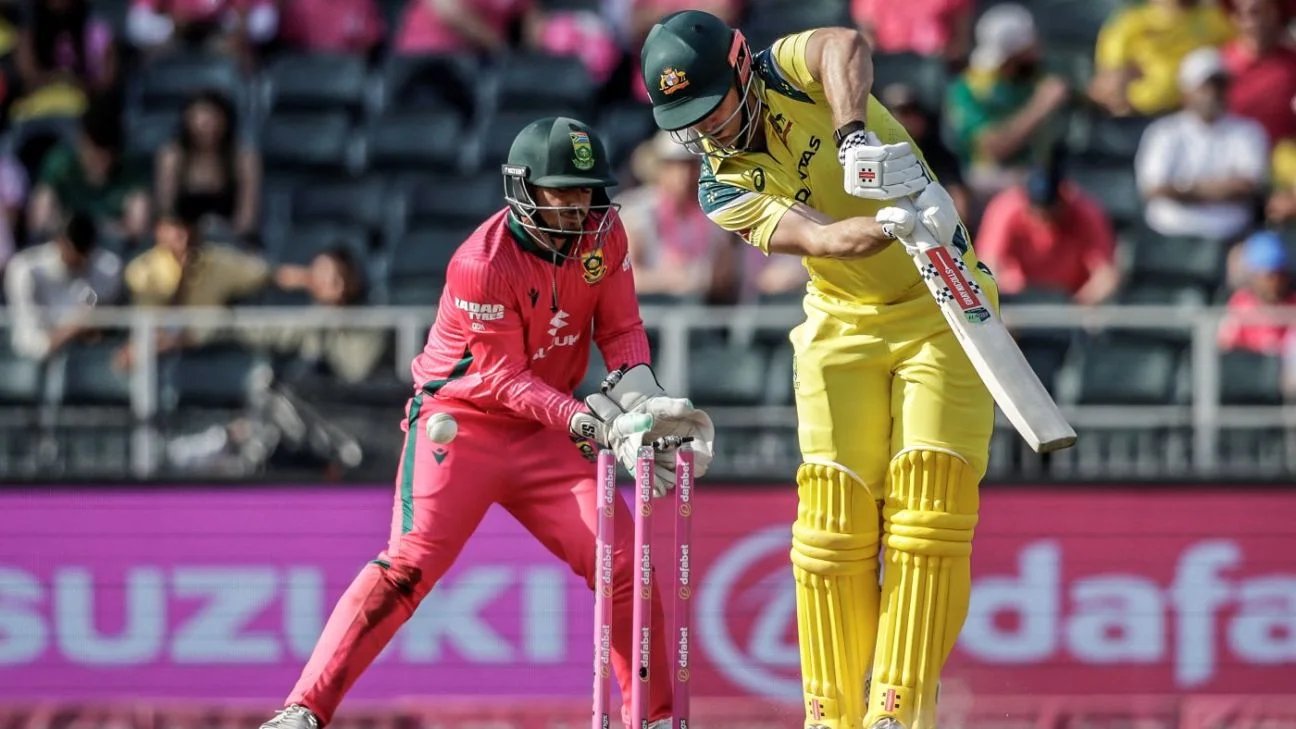
How do they stop the middle-order spin cycle?
The injuries to Green in Zimbabwe and Inglis in South Africa did not help. But even with those, their overall play in the middle overs, particularly against spin, was exposed and the lack of finishing power is a worry heading.
Cracks appeared in the final ODI against Zimbabwe where they narrowly escaped defeat after collapsing. Keshav Maharaj and Bjorn Fortuin exposed them properly in Durban and Johannesburg to turn the tide after Australia’s openers had got off to blazing starts.
Of the 20 international sides to have played ODI cricket since the 2023 World Cup, Australia have the poorest batting average against left-arm orthodox spin – just 22.95. Individually, Green has been dismissed eight times at an average of 18.62; Marsh seven times at 13.85; Inglis eight times at 11.75. How they rectify those numbers and bed down a middle-order combination with only six scheduled ODIs left before the World Cup remains to be seen.
Is the top three set in stone?
But offsetting the positives is their inability to kick on. The spotlight has shone on Australia’s shaky middle-order but the inability of their top three to make big scores is worth noting.
Marsh’s troubles against left-arm spin is a reason he can’t get into the middle overs. He is in career-best ball-striking form in white-ball cricket but has not faced more than 63 balls in his last nine ODIs despite passing 36 seven times.
Who will give Australia their middle-overs wickets?
Like the middle-order batting, the middle-overs bowling is a concern coming out of the tour. Personnel had a part to play with Josh Hazlewood only playing three games, Mitchell Starc two and Pat Cummins one. Nathan Ellis’ form was outstanding but his side strain midway through the second ODI against South Africa highlighted the issue.
Australia had no problem taking powerplay wickets on the tour, even when the likes of Xavier Bartlett and Spencer Johnson played in the absence of the big three. But opponents have been able to rebuild easily. Middle-order centuries to Matthew Breetzke, Temba Bavuma and David Miller in the South Africa series exposed the issues quite clearly.
How do they solve the fifth bowler problem?
This knits in with the middle-order batting and middle-overs wicket-taking issues. The retirement of Glenn Maxwell has left them short on two fronts. There were positive signs from Renshaw with the ball in Zimbabwe but South Africa’s superior spin hitters took to him thereafter. Peake and Connolly showed promise but both are very inexperienced in terms of their ability to contain or dismiss top-quality middle-order batters at international level.
The shoulder injury to Green was untimely. He remains the major piece of the puzzle as a seam-bowling allrounder but he has scarcely bowled in white-ball cricket in recent times and his ODI batting has regressed since his 47-ball century against South Africa last year.
Edwards bowled impressively as a late inclusion in the South Africa series, including taking a maiden five-for in his second game, but whether his batting can provide what Australia need in their top seven is a question. Liam Scott is another who got a taste of ODI cricket in Bangladesh but was not selected for this tour. Beau Webster was also considered for the tour but remains a Test-only option for now.
Alex Malcolm is an associate editor at Cricinfo