
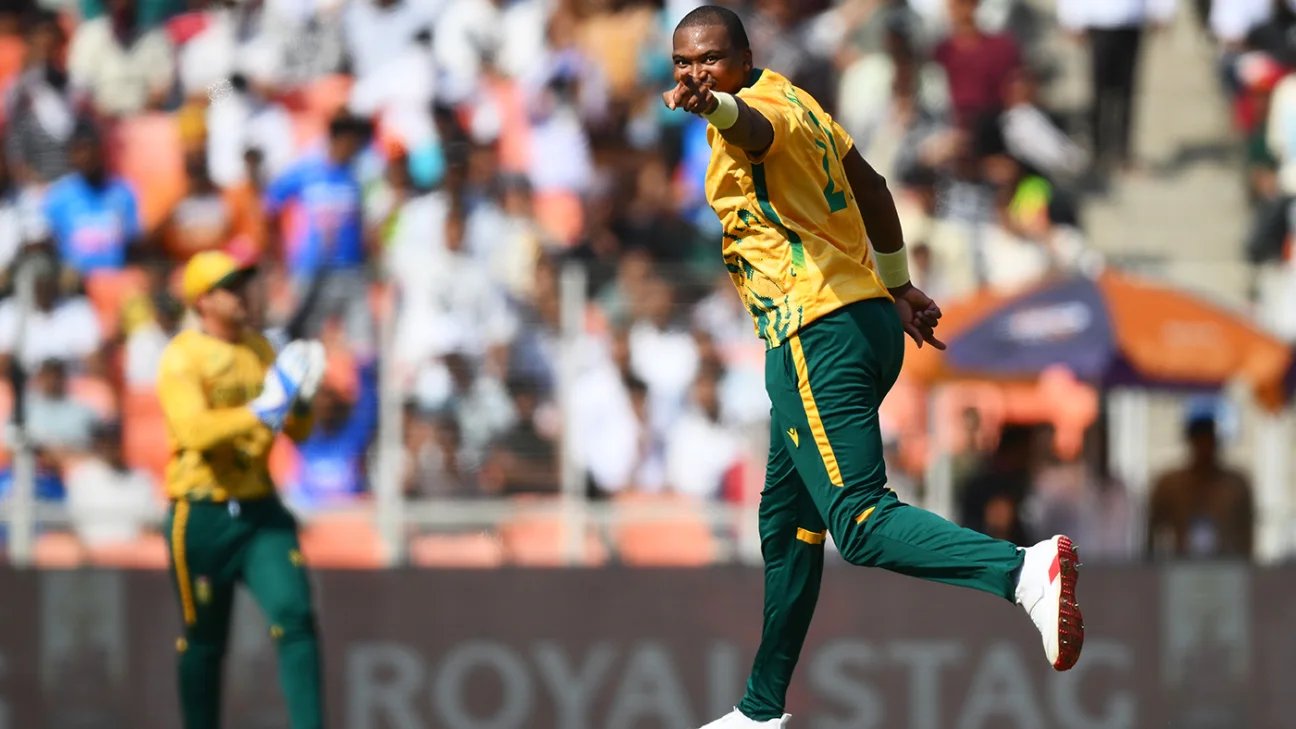
“All that changed was that someone believed in me”.
Then came the lull. Loss of form, injuries and the emergence of a newer crop of fast bowlers limited his appearances. It wasn’t as though Ngidi ever went away. He was always part of the conversations, part of squads, but not always part of the playing XIs.
That seems to have changed over the last 18 months. In one of the most rewarding periods of his international career, Ngidi says the “clarity in communication” from the current coaching set-up has been transformative.
“The consistency and communication from our national coach that I will be playing, that I will be selected and that he didn’t see me as a back-up bowler to anyone – that was massive for me,” Ngidi says. “If people always speak to you as if you’re the back-up for someone, then you probably end up playing that way – as a back-up. But when a coach tells you that you’re not second-best to anyone, I see you as my frontline bowler… I just started to play that way. That’s exactly what I needed.
“It wasn’t anyone teaching me a specific skill. It was more the communication in how you see me and what you want me to do. I think that was the biggest difference for me this season.”
While Ngidi was getting chances, they were sporadic, particularly in T20Is, where his variations are some of the best in the business.
“[With] the coaches before [Conrad], it was difficult, because even though my numbers in T20 cricket were still good, and the performances I was putting in were still good, you knew that you were never going to get picked anyway. So it was like: Well, why bother? Why really try if I know that it doesn’t matter how much work I put in, I’m not going to get the reward for it,” Ngidi said.
“When someone treats you as if you’re not as good as someone else, you tend to not work as hard, because you think, ‘Oh, well, it doesn’t matter how hard I work; this person will never believe that I’m as good as anyone else, or a specific person’.”
“This season, I knew that if I put in the work, I was going to get the results because I was being given the opportunity. And that was the difference: I’ve been given the opportunity and now it’s up to me about what I do with that.
“I got the freedom to express myself. Like, having a coach who allowed me to bowl six slower balls in an over if I wanted to… that’s something most coaches would probably tell me not to do. But the coach we have has given me the freedom to express myself and play cricket the way I see it. And that seems to work for me.”
Yet, Ngidi’s biggest change during the last season was more psychological than technical.
“My biggest learning was that I was a bit too serious, in terms of my cricketing career. Always worried about what’s coming next or how am I going to get selection – things that were never in my control. This season, the difference was… there’s been a lot of changes in my personal life as well.
“So it was just: play the game as you enjoy it. I’m not getting any younger, so what’s the point in stressing about things that I can’t control? I just started to play that way and that’s exactly what I needed.
“There’s a lot that happened last season for me, just to be able to show that, well, this is what I’m capable of. Now, all of a sudden you’re in demand as a T20 player, as a cricketer. Teams are looking at you, speaking to you. And all that’s changed is that someone just had a bit more belief in me than another person.”
What now looks like a stock Ngidi delivery was anything but an overnight discovery. He began experimenting with the slower ball in 2018 with Dwayne Bravo at Chennai Super Kings. He first used it in a game in 2019, and has since added a layer of variations to it: slower-ball yorkers, back-of-a-length variations, bouncers, wider channels, and most importantly, the ability to adjust his variations with the batters moving around in the crease.
“My idea was: how do I make the slow ball so effective that batsmen get worried about it? When I was with Bravo, I could see that was an effective way of bowling it. So I started learning it in 2018.
“So from 2018 to 2021, that’s how long it took me to confidently bowl that one, or the one that dips. And then from 2021 till now, what I’ve perfected is how to be able to bowl a slower-ball yorker, or get it to dip on the yorker line. The toughest thing now is to be able to bowl that on command, and to be able to bowl it when a batsman moves.
“So if I see you running down the wicket, can I change at the last second and still execute the delivery? So yes, 2026 is when I felt most comfortable bowling it consistently in a game. Before, maybe I still had a little bit of doubt, and I was still nervous, whereas now, it’s like muscle memory; it’s second nature.”
While balancing national duties with franchise demands remains a constant challenge for any modern player, Ngidi, who has missed the start of the series against Australia due to a hamstring issue, says injuries are simply a part of the journey.
“There’s sacrifices that have to be made, but I don’t mind doing that because there’s rewards in the end. And if you do get injured and you don’t end up playing in what you had planned for, at least you can sit at home and you don’t feel bad about yourself that I didn’t put in the work before. I put in the work. If I get injured, I get injured, so be it. That’s life. But at least I can sit with peace in my heart that I did try to be there.”
Ngidi now races against time to be fit for the second Test against Australia, which begins on October 18 in Gqeberha.
After playing international cricket for close to ten years, he doesn’t need to prove that he belongs. He knows he does. What was probably lacking was the backing, and now that he has it, he is building on the promise that was always there.
Ashish Pant is a sub-editor with Cricinfo