
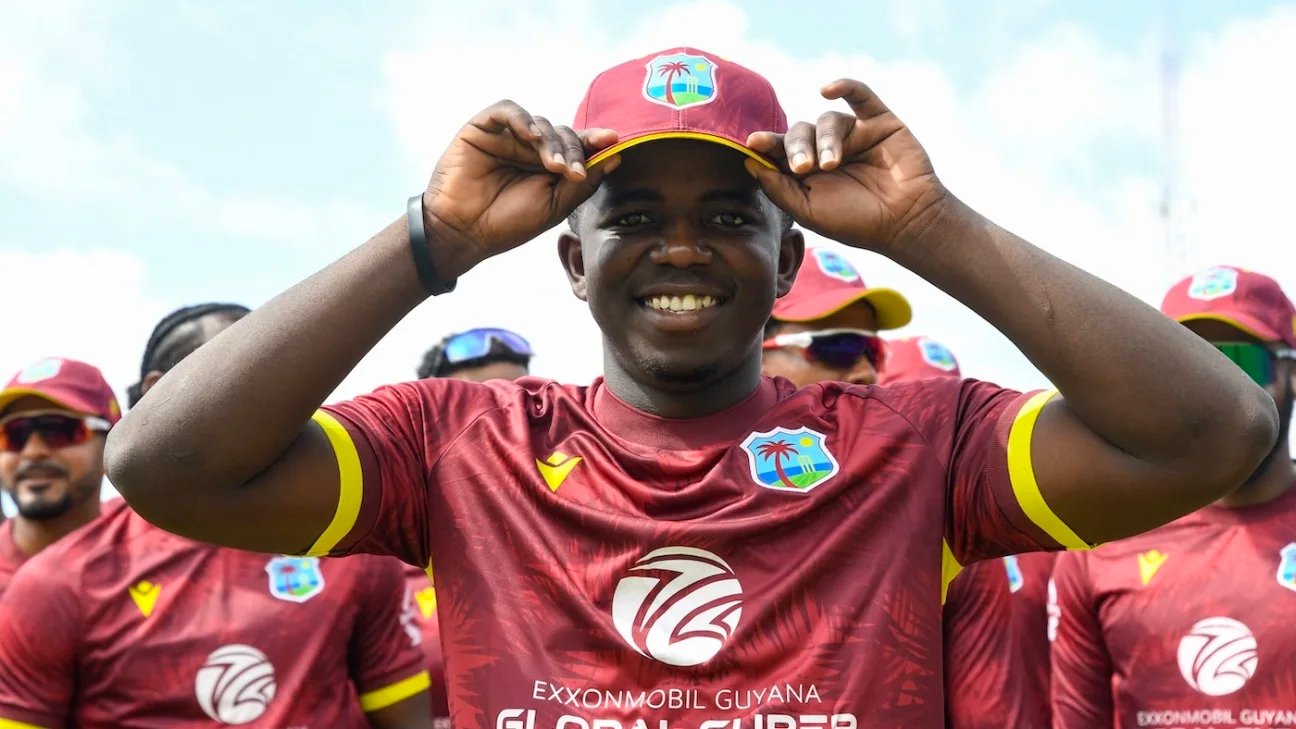
In the TV show The Mentalist, Patrick Jane can learn plenty about people without them telling him much. The fictional crime consultant, portrayed by Simon Baker, observes instead – expressions, behaviour, little details that others might miss – and uses what he sees to work out what the person opposite him might be thinking.
Over the past few months, Lawes has gone from Under-19 cricket to trying to outthink Rohit Sharma, Virat Kohli and Shubman Gill. Yet, when he stands at the top of his mark, he says the reputation of the batter in front of him doesn’t matter.
Lawes reckons he has about four variations now and says the world hasn’t seen all of them yet. There is another delivery he is working on that doesn’t even have a name. “I’m just trying something,” he says. Will it come out in a match eventually? “Maybe someday, yeah.”
He comes from Wakefield Savannah in Linstead, St Catherine, Jamaica and cricket was a big deal at home long before he even dreamed of it as a career. His mother, Ilyn Henry-Campbell, is Lawes’ biggest supporter and her own relationship with the game goes back to when she was a girl, buying batteries for the radio so she could listen to the cricket. Lawes later learned his trade at St Catherine Cricket Club, which had produced Andre Russell and Rovman Powell.
Lawes’ fascination with spin, though, came from watching Adam Zampa represent his home franchise, Jamaica Tallawahs, in the CPL. Eight years after watching the Australia spinner play for Tallawahs, what catches Lawes’ eye about Zampa is not how much he turns the ball but more what happens after somebody hits him.
“I see he gets hit a lot in his career and he always bounces back pretty strongly,” Lawes says. “So, I look at that and take that as a good motivation for me.”
That is important because Lawes isn’t particularly interested in becoming a bowler whose first priority is keeping the runs down. Give him a hypothetical ten-over spell of 1 for 40 or 4 for 65, and he immediately chooses the latter.
“Four for 65 for sure,” he says. “You know, I’m a wicket-taking bowler. So, the more wickets I get… I mean, the runs do matter, but getting four wickets for 65 is a win for me any day of the week.”
The challenge now is working out how to take those wickets against international batters. Lawes has already spotted one major difference from age-group cricket: senior batters are less likely to give a bowler an opening.
“An Under-19 batter doesn’t have the same temperament as an international batter,” he says. “An international batter has a more mature mindset about how they go about things. So, you have to really do something special to outsmart someone at this level.”
That confidence has not always been there. On an Under-19 tour of Sri Lanka, Lawes played three of the seven matches, took one wicket, and conceded around seven an over. He had trained extensively before the series and expected more from himself. When the rewards didn’t come, he began wondering whether he was good enough.
“I was spaced out for a bit, looking into space, thinking about what had really just transpired”
Vitel Lawes on getting his first West Indies call-up
Nikita Miller, the former West Indies spinner who has worked closely with Lawes, did not think there was much technically wrong. The change, Lawes says, was more about his mindset.
The results followed as Lawes finished as West Indies’ leading wicket-taker in their subsequent Under-19 series against England and then took ten wickets at the 2026 Under-19 World Cup. He was the only West Indies player named in the ICC team of the tournament. The progress was enough to earn an invitation to a West Indies ODI camp, where Lawes felt he fitted in and was up to the standard of the senior players around him. He then went home and returned to local cricket.
In July this year, Lawes was playing a two-day competition, which his team won. He didn’t have an internet connection and went to his club to wait for the celebrations to begin. When he got there, he discovered several missed calls from West Indies head coach Daren Sammy.
Lawes called back, and Sammy told him he had been selected for West Indies. He had yet to play a game of senior domestic cricket.
“I mean, from then, I was spaced out for a bit, looking into space, thinking about what had really just transpired,” he says. “The most exciting part of me was to share the news to the people that mattered to me and to see them being happy for me. That was maybe the most heartfelt moment.”
A wristspinner with variations and a wicket-taking mindset would seem almost designed for T20 cricket, but it isn’t Lawes’ favourite format. That is ODI cricket. Lawes is on tour in India only for the ODIs; for the T20Is, the selectors have picked Gudakesh Motie and Akeal Hosein as the primary spinners.
“You get a lot of time [in ODIs],” Lawes says. “You get just enough time to do what you want – across spells, and with the newer and older balls. And you get enough time to change the context of a game. I don’t really look at T20 cricket that way. But if I get the opportunity to play, I will take it with both hands.”
At this point in his career, Lawes says getting opportunities to develop matters more than specialising in one format: “Doing that at the highest level is probably the best place to do it. You get to trial and error.” Test cricket is something he actively wants, although he doesn’t want to rank it against T20 cricket before he has actually experienced it.
There is plenty still to develop. But the reason West Indies have fast-tracked Lawes is also fairly clear. During his debut series against New Zealand, Ian Bishop summed up the rarity of what he offers: “We’ve been asking for a slow bowler who can turn it both ways since the peak of [Sunil] Narine.”
India has also offered Lawes the chance to watch Kuldeep Yadav, another left-arm wristspinner, from relatively close quarters. He hadn’t spoken to the India spinner or watched him train when this interview took place, but he had followed Kuldeep’s bowling closely enough to note a few things.
“I’ve observed a couple of things,” Lawes says. What things? He isn’t saying. “I just keep that in observation. I don’t really want to speak much about it.”
There is a smile when he refuses to elaborate on exactly what he has observed in Kuldeep’s bowling. Perhaps those details will emerge later. For now, he would rather keep them to himself. He will, after all, observe rather than talk.
Sreshth Shah is a sub-editor at Cricinfo. @sreshthx