
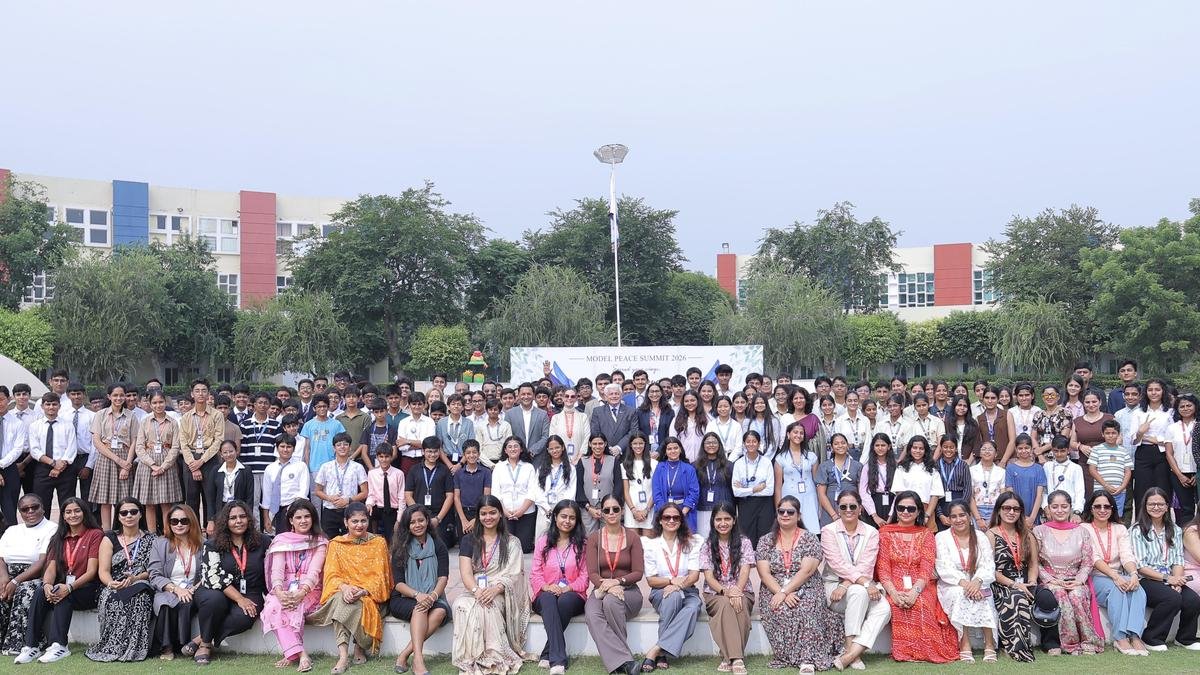
Ask a room of adults how to build peace, and you will usually get a speech. Ask a room of students, and you will get a negotiation. That, in essence, is what happened at the first Model Peace Summit, held this year at King’s College India from September 23 to September 26, 2026.
The concept was conceived by Helen Bowen, Head of School, after learning about the story of Sadako Sasaki and the Peace One Day initiative. Her vision was to bring students from around the world together to learn, collaborate, and explore how they can become active builders of peace. Over four days, 141 peace delegates from eight schools across four States – Delhi, Rajasthan, Madhya Pradesh, and Haryana – did not sit through panels about conflict. They argued cases in a moot court, brokered compromises in a peace council, and asked what justice looks like after harm has been done. Then they were asked to commit to something.
It is easy to be cynical about student summits, which are often accused of being CV-building exercises with good catering. But this one deserves a more serious look, and not only in India.
An old idea, reinvented
Students simulating international bodies is hardly new. The tradition is often traced to Oxford in 1921, with the first gathering explicitly called “Model United Nations” held at Swarthmore College in 1947. British readers will know how far the idea has travelled. The London International Model United Nations was dreamt up by University of London students who wanted a conference worthy of the city where the UN first sat. Haileybury’s annual conference is said to draw more than a thousand pupils, and Felsted School hosted 20 visiting schools and 265 delegates in 2025.
Beyond Britain, The Hague’s THIMUN began in 1968 as a local event and now draws some 3,200 students and teachers from around 200 schools. The Model European Parliament has brought sixteen-to-nineteen-year-olds together since 1994. In Ukraine, students have modelled a NATO parliamentary assembly while their country is at war.
What ties these together is a hunch that you understand diplomacy better when you have to do it. It is a sound hunch, and small beginnings can grow. The Kansai High School Model UN in Kyoto started as a capstone project by students and has grown from two schools in 1991 to more than 250 participants from twelve.
What was different in Rohtak
Most of these events model an institution: the UN, the EU, NATO. The Model Peace Summit demonstrated something harder to put on a name card, which is the skills, peace depends on.
Its program moved from understanding to dialogue to experience to commitment. Day one opened with a Peace Pledge and a shift in the central question, from “What is peace?” to “What does peace require from me?” Day two started with the Official Welcome Ceremony, swiftly followed by putting students inside three ways of resolving conflict. The moot court taught reasoned disagreement. The peace council taught that leadership is not simply getting your own way. A restorative justice session dealt with accountability and repair, which is rarely taught to anyone before adulthood, and often not then.
Day three widened the lens. Theatre asked students to inhabit perspectives not their own. An escape room made communication and delegation the only way out. A live student podcast asked whether media can make peace. A peace museum tied memory to real human stories, and a session on music explored healing. On the final day came mindfulness, sport, and a Peace Declaration built around a single question: what will I do differently now?
That last question matters most. Most conferences end at the closing ceremony. This one was designed to end with a personal commitment.
The engine, not the audience
Twenty-five King’s College India and IB Rohtak students together formed the organising committee, while another 54 took part as delegates. The organisers invited and coordinated other schools, wrote to parents, prepared sessions, set up venues, hosted guests and managed media and logistics. When plans changed, they adapted.
The summit’s guiding principle was that students were the engine and not the audience. Anyone who has watched adult institutions struggle with conflict will recognise why that matters. People rarely learn responsibility from being told about it. They learn it by being trusted with something that could go wrong.
The visiting delegates made the room richer. Seven schools joined the host, among them Mayo College in Ajmer, Shrewsbury School in Bhopal, The Mann School in Delhi and Heritage International School in Gurugram, alongside several from Rohtak itself. Students from cities hundreds of miles apart had to build understanding with people they had never met, which is itself a small act of peacemaking.
The event also looked outward. Experts from the UN Mine Action Service (UNMAS) and HumAHive joined online, a digital safety specialist travelled all the way from the U.K., and the international schools’ community was represented through the Council of British International Schools (COBIS). Greetings arrived from King’s College Taunton and from China. Rohtak students met a wider world without leaving the campus.
A modest claim, and a large one
None of this ends wars. The organisers would not say it does, and neither will I. Students who learn to listen at a summit will still return to schools, families and societies with real divisions.
But the organisers make a claim worth taking seriously: that peace is a set of behaviours (empathy, dialogue, responsibility, respect, courage) and that behaviors can be practiced. Their own summing-up was that students were not merely told about peace for four days. They were given the chance to do it. Among the lessons they drew: leadership is responsibility, not a title; peace begins with listening; and disagreement does not have to become conflict.
Britain and India each have a long tradition of student debating and simulation, and a shared interest in raising young people who can disagree without breaking things. There is an obvious next step. The organisers speak of a larger international dimension and of student-led peace projects that outlast the Declaration. Link a Model Peace Summit in Delhi with a school in Somerset or a university in London, and you have the beginnings of something the grown-up world rarely manages: a conversation about peace conducted by the people who will inherit it.
The young, it turns out, can do more than we expect when we hand them the work rather than the script. That is a lesson many adult institutions would do well to take.
Kennedy conceded in 1963 that the work of peace is undramatic, and insisted all the same that “that pursuit must go on.” In India, a group of students has just shown how it might.
(Dr. Sudhanshu Sinha is Cambridge U.K. alumni and blogger)
Published – October 06, 2026 12:26 pm IST