
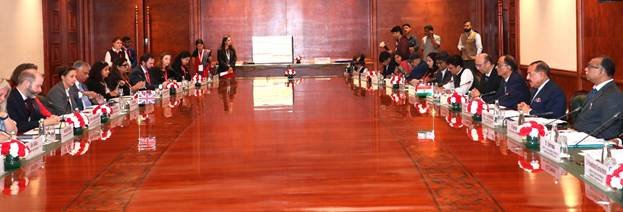
Dr Jitendra Singh, Minister of State (Independent Charge) for Science & Technology and Earth Sciences and Minister of State in the Prime Minister’s Office, Personnel, Public Grievances, Pensions, Atomic Energy and Space, attended the 8th meeting of the India-UK Science and Innovation Council (SIC) along with Jonathan Reynolds, UK Minister for Business, Innovation, Science and Trade in New Delhi.
The meeting reviewed progress in bilateral cooperation in science and innovation, and discussed opportunities to strengthen research partnerships, collaborate on emerging technologies, and translate scientific research into practical applications.
The Indian delegation included Prof. Ajay Sood, Principal Scientific Adviser to the Government of India, Prof. Umesh Waghmare, Secretary, Department of Science and Technology, Dr. Rajesh Gokhale, Secretary, Department of Biotechnology, Dr. Srinivas Kumar Tummala, Secretary, Ministry of Earth Sciences, Dr. Shivkumar Kalyanaraman, Chief Executive Officer, National Research Foundation for Research and Dr. Rajesh Pathak, Secretary, Technology Development Board, along with other senior officials from the concerned departments and institutions.
The UK delegation was led by Jonathan Reynolds MP, Secretary of State for Trade, Innovation and Business. The delegation included Ms. Lindy Cameron, British High Commissioner to India, Mr. Ben Mellor, Deputy High Commissioner to India, Ms. Amanda Brooks, Interim Permanent Secretary, Department for Trade, Innovation and Trade, Mr. Harjinder Kang, Her Majesty’s Trade Commissioner, and Mr. Rhys Bowen, International Director, Department for Trade, Innovation and Trade, as well as other representatives from the UK’s science, research and innovation ecosystem.
Dr. Jitendra Singh and Jonathan Reynolds jointly inaugurated the BRIC-CDFD-ONT India Genomics Centre of Excellence on this occasion. Dr. Rajesh S. Gokhale, Secretary, Department of Biotechnology and Director General, Council for Biotechnology Research and Innovation, Prof. Ullas Kolthur-Sitharamay, Director, BRIC-CDFD, and Mr. Nick Kehr, Chief Financial Officer, Oxford Nanopore Technologies were also present at the inauguration ceremony.
The Council’s broad collaboration agenda is based on the India-UK Research and Innovation Memorandum of Understanding, the Technology Security Initiative and the ‘India-UK Vision 2035’. These frameworks provide a strong foundation for collaboration between research institutions, universities, industry and innovation, with a focus on translating scientific advances and research into practical technologies and applications.
Industry-led research and technology commercialization remain important areas of engagement. The Department of Science and Technology’s collaboration with Innovate UK supports joint industrial research and development projects aimed at developing new intellectual property, technologies, processes, and prototypes. Eight projects have been agreed under this program to support areas such as advanced manufacturing, power electronics, and net-zero technologies, which are currently in various stages of implementation.
This collaboration spans emerging and strategic technologies, including artificial intelligence (AI), quantum technologies, semiconductors, critical minerals, advanced materials, biotechnology, telecommunications, and net-zero technologies. These areas offer opportunities to leverage complementary research capabilities, strengthen innovation ecosystems, and promote the development of technologies with industrial and societal applications.
Joint research between Indian and UK institutions also covers antimicrobial resistance, healthcare, agriculture, climate and meteorology, geo-hazards, advanced manufacturing and basic sciences. Collaboration in weather and climate science includes research on natural hazards associated with the South Asian monsoon, advanced modelling capabilities and risk-based forecasting.
The meeting reaffirmed the importance of continued institutional engagement and close ties between research, industry, and innovation ecosystems. Continued India-UK collaboration can help advance scientific discoveries, strengthen research, and translate scientific capabilities into practical solutions to shared challenges.
