
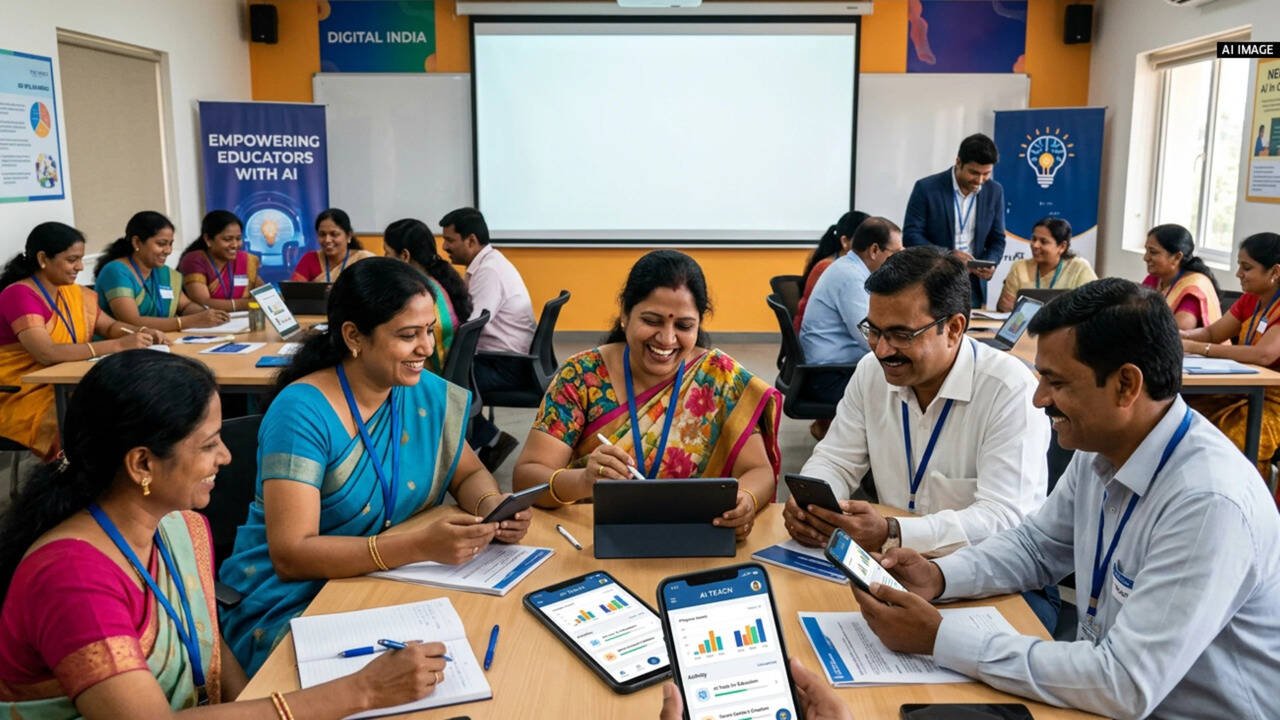
Tech giant Google has announced a major nationwide expansion of its ‘Google AI Educator Series,’ alongside a series of new academic, research, and vocational initiatives aimed at integrating Artificial Intelligence (AI) into India’s educational and economic frameworks.
Following the successful training of over 80,000 educators since the programme’s initial launch in May, the mobile-first teacher training initiative is now being extended through new strategic partnerships with the state governments of Bihar, Madhya Pradesh, and Sikkim, as well as the Union Ministry of Skill Development and Entrepreneurship.
To ensure nationwide accessibility, Google is rolling out the programme as a free, self-paced online curriculum.
Strictly aligned with the National Education Policy (NEP) 2020, the flexible modules are designed to accommodate the demanding schedules of teachers. The training equips educators with practical confidence in using AI tools such as Gemini and Gemini Notebook. These tools are intended to help teachers design lesson plans, create tailored learning aids, and streamline daily academic preparation, ultimately allowing them to reclaim time to focus on mentoring students.
The online training is currently available in English, with localised versions in Hindi, Marathi, Telugu, Assamese, Odia, and Punjabi scheduled for release later this month.
Beyond individual teacher empowerment, Google is actively bolstering institutional AI capacity across both school and higher education levels. The tech major is supporting educators across 100 Atal Tinkering Labs (ATLs) nationwide through ‘ATL Saathi’, a newly developed, Gemini-powered desktop application tailored specifically for STEM (Science, Technology, Engineering, and Mathematics) curricula.
In the higher education sector, Google has formalised partnerships with premier institutions like IIT Bombay and the Office of the Principal Scientific Adviser to anchor educational AI research within real-world academic settings.
In addition to foundational education, Google is directing significant resources toward high-level academic research, specifically targeting climate resilience in agriculture. Google DeepMind, in collaboration with google.org
via the AI Collaborative for Food Security, will fund a three-year postdoctoral fellowship at the Hyderabad-headquartered International Crops Research Institute for the Semi-Arid Tropics (ICRISAT).
Notably, this is Google DeepMind’s first fellowship in India and its first outside the United Kingdom. The fellowship will focus on building AI tools to characterise the genomes of critical crops like pulses (chickpea, groundnut, and pigeon peas) and climate-resilient sorghum (jowar).
This research pairs advanced genetic analysis with machine learning to identify promising plant combinations, accelerating the development of more resilient crop varieties faster than traditional, decade-long agricultural breeding methods.
“At ICRISAT, we are committed to advancing crop productivity, resilience, and sustainability in the drylands, especially as the world grows increasingly vulnerable to the effects of climate change.
We are honored to receive Google DeepMind’s first fellowship outside the UK and aim for this collaboration to empower the agri ecosystem with cutting-edge tools,” said Stanford Blade, deputy director general of research & innovation, ICRISAT.
Furthermore, Google is expanding its focus to vocational training and economic inclusion. As part of its commitment to India’s national AI roadmap, google.org is providing a $15 million grant to the non-profit organisation The/Nudge.
This funding will accelerate the development of scalable AI tools designed to help India’s 90 million micro, small, and medium enterprises (MSMEs) overcome barriers related to formal credit access, market discovery, and regulatory compliance.
A key component of this initiative includes the launch of a multilingual, voice-led educational platform designed to train local talent in tier-III and IV towns. The platform aims to equip users with job-ready skills and connect them directly with employment opportunities within the expanding small business sector, creating a vital link between rural vocational education and national economic resilience.
