
Also read: The 400-year-old Rajasthani art of Pichwai finds a new muse in the city of Venice
However, people had been creating their own stories and Gods to rally around long before the introduction of Cinema. Mata ni Pachedi, which translates to ‘Behind the mother goddess’ in English, is an artform practiced by the Vagari community of Gujarat. This practice was born out of necessity, as they were excluded from formal temple worship. The Vagaris started painting intricate portraits of Gods and Goddesses on textiles, allowing for the creation of a shrine wherever the cloth was placed.

Courtesy of Nilaya Anthology
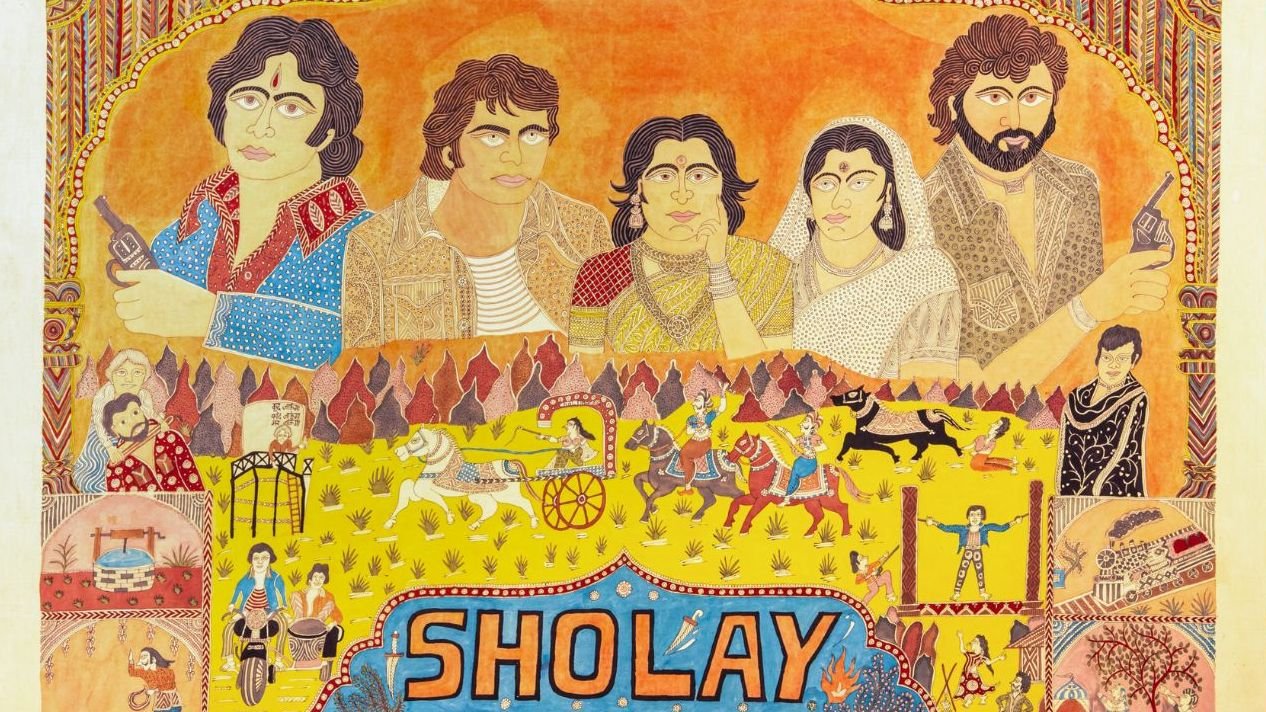
This forms the basis of the exhibition ‘Old Gods and New’ which opens at Nilaya Anthology today, in tandem with their Monsoon Film Festival. Fifth-generation Mata ni Pachedi artists Sumit and Vivek Chitara were invited to create their own interpretations of cinema in their distinct style. The exhibition brings together two forms of art whose inception lies in community building, and creating their own Gods to worship.

Courtesy of Nilaya Anthology
Also read: Exploring the seminal works of Nandalal Bose, illustrator of the Indian Constitution
Nilaya Anthology’s creative director Pavitra Rajaram met Sumit Chitara when he was only 14 years old and working on Mata ni Pachedi pieces alongside his father Sanjay Chitara. At that age, he was already using his chosen medium of art to interpret the world around him— rendering modern motifs like autorickshaws, the Pepsi logo, and portraits of Shah Rukh Khan in the visual grammar of Mata ni Pachedi. “It showed me that craft languages can expand to include modern imagination as well,” explains Rajaram. “This show has been on my mind for a long time, and it felt like the perfect fit with the Monsoon Film Festival.”