
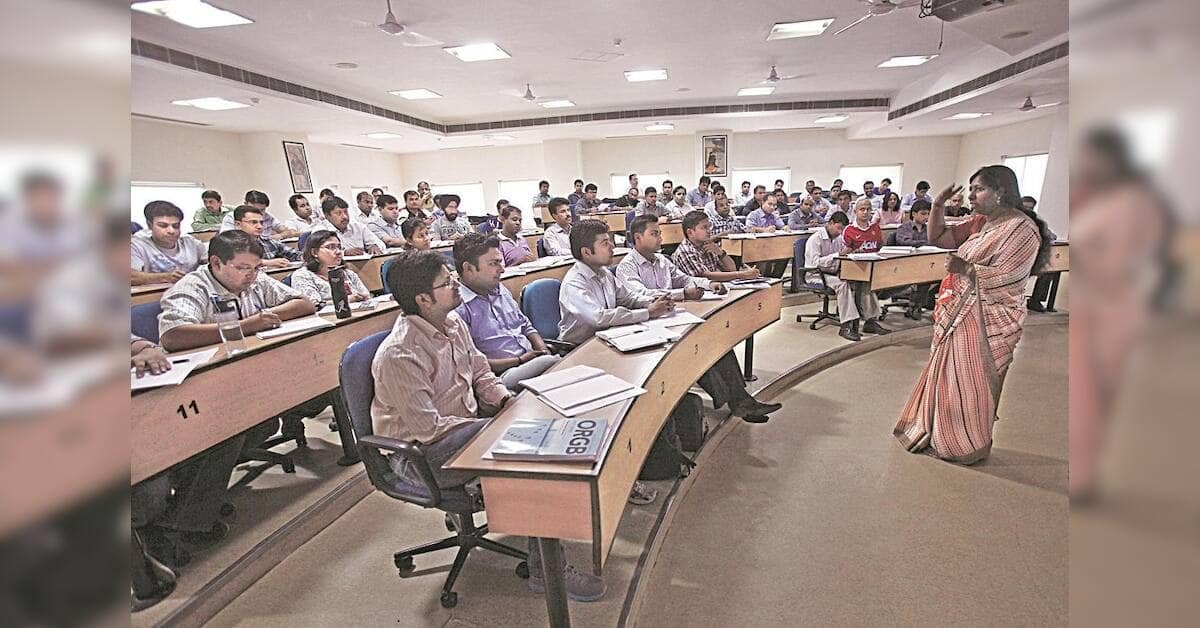
The composition of the classroom has changed too. Women’s share of core undergraduate enrolment at IITs rose from 8 per cent to 20 per cent during FY18 and FY24. At IIMs, women’s share of core postgraduate enrolment rose from 26.3 per cent to 37.7 per cent; at NITs, their share of core undergraduate enrolment increased from 18.4 per cent to 21.8 per cent.
Employers did not mark down the larger graduating classes. More students were placed at higher reported median pay (105 per cent growth in FY24 over FY16). The market still rewards technical and managerial capability when it trusts the institution certifying it. IITs, IIMs and NITs are therefore a benchmark, not a description of the college most young Indians attend. Thus, India has expanded higher education to the masses much faster than what one could perceive in the last decade. The time has now come to build on it further.
Firstly, a recent parliamentary committee report recorded vacancy rates of 34 per cent across all national universities, with the highest vacancy at the professor level at 54 per cent. We need to reduce these vacant positions.
Secondly, actual Union expenditure by the department of higher education almost doubled between FY15 and FY25. Yet its share of total Union expenditure fell from 1.6 per cent in FY18 to 1 per cent in FY25. Higher-education institutions accounted for 12.6 per cent of India’s research and development (R&D) expenditure in FY24, while the country’s total research effort was only 0.84 per cent of gross domestic product. We need to target this increase to 1.5 per cent.
Thirdly, the 2025 Periodic Labour Force Survey found that only 31 per cent of people aged 15-29 had received formal vocational or technical training. It is a pity that while hospitals, factories, data centres and modern cities run on technicians, machinists, electricians, operators, care workers and logistics specialists, our social imagination still ranks the office above the workshop. Germany and Switzerland place apprentices inside recognised occupational ladders, while Singapore connects work-study programmes to continuing education. India should apply the same principle.
Fourthly, across private and public universities, affordability and outcomes differ sharply and there needs to be a convergence.
Fifthly, changes must be made for the National Testing Agency (NTA). The NTA was created in 2018 as a registered society but not by a dedicated statute. According to the Ministry of Education’s written reply to the Rajya Sabha on July 31, 2024, a total of 194 personnel were reported at NTA, excluding the director-general. These included 171 contractual or outsourced workers.
Meanwhile, the government, following the controversies of 2024 and the Radhakrishnan Committee report, has added senior posts and introduced district coordination, centre audits, command-centre monitoring and biometric exception procedures. The Public Examinations Act has now strengthened deterrence against organised unfair means. These steps matter.
China’s Gaokao examination system is useful not because it is flawless, but because it treats redundancy as part of fairness. In 2026, 12.9 million candidates registered across 7,981 centres and roughly 348,000 examination rooms, backed by about 21,000 reserve rooms; more than 14,000 candidates with disabilities received accommodation. Provincial administrations coordinate secure custody, monitored transport and storage, emergency planning, policing, traffic and health support. The practical lesson is to plan for the exam day that goes wrong. When floods blocked access in Anhui province in 2020, two papers were postponed, reserve papers prepared and local transport mobilised. However, we must also appreciate that by July 2024, NTA did conduct more than 240 examinations, serving more than 54 million candidates. In addition, in 2025, the Staff Selection Commission (SSC) conducted 10 exams for appointments to clerical posts involving 18.5 million applications.
We propose four changes that would make the examination system feel less like a black box and more like a public institution emulating the global experience, particularly from China’s Gaokao.
NTA needs firmer foundations. A dedicated law making it accountable to parliament and independent scrutiny, including CAG (Comptroller and Auditor General of India) audit. NTA should build a permanent team of specialists, technologists and security professionals backed by a board that is clearly responsible when systems or vendors fail.
Creation of a candidate charter to promise time-bound decisions on disputed answers, translation mistakes, incorrect scores, disrupted examinations and re-tests. An appeal decided after admissions have closed is no remedy at all.
NTA should publish an annual account of disruptions, leaks, re-tests, appeals, vendor failures and corrective action.
NTA should immediately move over to computer- based tests along the lines of the joint entrance examination (JEE), with multiple dates spread over morning and afternoon sessions and the best score counted over two attempts, say in January and April. The entire application process may be mimicked along the lines of JEE or even the SSC exam pattern.
Finally, for millions of young Indians, an examination is a bridge between circumstance and aspiration. Article 21 of the Indian Constitution protects a life of dignity, Article 14 forbids arbitrary State action, and Article 21A establishes that education is a constitutional commitment, not an act of charity. We propose that Article 21 be amended to support a right to free and fair educational opportunity. Free should mean freedom from fraud, discrimination and unreasonable barriers.
Fair must mean transparent rules, secure examinations, accurate evaluation and an effective remedy when the system fails. A student cannot demand a rank, but she is entitled to demand an honest race. Let us make a beginning.
Ghosh is member, 16th Finance Commission and PMEAC, and group chief economic advisor, State Bank of India. Sharma is economist, State Bank of India. Views are personal.