
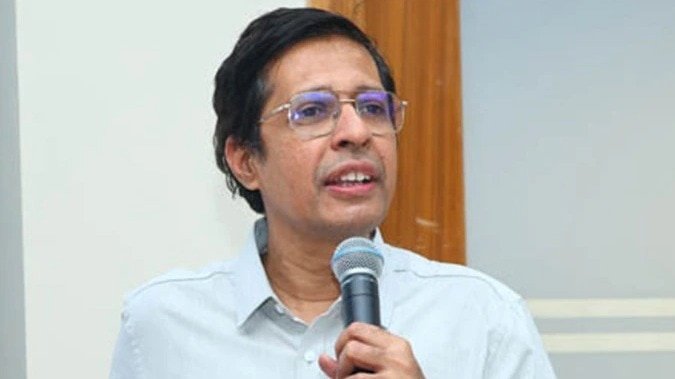
“IIT education should not be restricted to those who clear JEE Advanced.” IIT Madras Director Professor V Kamakoti has argued for wider access to IIT education through the institute’s BS degree programmes, saying the model is intended to “democratise” access to quality education. The remarks are crucial as Prime Minister Narendra Modi has recently announced a high-powered task force on examination reforms, with Kamakoti among its members.
In a video posted by IIT Madras’ official X account, Professor V Kamakoti is seen discussing the wider implications of accessing IIT education through non-JEE routes.
Kamakoti’s comments on expanding access to IIT education also come in the context of the highly competitive route through which students enter the conventional undergraduate programmes at the IITs.
The Council of IITs states that admission to undergraduate programmes at the IITs is through JEE Advanced.
The IIT Madras BS programme offers a different route.
IIT MADRAS BS PROGRAMME OFFERS AN ALTERNATIVE ROUTE
IIT Madras launched its BS in Data Science and Applications in 2020. Unlike its conventional undergraduate engineering programmes, the programme does not require students to qualify through JEE Advanced. Students can enter through the institute’s own admission process.
The programme was designed to allow students from different academic and professional backgrounds to study at IIT Madras. The institute has said that the programme is open to learners from different streams and can also be pursued alongside another degree or full-time work.
The first batch consisted of 101 students and received provisional diploma certificates in 2022. IIT Madras said those students came from different parts of the country and included working professionals and students from different socioeconomic backgrounds.
The programme has since expanded considerably. IIT Madras said in 2025 that more than 38,000 candidates were enrolled in its BS degree programmes in Data Science and Electronic Systems.
The institute has also expanded the programme beyond Data Science. Its BS offerings now include programmes in areas such as Electronic Systems, Aeronautics and Space Technology, and Management and Data Science.
WHY THE BS PROGRAMME MATTERS
The importance of the programme lies in the admission route. Students who may not enter an IIT through the conventional JEE Advanced route can still pursue an IIT Madras degree through these programmes.
Kamakoti has described the programmes as part of IIT Madras’ effort to “democratize access to IIT-quality education”. In 2025, while announcing admissions to the BS programmes, he said the courses were intended to reach learners across the country and the world.
The programmes also have a different structure from the conventional residential undergraduate model. Teaching is largely online, while examinations are conducted in person. Students can also move through different stages of the programme, with certificate and diploma options before completing the full degree.
The institute has continued to maintain that the alternative route does not mean a relaxation of academic standards. In 2025, IIT Madras highlighted that three students from its BS Data Science programme secured positions among the top 10 ranks in the GATE 2025 Data Science and AI paper, including the top rank.
Kamakoti’s position therefore raises a larger question about how access to premier institutions should be defined. If the purpose of an IIT is also to provide high-quality education, the question is whether that education should remain limited to the students who clear one entrance examination.
IIT Madras has, through its BS programmes, already created one answer to that question: expand the number of students who can access its academic programmes while keeping the academic requirements in place.
– Ends