
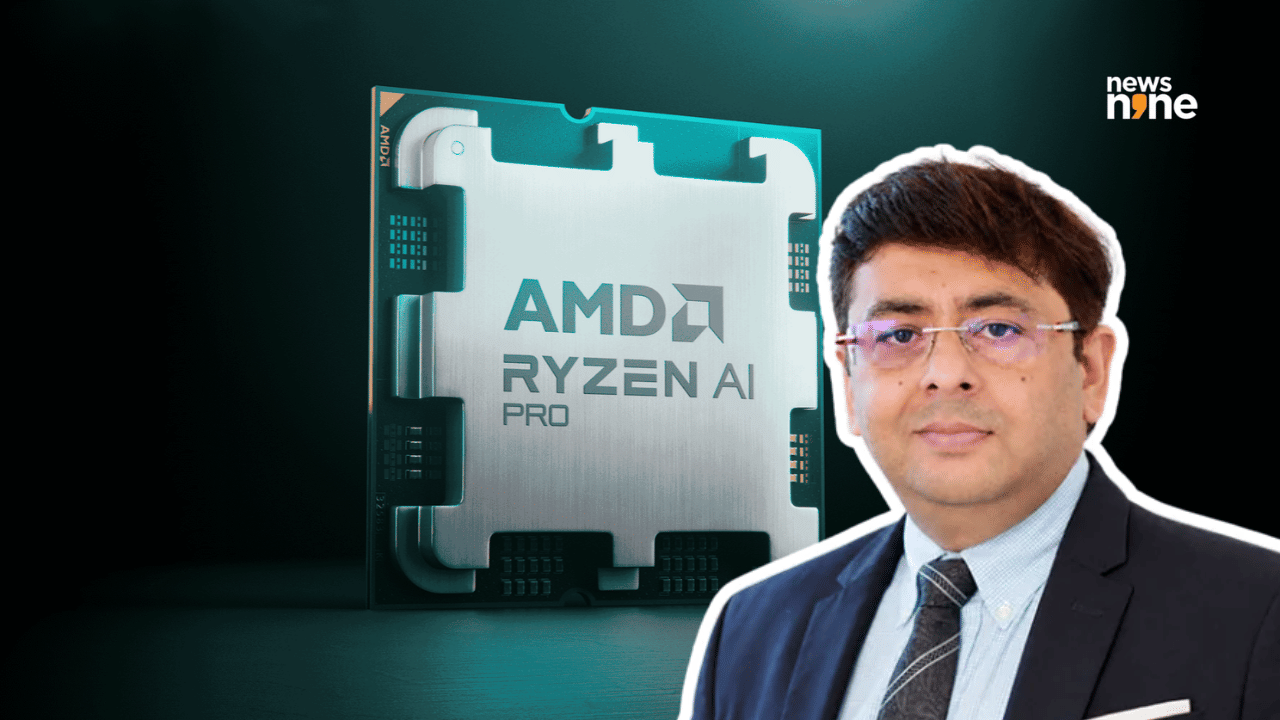
Indian businesses are increasingly exploring AI PCs to process sensitive information locally, according to AMD India Sales MD Vinay Sinha in an exclusive interaction with News9Live. AMD believes suitable on-device AI workloads could lower recurring cloud expenses, with its internal estimates suggesting a six-month break-even period.

AMD India MD Vinay Sinha tells News9Live why banks, hospitals and IT firms are exploring AI PCs and how local AI could recover costs in six months.
Indian businesses are showing growing interest in AI-powered PCs, particularly in banking, healthcare and IT services, where handling sensitive customer information is a daily concern. In an exclusive email interaction with News9Live, Vinay Sinha, Managing Director, India Sales at AMD, said companies are moving beyond testing artificial intelligence and beginning to use it in their regular operations.
The shift could change how businesses spend money on AI. Instead of sending every request to cloud servers, companies are exploring computers that can process AI tasks locally. According to AMD’s internal estimates, a Ryzen AI Halo system handling around six million tokens daily could recover its investment in roughly six months.
Indian banks and healthcare companies show growing interest in AI PCs
“We are seeing growing interest in AI PCs in India as enterprises move from initial pilots to production deployments,” Sinha told News9Live.
He pointed to banking and healthcare, where companies must protect customer information and meet strict data handling requirements. Indian IT services firms are exploring similar solutions as overseas clients demand tighter control over confidential business information.
AMD says dedicated Neural Processing Units, or NPUs, can handle suitable AI tasks directly on a computer, reducing the need to send sensitive information to external servers.
Can AMD’s AI PCs protect sensitive company data?
AMD Ryzen AI PRO computers use several security technologies. AMD Secure Processor helps protect the system during startup, Memory Guard encrypts system memory, and Microsoft Pluton provides hardware-level protection for credentials and encryption keys.
Running AI locally can also help companies manage information across countries with different data protection rules.
“However, on-device processing alone does not ensure regulatory compliance,” Sinha said.
He explained that businesses still need to control where information is stored, accessed and shared.
Can businesses save money by running AI locally?
Cloud AI services often charge companies based on usage. For organisations processing large volumes of routine requests, those bills can add up.
“In AMD modeled assumptions, a Ryzen AI Halo system can process approximately six million tokens per day and reach break-even in roughly six months”, Sinha said.
He added that local processing could reduce overall AI expenses over three to five years, depending on workload and utilisation.
What about larger AI models and battery life?
AMD’s Ryzen AI processors combine a CPU, GPU and NPU to distribute computing tasks. The NPU handles sustained AI workloads efficiently, helping conserve battery life.
Sinha said certain Ryzen AI Max+ PRO 395 configurations can run models exceeding 300 billion parameters using four-bit quantisation, depending on memory and system configuration.
For larger AI tasks and centralised operations, businesses may still require cloud infrastructure. AMD expects companies to increasingly combine local and cloud AI as enterprise adoption grows.

Follow us on social media