
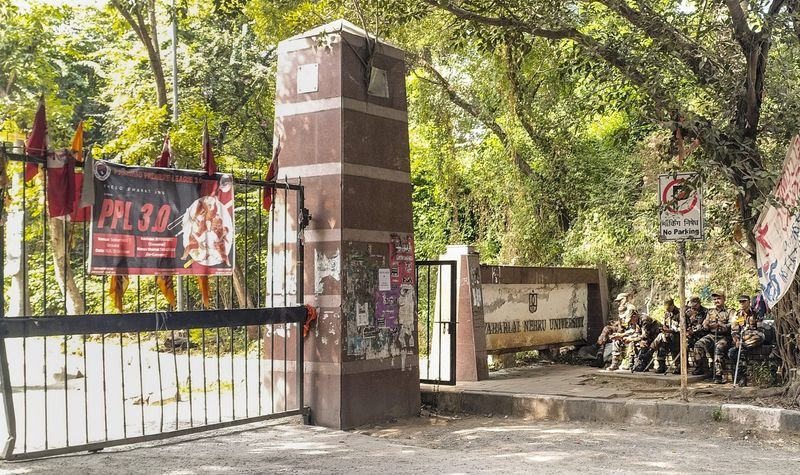
The report pointed to the ruling BJP’s continued deployment of the University Grants Commission (UGC) as “a primary vehicle for state influence over higher education”, despite its criticism for policies perceived to tighten government control.
New Delhi: Violent police and military crackdowns on student expression in India and at least four other countries were among the 382 incidents of attacks on higher education communities across 59 countries and territories that took place between July 1, 2025, and June 30, 2026, according to an annual survey by Scholars at Risk’s (SAR) Academic Freedom Monitoring Project.
Released on September 15, the SAR’s Free to Think 2026 report identified violent state repression, paired with government interference in university autonomy, as the leading cause of the global decline in academic freedom.
The UN’s Human Rights Council (OHCHR) defines academic freedom as “the human right to acquire, develop, transmit, apply, and engage with a diversity of knowledge and ideas through research, teaching, learning, and discourse”. On July 7 last year, OHCHR also adopted a resolution on the right to education and emphasised “that States, academic institutions, teachers and staff have the responsibility to promote an inclusive, safe and enabling environment for academic, evidence-based enquiry, debate and discussion.”
Yet, as per the data collected by SAR, students and faculty in more than a dozen countries faced targeted violence for exercising their rights to academic freedom, free expression and freedom of association. Campuses in 16 countries suffered violent attacks, intrusions, or occupation, or threats of violent attacks, that undermined safety and campus integrity.
Eight countries saw an erosion of institutional autonomy, with external interference in administrative operations, curricula, and hiring or admissions practices.
The report documented the direct repression in India, Iran, Serbia, Senegal and Indonesia, among other countries. It also documented other forms of attacks such as the arrests, prosecution, and imprisonment of academics in China, Russia and Afghanistan; the forced disappearances of Baloch student activists in Pakistan. It pointed to the growing interference in university autonomy and operations, such as decisions on hiring, curriculum, administrative functions and the physical campus environment, as seen in the United States, Afghanistan and India.
The countries examined were scored on the Academic Freedom Index (AFI), a tool co-developed by the Global Public Policy Institute (GPPi), the Friedrich-Alexander-Universität Erlangen-Nürnberg (FAU), the V-Dem Institute, and SAR.
How India fared
With the Union government expanding its authority over India’s higher education, influencing university governance, leadership appointments, and academic priorities across leading institutions, the academic freedom, per the AFI score, was “severely restricted” at 0.14 in 2026, down from 0.16 in 2024.
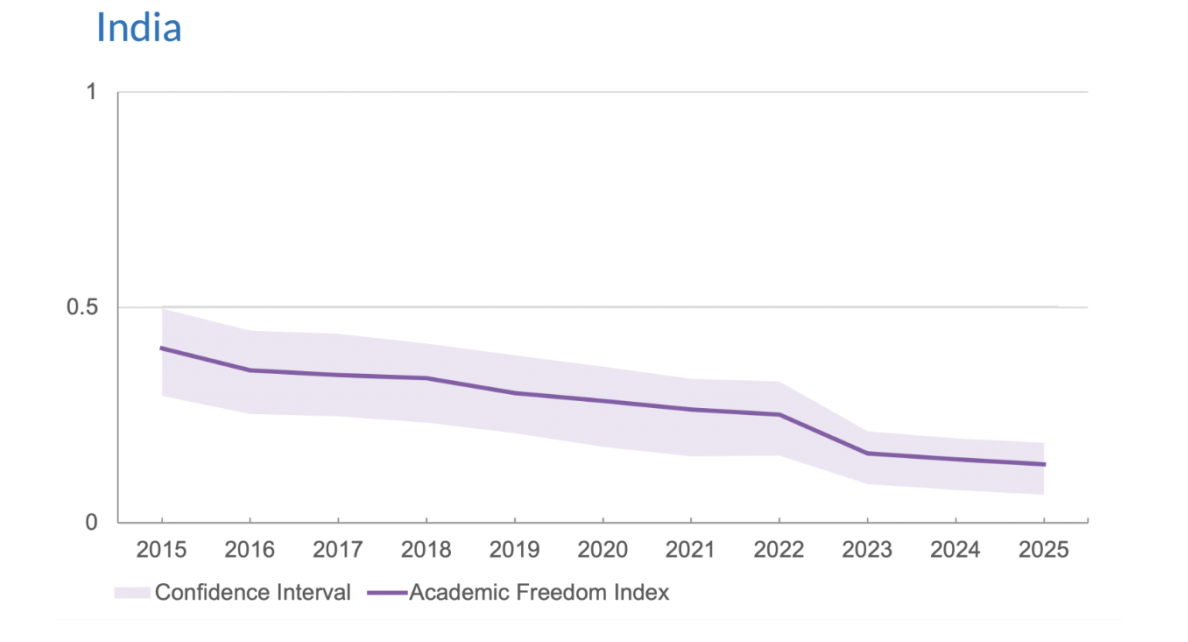
The AFI reflected low scores in India over the past few years, decreasing consistently, down to 0.14 in 2026. Source: SAR
According to the report, university administrators took actions that stifled campus discourse, including dismissing faculty members, canceling academic events, and enforcing new policies restricting student expression. Both students and police committed acts of violence at protests or other campus gatherings.
The report pointed to the ruling Bharatiya Janata Party’s continued deployment of the University Grants Commission (UGC) as “a primary vehicle for state influence over higher education”, despite its criticism for policies perceived to tighten government control.
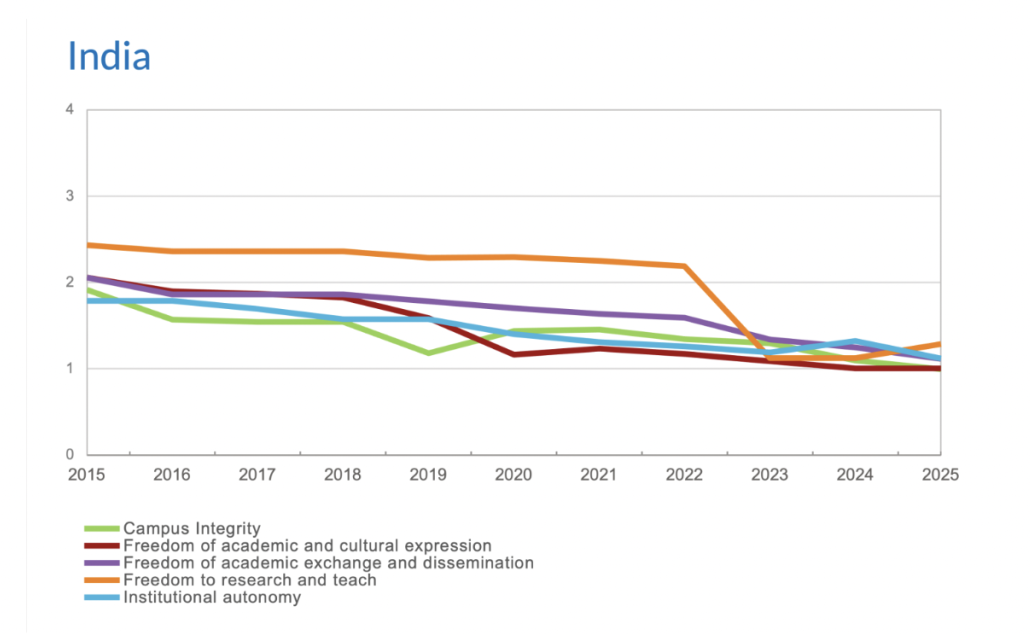
Since 2022, greater restrictions on the freedom to research and teach have driven declines in India’s AFI. Source: SAR
The SAR highlighted the Supreme Court’s March order issuing a “life ban” against three academics who worked on an NCERT chapter on “corruption in the judiciary”, an order that was later taken back. It also noted the Jammu and Kashmir government’s ban on the sale, distribution, and possession of 25 books.
It also noted a series of curtailments including event cancellations in Delhi University, Banaras University and Mumbai University; pressure from authorities over student protests such as in Tata Institute of Social Sciences (TISS) and Jamia Millia Islamia; as well as “political flashpoints” around academic and cultural events, where clashes between students fell along political lines – particularly between the right-wing Akhil Bharatiya Vidyarthi Parishad (ABVP), and left-wing All India Students Association (AISA) and National Students’ Union of India (NSUI).
How others fared
The Free to Think 2026 report found an escalation in the use of illiberal policies, laws and extralegal actions targeting higher education in democratic contexts, particularly in the United States, resulting in crackdowns on dissent and disfavoured speech.
The US government passed legislation censoring curricula and academic content perceived as misaligned with political agenda, weaponised or cut access to funding on ideological grounds, interfered with independent scholarly research; appointed partisan actors to university governance bodies; and restricted cross-border collaboration, instituting sweeping entry bans in the country.
The AFI score for the US stood at “fully free” in 2019. However, since 2020, academic freedom has declined dramatically and by 2025, it was 0.4 – rated “moderately restricted” but on the verge of being rated “severely restricted”.
In Iran, while higher education was already under pressure, the war against the United States and Israel worsened it. The country’s AFI was “completely restricted” with respect to higher education. Authorities violently cracked down on student protests, enacted legislation that increased surveillance on higher education, and arrested and detained students and scholars, charging some with espionage and executing several as a clear warning to others, the report stated. Further, the US-Israel-led war significantly destroyed university infrastructure and halted academic activity.
Academic freedom in Afghanistan remained extremely low, rated as “completely restricted” by the AFI from 2022. In China, Russia and Zimbabwe, books were banned and the governments disfavoured research topics or blacklisted entire education institutions from operating within their borders.
Meanwhile, governments in Georgia, India and Serbia, also interfered by banning research topics, cutting funding on ideological grounds, and placing partisan actors on university governance bodies.
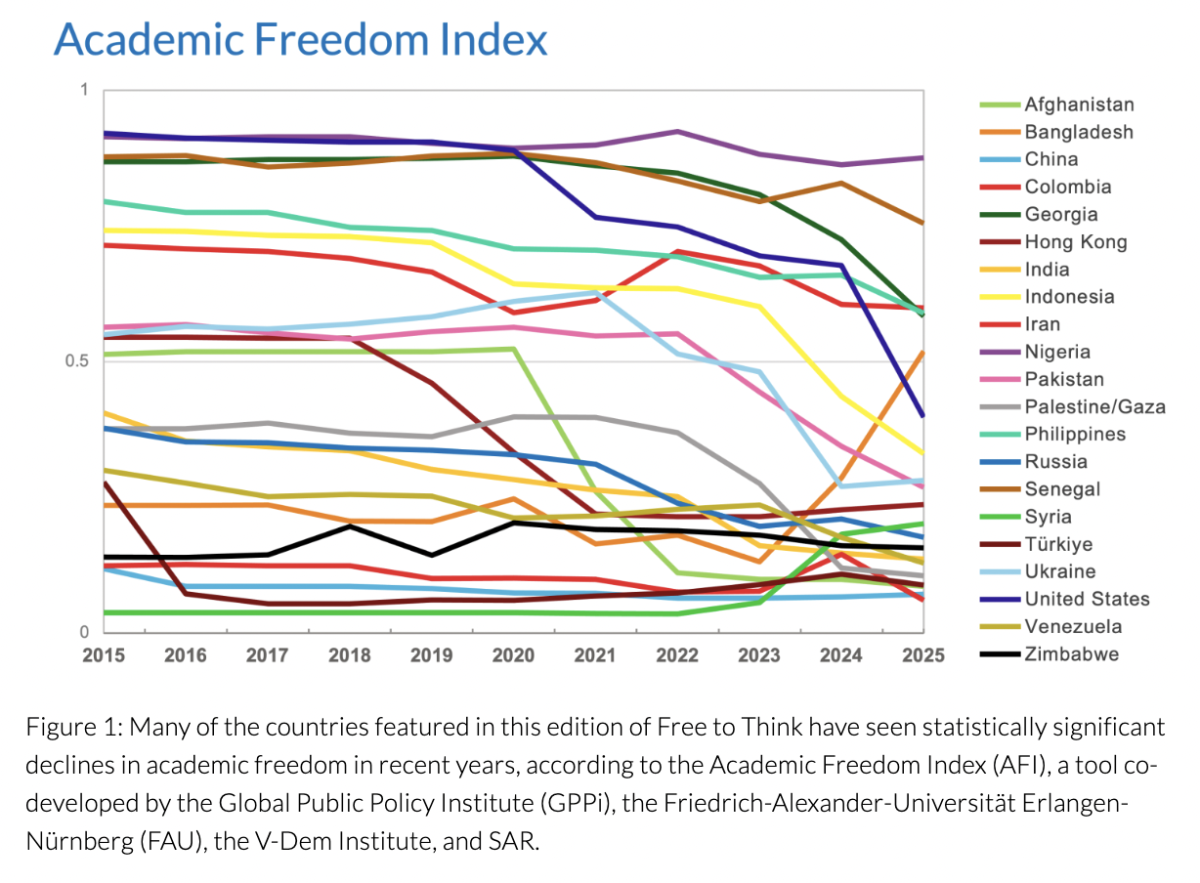
AFI trends across 22 out of the 59 countries examined for academic freedom. Source: SAR
According to Robert Quinn, SAR’s executive director, “Universities are critical to democratic society because they cultivate critical thinking. Scholars work at the intersection of power and ideas. But those in power often do not like to have the ideas that sustain their power questioned. As democracy comes under strain globally, we see governments interfere in higher education.”
Countries where academic freedom improved
The SAR report did have some good news too, thought it asked to approach it with “cautious optimism“.
Among the 59 countries it examined, the report found that Brazil, Bangladesh, Hungary and Venezuela saw improvements in their levels of academic freedom and demonstrated signs of democratic resilience, led by the efforts of higher education communities to resist state control and significant changes in political leadership.
In Bangladesh, nationwide student protests in 2024, led to the establishment of an interim government in Bangladesh, following which academic freedom improved through “political reforms that depoliticised campus governance and removed high-level political appointees”. The AFI for Bangladesh, increased from “completely restricted” (0.13) in 2023 to “moderately restricted” (0.52) in 2025.
In Hungary, under the leadership of Prime Minister Viktor Orbán, the AFI score fell from “fully free” (0.95) in 2009 to “severely restricted” (0.3). However, after his exit in April 2026 following the election of Péter Magyar, there were signs that Hungary would phase out the private foundation university model and rejoin the Erasmus student exchange programs.
Brazil’s AFI score, under President Jair Bolsonaro had dipped to “moderately restricted”. However, the government of Luiz Inácio Lula da Silva since 2022, has made efforts that restored academic freedom. The AFI score rose back up to “fully free” (0.85) by 2025.
“These countries demonstrate that it is indeed possible to reverse the decline of respect for institutional autonomy, but that it will not happen without the commitment and involvement of the higher education community. Universities must reject government attempts to control the sector. And governments must both proactively signal support for the sector and refrain from interference,” said Clare Robinson, director of advocacy at SAR.
The SAR called on states, higher education communities, and civil society to recognise the urgent need to protect academic freedom by rejecting violence and coercion aimed at restricting inquiry and expression; protecting threatened scholars, students and higher education institutions; fighting illiberal policies and practices that constrain intellectual discourse, research and teaching. It called on governments to allow critical discourse and publicly demonstrate that it is “not disloyalty, that ideas are not crimes, and that everyone must be free to think, question, and share their ideas”.
This article went live on September fifteenth, two thousand twenty six, at thirty minutes past ten in the morning.
The Wire is now on WhatsApp. Follow our channel for sharp analysis and opinions on the latest developments.