
“Look, our conversation is, if we’re going to improve as a T20 side… our strike rate has got to improve,” Pybus said after the game. “Our dot-ball percentage is too high and our strike rate has got to improve.”
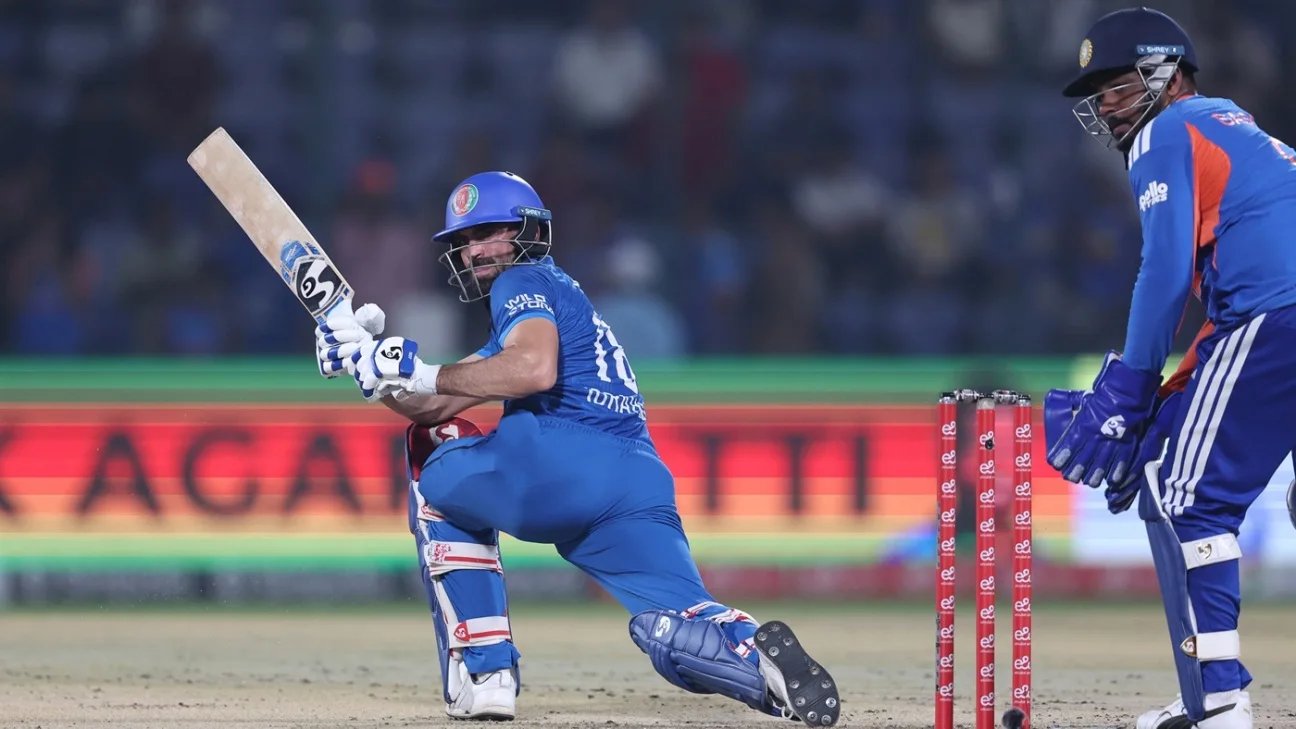
In the second T20I, Afghanistan had a dot-ball percentage of 41.6% and a run rate of 7.80. In comparison, India had a dot-ball percentage of 32.9% and scored at 11.48. Why has there been such a big gulf between the two batting line-ups in this series so far?
One reason is that though Afghanistan are technically the hosts of this series, India’s players are much more familiar with the conditions at the Arun Jaitley Stadium, which is also Delhi Capitals’ home ground.
“They play on these wickets the whole of the IPL,” Pybus pointed out after the game. “They know how to play on these wickets and their game has developed on these wickets. For us, we don’t have these quality wickets back in Afghanistan.”
According to Pybus, the lack of power-hitting in Afghanistan cricket is also a “talent pool” issue. The run rate at this year’s Shpageeza Cricket League, Afghanistan’s domestic T20 competition, was 8.77. In comparison, run rate at the IPL this year was 9.39. There is the mitigating factor of an extra batter because of the Impact Player rule in the IPL, but Pybus pointed out Afghanistan’s more bowling-friendly home surfaces as a reason for their go-slows in this series.
“Again, what India have got is they’ve got unbelievable depth and competition for spots. Afghanistan has got some really good talent coming through, but we don’t have a talent pool anywhere remotely as deep as India’s. It’s about us working with the players. I think you’ll find that the average par for Afghanistan’s powerplay [in T20Is] is about 45 for 1.
“We’ve got to develop the play so that our strike power in the powerplay is we need to be able to get up there [to India’s level] and we need to be able to hold it… That is stuff that we’ve really got to seriously work on over the next 12 months.”
Pybus described the Delhi pitches as being “like a sheet of glass.” Both surfaces in the series so far have been dry and allowed true bounce, with minimal seam movement or spin on offer. “[India’s] players, they’ve learnt how to set their game up where they can hit, as we saw today. You can hit the seamers and the spinners off the top of the length.”
On the other hand, Afghanistan’s top four collectively scored 59 off 59, before their middle and lower order, led by Darwish Rasooli, Mohammad Nabi, and Rashid Khan propelled them to 159. The top order’s reluctance to hit India’s bowlers off the top of their lengths – especially in the powerplay – stymied their scoring options.
When asked about Afghanistan’s involvement with pitch preparation for this series – since they are the hosts – Pybus was cryptic. “Look, we want good cricket wickets. It’s as simple as that,” he said. “This is T20 cricket. We’re not trying to make a track spicy for a Test match. We’ve got to be good enough… [T20 cricket] looks like a batting game, but if your skills are good enough as a bowler, you’ll be in the game. You see that all the way through the IPL.
“If we were to try and massage a wicket, we’re really not helping ourselves when we do come to play in World Cups and against the top sides.”
Pybus, who spent more than five years with Cricket West Indies, also gave an alternative solution to Afghanistan’s lack of hitting depth. “One of the things which I would be suggesting to the board, which is what we did in the West Indies, is we appointed an international curator to get a uniform surface. That was more for when we were travelling around the territories in the West Indies, when we were playing international matches, to make sure we were getting the wickets that we wanted.
“But I do think being able to make sure that the stadiums have got very specific wickets for our white-ball cricket [will help in Afghanistan]. We need purity of wicket to develop the quality of batters.”
Abhijato Sensarma is a sub-editor at Cricinfo