
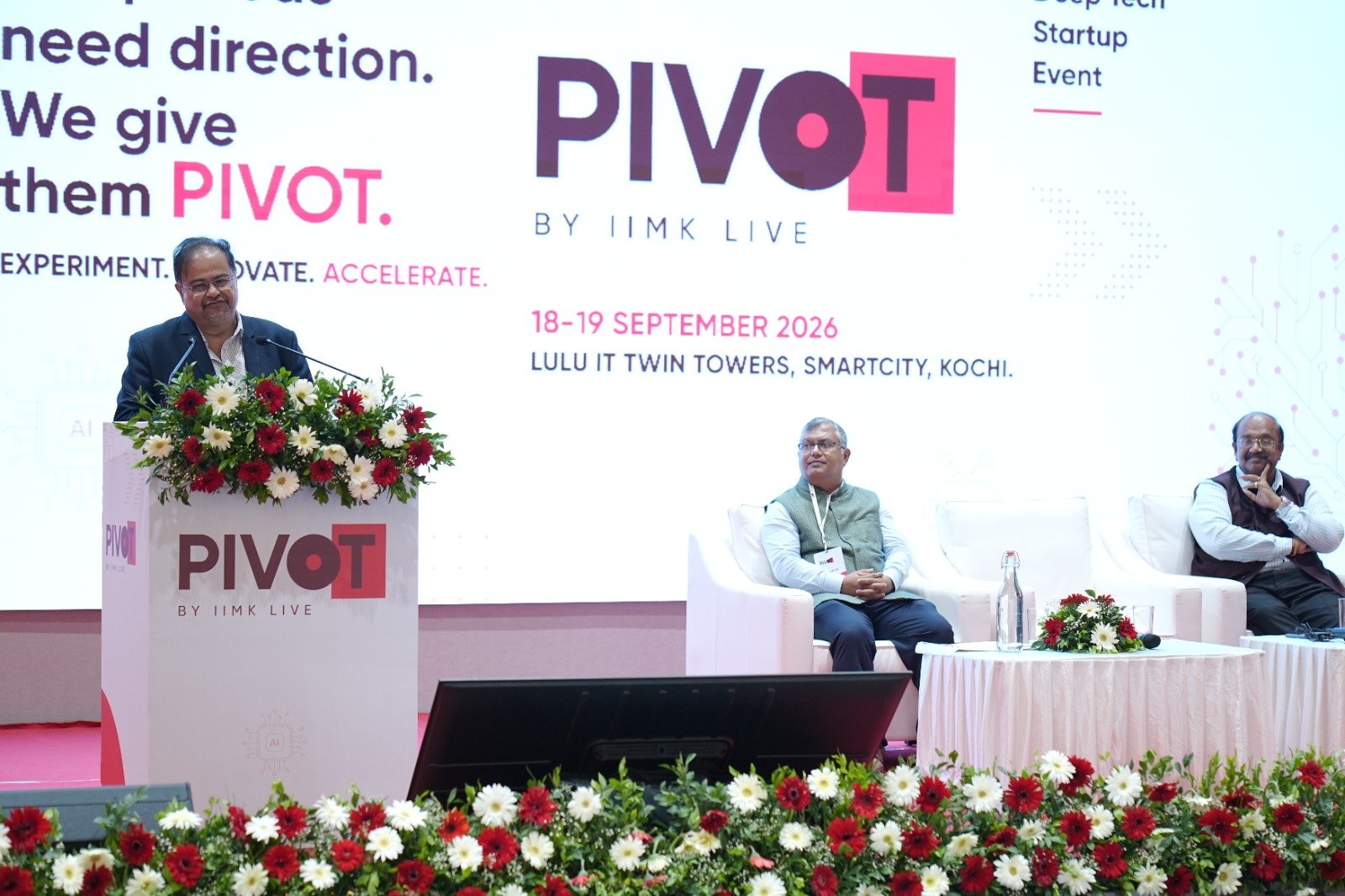
- India’s next phase of startup growth must move beyond its software-led success and build capabilities in hardware, DeepTech and critical technologies, Says India AI Mission’s Ramanan Ramanathan
- “Deep Tech Must Challenge Assumptions and Create New Possibilities” says Prof. Debashis Chatterjee, Director IIM Kozhikode and calls for a new “choreography of business” as DeepTech founders navigate technology, purpose and customers
Kochi : India’s next phase of startup growth must move beyond its software-led success and build capabilities in hardware, DeepTech and critical technologies, said Mr. Ramanan Ramanathan, Mission Governing Board Member, India AI Mission, at the inaugural day of PIVOT 2026 – the DeepTech Innovation and Venture Summit, organised by IIMK LIVE, the business incubator of the Indian Institute of Management Kozhikode (IIM Kozhikode). Prof. Debashis Chatterjee, Chairman, IIMK LIVE and Director, IIM Kozhikode, inaugurated the two-day summit being held at the Amenity Tower Auditorium, Lulu IT Twin Towers, SmartCity, Infopark, Kochi.
Bringing together founders, investors, corporates, researchers, policymakers and technology leaders, PIVOT 2026 is exploring the challenges of building and scaling DeepTech ventures. More than 1,000 participants are expected across the two days, with 40+ speakers and 25+ sessions.
Deep technology is not merely about building products; it is about asking fundamental questions, challenging assumptions and creating new possibilities,” said Prof. Debashis Chatterjee, Director, IIM Kozhikode and Chairman IIMK LIVE while inaugurating PIVOT, IIMK LIVE’s deep-tech event in Kochi. Referring to new-age ventures working in frontier areas such as rockets, Prof. Chatterjee noted that deep-tech entrepreneurs are attempting to create new realities, often with technologies that precede the markets they may eventually serve, making patient and appropriate funding critical to their journey.
He also highlighted how the deep-tech mindset extends beyond technology itself. Unlike consumer businesses that often respond to established market demand, deep-tech ventures may operate in areas where applications and markets are yet to fully emerge. Drawing on his experiences and interactions across cultures and with policymakers, Prof. Chatterjee stressed the need for entrepreneurs to understand policy, institutions, cultures and the wider ecosystem that enables innovation. His address set the tone for PIVOT as a platform for questioning the possible, challenging the known and exploring possibilities that do not yet exist.
Delivering the keynote, Mr. Ramanan Ramanathan, Mission Governing Board Member, India AI Mission, argued that India’s startup ecosystem now needs to build the technological foundations beneath its digital economy. “India built its startup story on software. The next one has to be built on hardware,” Ramanathan said. He noted that India’s first major startup wave was driven largely by software-led businesses spanning payments, e-commerce, delivery and IT services. The next opportunity, he said, lies in areas such as semiconductors, spacetech, defence technology, electric vehicles, drones, robotics, IoT and sovereign AI. Ramanathan traced the evolution of India’s innovation ecosystem from the startup programmes launched in 2016 through the policy push for self-reliance following the COVID-19 pandemic, and the subsequent emergence of initiatives including Viksit Bharat, the India AI Mission and the India Semiconductor Mission. He noted that India has crossed the milestone of 120 unicorns. At the same time, he highlighted the structural challenges facing DeepTech, including relatively low research and development spending, limited private early-stage capital, low patent activity and regulatory processes that can move slower than technological change.
The afternoon sessions brought a founder’s perspective to the DeepTech journey, with Rakshit Bhatt, Co-founder and VP – Product, GalaxEye, sharing the story of the Earth-observation startup that emerged from IIT Madras’ Avishkar Hyperloop team.Bhatt explained how GalaxEye combines optical and Synthetic Aperture Radar (SAR) imaging technologies to enable satellite-based Earth observation in conditions where conventional optical imaging is limited, including at night and through cloud cover. Bhatt identified five attributes for DeepTech founders: technical audacity, a clear pitch, milestone-driven execution, the right people and a story investors can follow.
The parallel tracks also had panels with Kaustubh Patekar of ProdZen, Himanshu Joshi of NITI Aayog and Raghu A of Deloitte India on venture creation; Prof Sujatha Srinivasan of IIT Madras and Mallikarjuna Rao Gonella of Qualcomm on commercialising research; Chandrashekhar Bhide of Lithion Power, Devesh Varma of OLA Foundation and Anuj Gupta of Gradient Advisors on scaling; and Harish Balasubramanian of Walmart Global Tech India and Abhishek of PwC on corporate partnerships. Day 2 (Saturday) sessions will focus on funding, investment readiness and venture growth, with investors and ecosystem leaders from Bharat Innovation Fund, Samara Capital, Pavestone VC and Blume Ventures scheduled to participate.