
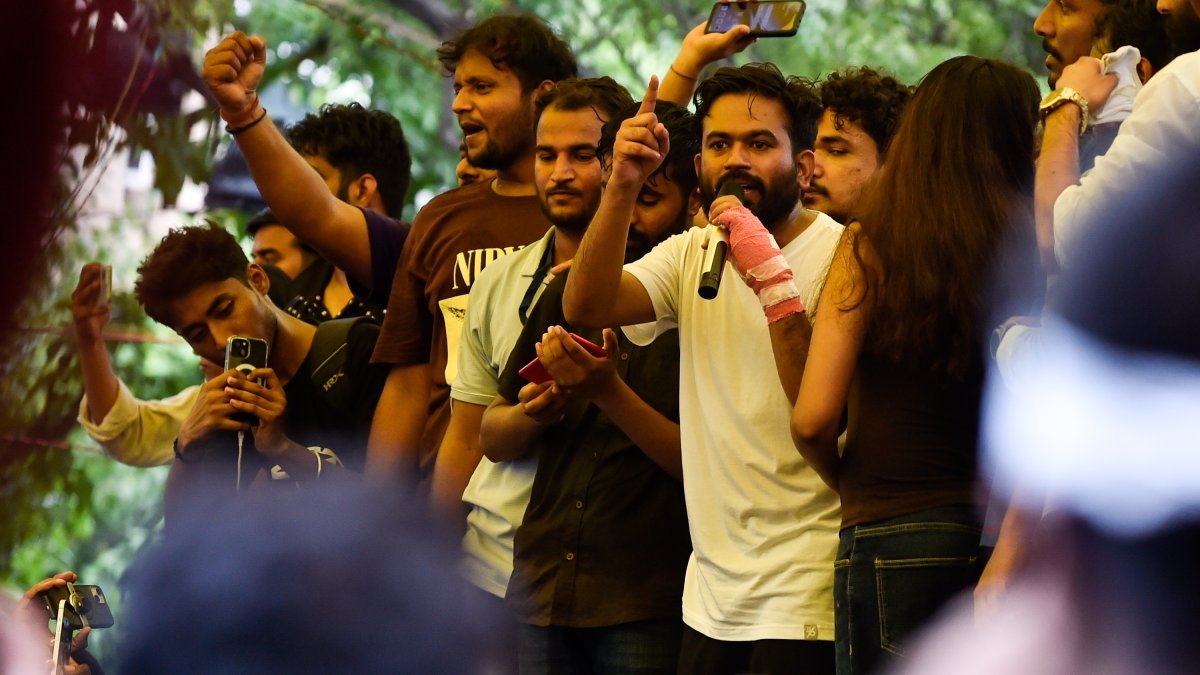
India’s education minister resigned on Saturday, following weeks of protests from the “Cockroach” movement, which was challenging alleged exam paper leaks and irregularities in the country’s education system.
Dharmendra Pradhan announced his resignation in a post on X, handing a major victory to the youth movement that spearheaded nationwide demonstrations, sit-ins and hunger strikes. His resignation marks the first significant concession by Prime Minister Narendra Modi’s government to one of the most visible waves of public dissent it has faced in recent years.
The government has rarely yielded to sustained public pressure during Modi’s more than 12 years in office. The most notable exception came in 2021, when it was forced to withdraw controversial farm laws after a yearlong farmers’ protest.
Founded by former Boston University student Abhijeet Dipke more than a month ago, the “Cockroach'” movement started as a call for education reforms but grew into a broader protest over unemployment, government accountability and economic opportunities. Students, professionals, families and activists joined rallies in New Delhi and other cities across India.
Following Pradhan’s resignation, movement organizers called off the protests, saying the government had accepted their remaining demands. Those included broader reforms to India’s education system, compensation for families of students who died by suicide following exam paper leaks, and a commitment that no legal action would be taken against those who participated in the protests.
“We urge everyone to peacefully withdraw from protest sites,” Ashutosh Ranka, spokesperson of the Cockroach Janta Party, which launched the protest movement, said at a news briefing in New Delhi Saturday.
News of Pradhan’s resignation sparked celebrations among the thousands of protesters who have camped at New Delhi’s protest site for more than a month. Many embraced each other and waved the Indian flag.
Prachi Kumar, a corporate employee who joined the protests, said Pradhan’s resignation was necessary to restore accountability in the education system.
“This had to be done. Someone must be held accountable,” she said.
The Cockroach Janta Party declared victory following the resignation, writing on X: “DEMOCRACY WINS!”
The demonstrations became one of the most persistent challenges to Modi’s government in recent years, with thousands returning to the streets even after police used tear gas and batons to disperse marchers.
Tensions escalated on Monday when police moved to disperse thousands of protesters marching toward Parliament. Several students were injured in the crackdown, intensifying anger among demonstrators.
Modi’s government had earlier sought to ease tensions by announcing fast-track courts for cases involving exam paper leaks and saying it would introduce legislation to strengthen measures against cheating and corruption in the examination system. The measures failed to satisfy protesters, who said they did not address government accountability.
Here’s more to know about the movement founded by Dipke, who completed a master’s in public relations last year:
A court remark sparks a youth movement
The immediate trigger for the protests was public anger over alleged leaks of some of India’s most competitive entrance examinations for medical colleges and government jobs. The exams are a pathway to stable employment and upward social mobility for millions of Indians. The possibility that the exams have been shared in advance often force authorities to cancel or repeat tests, leaving students with months or years of lost preparation and uncertainty.
The movement began in May, when India’s Supreme Court Chief Justice Surya Kant, during an unrelated court hearing, compared some unemployed young people to “cockroaches.” The remark sparked an online backlash, prompting Boston University student Abhijeet Dipke to launch the Cockroach Janta Party, or Cockroach People’s Party.
Many young Indians embraced the remark and adopted the cockroach as an emblem of resilience. The campaign exploded on social media, attracting more than 21 million Instagram followers within days. Supporters posted memes, mock campaign slogans and satirical commentary targeting Modi’s government over unemployment, limited job opportunities and economic pressures.
The movement took on a street presence in June when Dipke returned to India from the U.S. and began organizing protests across cities and university campuses that drew hundreds. Plans to stage a sit-in at Jantar Mantar, a prominent protest site in New Delhi, gained nationwide attention.
Since then the movement has demanded the resignation of Education Minister Dharmendra Pradhan, examination system reforms and compensation for families of students who died by suicide after exam paper leaks.
Protests expand beyond student issues
The New Delhi sit-in initially drew a few hundred daily protesters, but the turnout soon grew into the thousands. The movement gathered more momentum after prominent activist Sonam Wangchuk joined the demonstration and began a hunger strike that has lasted more than three weeks. Police forcibly transferred Wangchuk to a hospital.
As the protests have grown, they have embodied broader frustrations over government accountability and the prospects of young people. Many protesters say they have lost trust in institutions including the education system, political leadership, the judiciary and the media.
The movement also has attracted professionals and families beyond the core student base. Supporters across India have ordered food online with directions to share the deliveries with anyone at the protest sites.
The movement’s appeal has widened partly because of the lack of a traditional political party structure. Organizers say volunteers and supporters fund their own travel to protests and rely on social media for mobilization.
What Dipke’s said about BU’s influence
Last month, Dipke told the College of Communication in an interview that many of his BU classes emphasized that campaigns should be clear, timely and relevant.
“The idea of creating a manifesto was inspired by what I learned at BU about the importance of having definitive goals in a campaign,” he said. “I also learned that there must be visual consistency that aligns with the core idea of the campaign, which is why I decided to use the ‘cockroach’ as the symbol of our movement.”
Asked about the potential criticism about the movement as an unserious meme, Dipke said, “I would argue that the real question is why millions of young people felt the need to rally behind a satirical movement in the first place. The answer lies in the failure of the existing political ecosystem to address many of the concerns of the youth.”
And he added that satire was “the vehicle” that helped him as a communicator draw attention to the issues.
Dipke said he and his family have gotten anonymous death threats, as well as offers to stop campaigning, and said to fellow BU students that there’s risk inherent in “impactful public-interest communication.”
“I also believe that speaking up becomes even more important when people are being discouraged from doing so. Democracies depend on citizens who are willing to ask difficult questions and hold power accountable,” he said, adding that “kindness and hope have always proven stronger than intimidation.”
NBC10 Boston’s Asher Klein contributed to this report.