
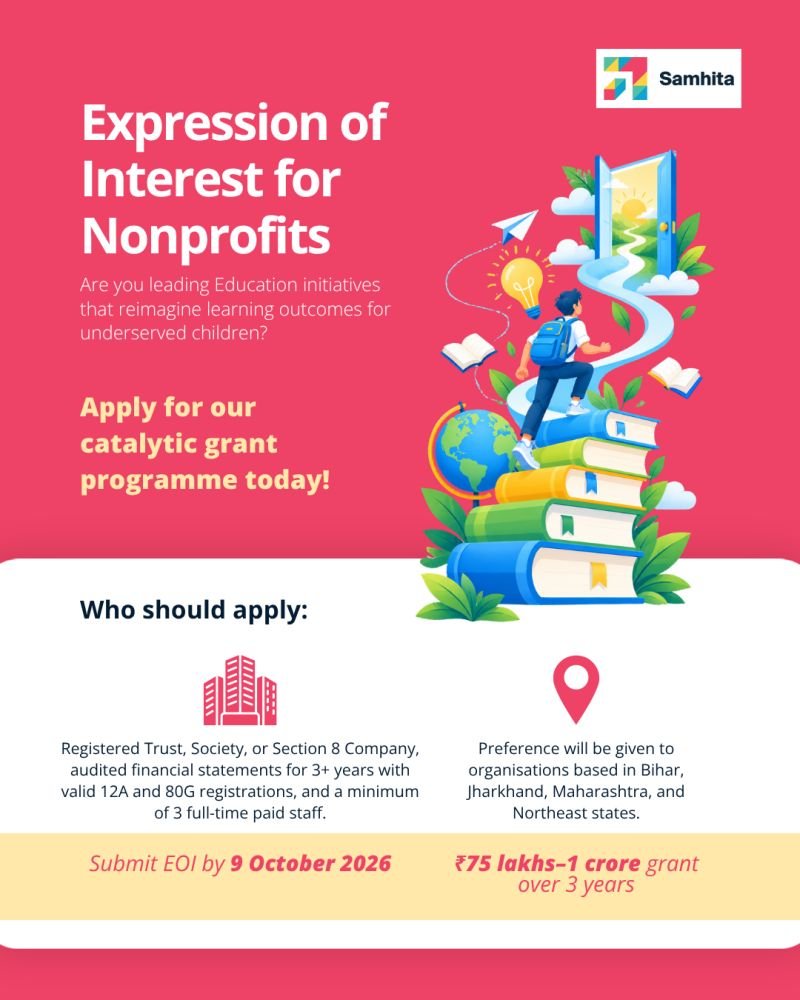
The Samhita-Collective Good Foundation (Samhita-CGF) has launched a Catalytic Grant Opportunity for Education, inviting Expressions of Interest (EOIs) from eligible non-profit organisations working to improve education and strengthen pathways to further learning, skills development, employment, and livelihoods for underserved children and young people in India.
The grant programme will provide funding for up to three years, with successful organisations eligible to receive between ₹75 lakhs and ₹1 crore for the entire grant period. The initiative is particularly interested in practical approaches that improve learning outcomes, strengthen parental engagement, develop adolescent agency, and support successful transitions from school to further education and employment.
Grant Opportunity Overview
Samhita-CGF is seeking organisations with demonstrated impact, strong leadership, and a deep understanding of the communities they serve. Funding can support the strengthening or expansion of existing programmes, development and testing of new models, organisational capacity building, evidence generation, and replication.
The programme will select approximately 2–4 organisations through a two-stage application and due diligence process.
Key details include:
- Grant provider: Samhita-Collective Good Foundation
- Priority area: Education and School-to-Work Transition
- Grant duration: Up to three years
- Grant size: ₹75 lakhs–₹1 crore over the full grant period
- Expected shortlisted organisations: 2–4
- Location: India
- Application: Expression of Interest followed by full proposal and due diligence
- EOI deadline: 9 October 2026
Priority Areas
The funding opportunity focuses on a single portfolio: Education and School-to-Work Transition. Applicants should ensure that their proposed intervention aligns closely with this priority.
Improve Learning Outcomes for Children Aged 9–15
Samhita-CGF is interested in evidence-based or promising approaches that improve educational outcomes among underserved children aged 9–15.
Potential approaches may include supplementary learning, teacher-led interventions, and models adapted to the needs of first-generation learners or tribal communities.
Strengthen Parental Engagement
The programme also seeks approaches that involve mothers, parents, and caregivers more meaningfully in children’s education.
Supported interventions may help parents provide additional learning support at home and address barriers that limit participation in schooling, particularly among first-generation learners and underserved communities.
Develop Adolescent Agency and Life Skills
Applicants may propose programmes that equip adolescents with practical life skills, confidence, communication abilities, decision-making capabilities, and wellbeing support.
The programme is particularly interested in approaches that strengthen adolescent voice, agency, and readiness for further education and employment.
Strengthen School-to-Work Transitions
Funding can support organisations helping young people successfully transition from school into further learning, skills development, employment, or livelihoods.
Relevant interventions may include career guidance, exposure to employment opportunities, employability training, mentoring, and placement support.
Who Can Apply?
Expressions of Interest are invited from Indian non-profit organisations that meet the programme’s eligibility requirements.
Applicants must:
- Be registered as a Trust, Society, or Section 8 Company in India for at least three years.
- Hold valid 12A and 80G registrations.
- Have audited financial statements for the previous three financial years.
- Demonstrate relevant experience in the programme’s priority area.
- Have at least three full-time paid staff members, excluding founders.
- Not currently be debarred by an Indian government authority from receiving grant funding.
Smaller organisations will not automatically be excluded because their compliance or institutional systems are less developed. Where necessary, documentation or systems may need to be strengthened before funding is released.
What Can the Grant Support?
The funding is intended for a defined programme rather than unrestricted organisational or core support.
Grant funds may be used to:
- Sustain or expand proven programmes.
- Introduce new components to existing programmes.
- Strengthen strategically important but underfunded areas.
- Establish or test new models.
- Reach underserved populations or geographical areas.
- Build organisational and implementation capacity.
- Generate evidence, documentation, and learning.
- Support replication or wider dissemination.
Applicants should explain clearly how the proposed funding will increase the programme’s impact for the communities it serves.
What Will Samhita-CGF Look For?
Applications will be assessed against several considerations, including the quality and relevance of the proposed intervention, evidence of need, potential impact, and alignment with the funding priorities.
Particular attention will be given to organisations that:
- Reach underserved communities and geographies.
- Advance social justice and address gender-related barriers where relevant.
- Demonstrate strong leadership and governance.
- Have the capacity to manage and deploy grant funding effectively.
- Address a genuine funding gap.
- Demonstrate institutional resilience and appropriate legal and financial compliance.
Small and medium-sized organisations are particularly encouraged to apply.
Bihar, Jharkhand, Northeast India, and Maharashtra will receive particular consideration, although there is no absolute geographical restriction. Priority will also be given to disadvantaged Dalit and Adivasi communities and economically disadvantaged populations more broadly.
Application Timeline
The application process consists of two stages.
- 21 September 2026: Grant call and EOI form released
- 25 September 2026: Open applicant webinar
- 9 October 2026: EOI submission deadline
- 10–27 October 2026: Eligibility screening and portfolio review
- 2 November 2026: Shortlisted organisations invited
- 2–18 November 2026: Stage 2 proposal submission
- 19 November–8 December 2026: Proposal evaluation, due diligence and site visits where applicable
- 9 December 2026: Final funding decisions communicated
How to Apply
Eligible organisations should complete the official Expression of Interest (EOI) form before 9 October 2026.
Applicants should carefully demonstrate how their proposed programme addresses the education and school-to-work transition priorities, the communities served, expected outcomes, organisational capacity, and intended use of the grant.
An open webinar will also be held on 25 September 2026 to explain the funding programme and answer applicant questions.
Eligible Indian non-profit organisations should submit their EOI through the official application form before the 9 October 2026 deadline.
For more opportunities such as these please follow us on Facebook, Instagram, Twitter, LinkedIn and WPChannel
Disclaimer: Global South Opportunities (GSO) does not take ownership or credit for the opportunities shared on this platform. All opportunities are sourced from official announcements and external sources for informational purposes only. Applicants are encouraged to verify all details, deadlines, and eligibility requirements from the official source before applying. Opportunities may be updated or changed by the providing organisations.