
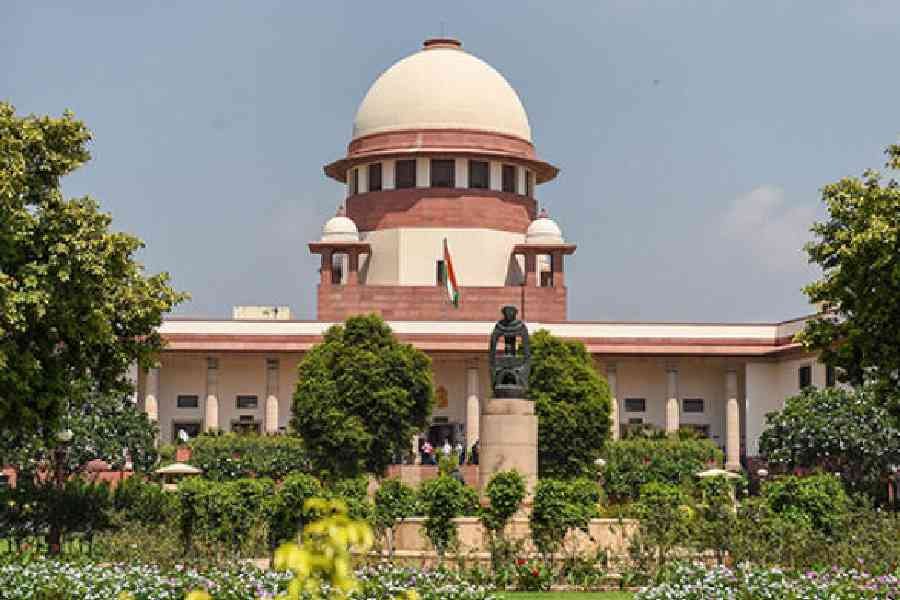
The Supreme Court on Wednesday observed that it will examine whether the Bar Council of India (BCI), as a statutory regulator of the legal profession, has the power to control and regulate law colleges or universities.
A bench comprising Chief Justice Surya Kant and Justices Joymalya Bagchi and V Mohana sought to know how the BCI can be considered an expert body to regulate legal education, as law scholars and academics were better suited to deal with academic matters.
“How can BCI regulate law colleges? That’s the real question. Their statutory role comes into existence only after one gets licence. So the issue is whether law schools can be regulated? We’d like to examine whether BCI has the power to control and regulate university/law college.
“How is the BCI an expert body to regulate legal education? What do they know about legal education? There are eminent law scholars, academicians… you can lay down general guidelines… curriculum should be four or five years…but you can’t control,” the CJI remarked orally.
The top court was hearing petitions questioning the functioning of the BCI-PEARL FIRST Trust and the establishment of law colleges by the Trust.
The bench issued notice on the petitions and sought the response of the Bar Council of India within two weeks.
During the hearing, advocate Prashant Bhushan, appearing for petitioner Girish Mittal, submitted that BCI passed a resolution in 2016 and abolished an earlier trust and transferred the funds to a new trust.
He highlighted the creation of the Bar Council of India Trust for Promotion of Education, Legal and Professional Reforms and Improvement in Research in 2020.
Bhushan alleged that its deed made 11 managing trustees “original and permanent trustees” irrespective of their tenure as BCI members.
He contended that the trust subsequently established one law college each in Goa and Andhra Pradesh.
The counsel appearing for the BCI submitted that the Bar body has passed a resolution providing that there would be no lifetime trustees and that the tenure of trustees would be co-terminus with their membership of the BCI.
The top court had earlier remarked that BCI Chairperson Manan Kumar Mishra’s position was only “pro tem” until a freshly constituted lawyers’ body elects its office-bearers and directed that it has to take any policy decision in consultation with the Attorney General for India and the Solicitor General.
Earlier, a plea was filed challenging the legality of Mishra’s prolonged tenure as BCI chairperson and seeking his removal from the post.
Mishra was first elected as BCI chairman till 2012. Although Mishra briefly demitted office in 2014, he returned as chairman in November that year and has remained in the post since then, said the plea filed by advocate Yogamaya M G.
The petition contends that Rule 12(2) of the BCI prescribes a two-year term for the chairman and vice-chairman, or until cessation of membership, whichever is earlier.
The plea has sought to constitute an independent committee headed by a former apex court judge or former chief justice of a high court.
It has challenged April 21, 2025, gazette notification that extends Mishra’s tenure until 2030.