
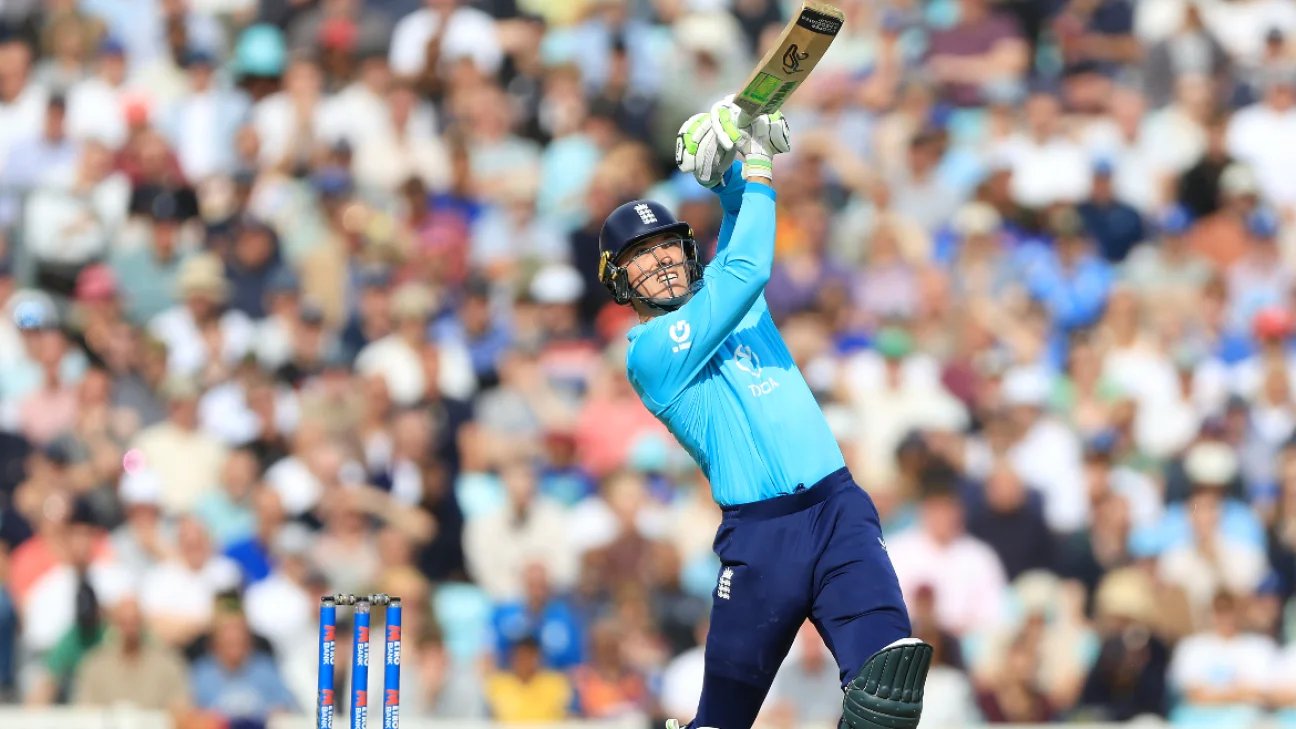
Neither man has much experience in 50-over cricket: Cox was playing just his 10th List A game, and Banton his fourth game in the last six years. But at 25 and 27 respectively, they have become seasoned cricketers, desperate to make the step-up to regular international level, and are adaptable enough to blend their T20 and red-ball skills in this format.
Banton was outstanding at The Oval, scoring freely even when Joe Root and Harry Brook struggled at the other end early in their innings. He was reminded, speaking to Buttler and Kevin Pietersen between games, that 50 overs is a long time to bat, and took low-risk options against the new ball before growing increasingly expansive after 20 overs.
He has shown since his return to England’s T20I side last summer that he is an exceptional player of spin. He made it into the 90s with a trademark reverse-slap for six off Sachindu Colombage’s legspin, then reached his maiden England hundred by charging down to crunch Dunith Wellalage through wide mid-off; all told, he hit 46 from 34 balls against spin.
“There were times when you’re just sat there in your room thinking, ‘Will that chance ever come again?'” Banton reflected. “I couldn’t be more grateful to Brooky and Baz for giving me that opportunity again in a slightly different role in the T20 side. I think that’s why we’ve been so good, just the backing from the senior figures in the group.”
He and Cox are both likely to win further opportunities in Pakistan next month: Buttler is a doubt for England’s tri-series, while Bethell is only likely to return in Australia in November. They will both leave The Oval full of confidence after playing vital innings in a series decider, while relishing the chance to back up their success.
The upshot is that England’s strongest ODI line-up is unclear, but that is no great problem. Instead, they must see it as a positive that they have been able to build bench-strength and create competition for places. Changes to the tournament’s structure mean that, to win next year’s World Cup, England would have to play a total of 13 ODIs, so injuries are almost inevitable.
There was a conscious shift in approach, too. McCullum spoke in the dressing-room after Thursday’s defeat about adapting to the “massive” impact that last year’s rule changes have had on ODI cricket, with a single ball used for the final 16 overs; England responded by frontloading their batting innings, adding 110 runs from overs 25-34.
“There are moments in the game: you’ve got to realise when to put your foot down, and when to drop down a few gears,” Banton said. “The key word for us now as a group is just being ‘smart’, really. That’s maybe why I’ve got a little bit of success recently: we’re just [focusing on] adapting to the match situation and the wicket.”
This was the first time in three years that England made 350 in an ODI without Root scoring at least a half-century. In the absence of Buttler and Adil Rashid, Root was the only man in the side with more than 50 ODI caps on Sunday, and it can only be a good thing if England are becoming less reliant on him.
England are not getting carried away just yet: they still have at least 20 ODIs to play before next year’s World Cup, and still have plenty of room for improvement after a wretched period in 50-over cricket. But they have now won three series out of three in the format this year, and four white-ball series out of four under McCullum and Brook this summer. They are tracking well.
Matt Roller is a senior correspondent at Cricinfo. @mroller98