
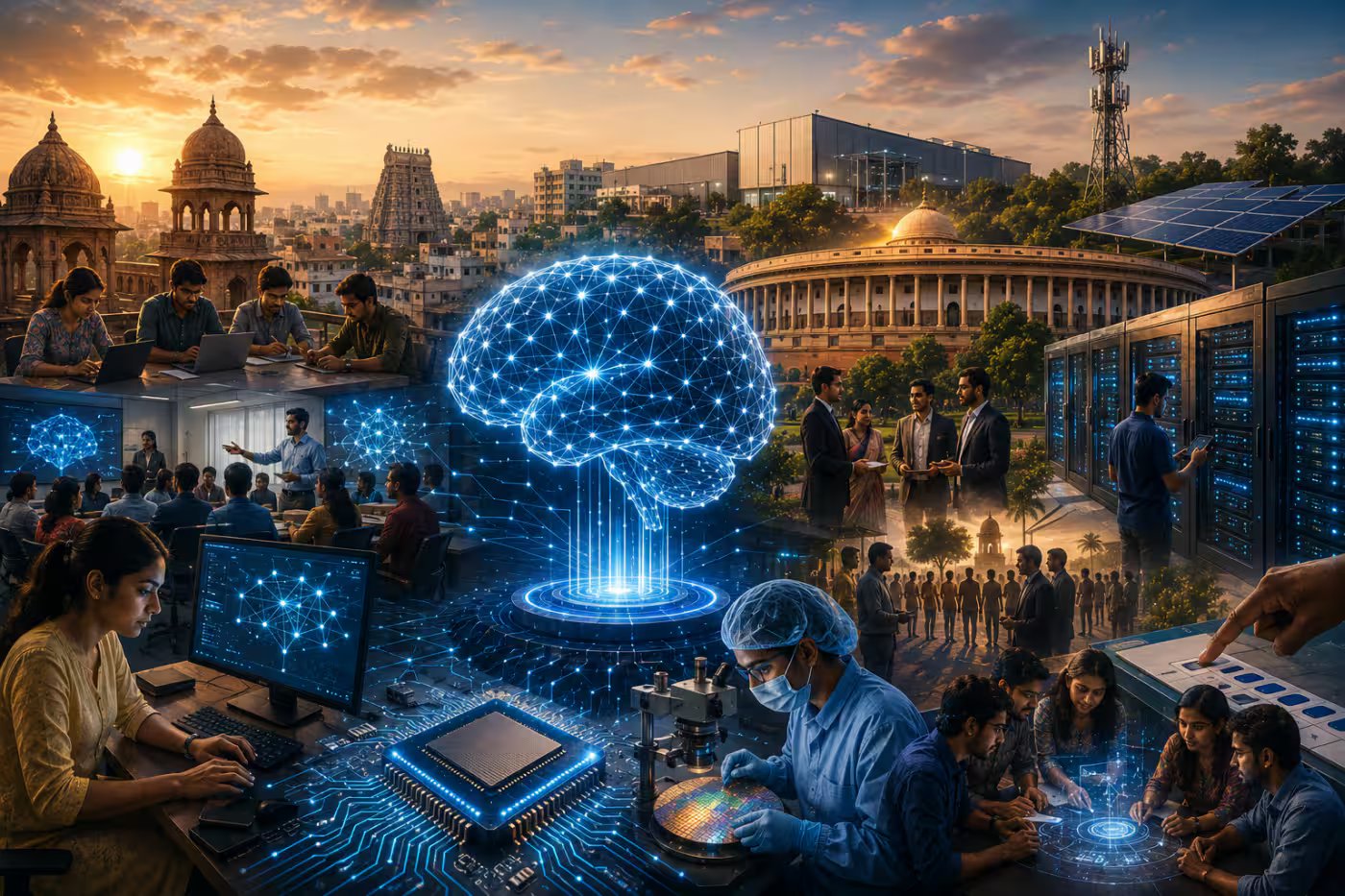
As India enters its 80th year of independence, it is no longer content to be a vast market for the world’s technology giants.
Its ambitions in artificial intelligence (AI) are growing.
- India wants to build capabilities across the AI stack, from models and applications to the infrastructure that powers them, while helping shape the rules governing the technology as it seeks to cement its place at the forefront of the rapidly evolving global AI race.
As the world’s third-largest digital economy, with an enormous digital population, a vast pool of engineers and burgeoning startup ecosystem, India has also become too important for the world’s technology giants to ignore.
- Over the past eight months, we have chronicled India’s push to build an AI ecosystem of its own, from developing homegrown models and manufacturing chips to building data centres and attracting billions of dollars in investment from global technology giants.
We have also examined the emerging questions around AI governance, from the idea of an AI minister to the role of AI in elections and the wider debate over how India should govern a technology reshaping society and the economy. Here’s a look back at eight key themes that have India’s AI journey so far:
1. India’s most important AI policy
The Rs 1.3 lakh crore India Semiconductor Mission (ISM) 2.0 announced in July could become a pivotal point for India’s AI ambitions.
- The policy begins to address the missing hardware ecosystem that AI ultimately depends on.
It could create the design talent, packaging capabilities and supply-chain resilience needed for India to build its own AI hardware ecosystem over the next decade.
Also Read: Hormuz disruption tests India’s chip resolve, exposes weak links in gases, petrochemicals and power.
2. Open or closed? India’s AI choice
One of the hottest debates in the AI ecosystem right now is whether the future belongs to open or proprietary models.
- The debate has gained renewed momentum with the emergence of Chinese open models that rival some of the leading US frontier closed models while being developed and deployed at a fraction of the cost.
So, what path should India take? The country’s advantage may lie in combining frontier and open-weight models while building sovereign capabilities where strategic autonomy matters.
3. Sarvam’s Challenge
Sarvam AI is currently the poster boy for India’s sovereign AI push.
- From inference infrastructure and defence AI to voice, vision, enterprise software, and even a trillion-parameter model ambition, the Bengaluru startup is attempting something much broader: building an AI stack that can stand on its own.
But questions remain over adoption, benchmark performance, and whether sovereignty alone can win users. Can it compete with global tech giants like OpenAI, Google, and Anthropic?
4. India’s AI Edge
2026 will be a crucial year for India’s AI ambitions as the country seeks to become a leader in the global AI race.
- In a wide-ranging conversation with Moneycontrol in January, S Krishnan, Secretary at the Ministry of Electronics and Information Technology, spoke about India’s AI strategy, homegrown AI models, and striking a balance in AI dialogue with other countries. Read the interview.
The conversation came ahead of the India AI Impact Summit in February 2026, the first-ever global AI summit to be held in the Global South.
- At the event, we also spoke to top minds at global tech giants, pioneering AI researchers, and investors. Here’s a quick recap.
5. India’s AI data centre gold rush
India’s $100-billion plus AI land grab is turning data centres into the next infrastructure gold rush
- The country is no longer just exporting IT services, it is becoming one of the world’s hottest destinations for AI infrastructure.
Global tech giants, private equity funds and Indian conglomerates are pouring billions into data centres, betting that the country’s AI ambitions and data localisation push will fuel decades of demand.
6. India’s space data centre race
India’s race to build AI infrastructure is also not confined to land.
- As AI workloads explode and terrestrial infrastructure hits power, cooling and land constraints, Indian startups such as Pixxel, Agnikul, TakeMe2Space are betting that the next frontier for compute could eventually sit hundreds of kilometres above Earth: in orbit.
As Skyroot Aerospace co-founder Pawan Kumar Chandana put it, the industry increasingly believes that “the lowest cost of compute will eventually be in space.”
7. The rise of the AI minister
When AI is transforming industries, economies and everyday life, can governance be far behind?
- AI is becoming a must-have portfolio in government cabinets, with states like Kerala and Tamil Nadu taking the lead.
As more governments experiment with AI portfolios, a new question is emerging: are dedicated AI portfolios a sign of serious intent, or simply administrative branding for the age of AI?
8. India’s AI elections
India’s elections are also entering a new phase, powered by AI.
- Political parties across Tamil Nadu, Kerala, Assam and West Bengal are embedding AI into their campaign machinery, turning what was once experimental into a core strategy.
From hyperlocal WhatsApp outreach to cloned voices, AI is transforming political communication. However, it is also raising fresh concerns around trust, ethics and control.
Bonus: What India’s Economic Survey said about the country’s AI future
The Economic Survey 2025-26, released on January 31, makes one thing clear: India’s AI moment will not be decided by who builds the biggest model. It will be decided by who manages constraints better.
- Constraints around compute, power, talent, jobs and capital run through the AI chapter, tying together what might otherwise seem like disconnected policy debates.
Seen together, the Survey reads less like a tech vision and more like an operating manual for deploying AI in a resource-constrained economy. Here are some key takeaways.
Was this newsletter forwarded to you? You can sign up for the AI Edge here. And don’t forget to sign up to Tech3, our daily newsletter that breaks down the biggest tech and startup stories every weekday evening.