
Last Updated:
Justice Datta said that even if an umpire selected by one of the teams gives correct decisions, his neutrality could still be questioned because of how he was chosen.




Justice Datta stressed that the Election Commission of India (ECI) must not only be independent but must also be seen to function independently.
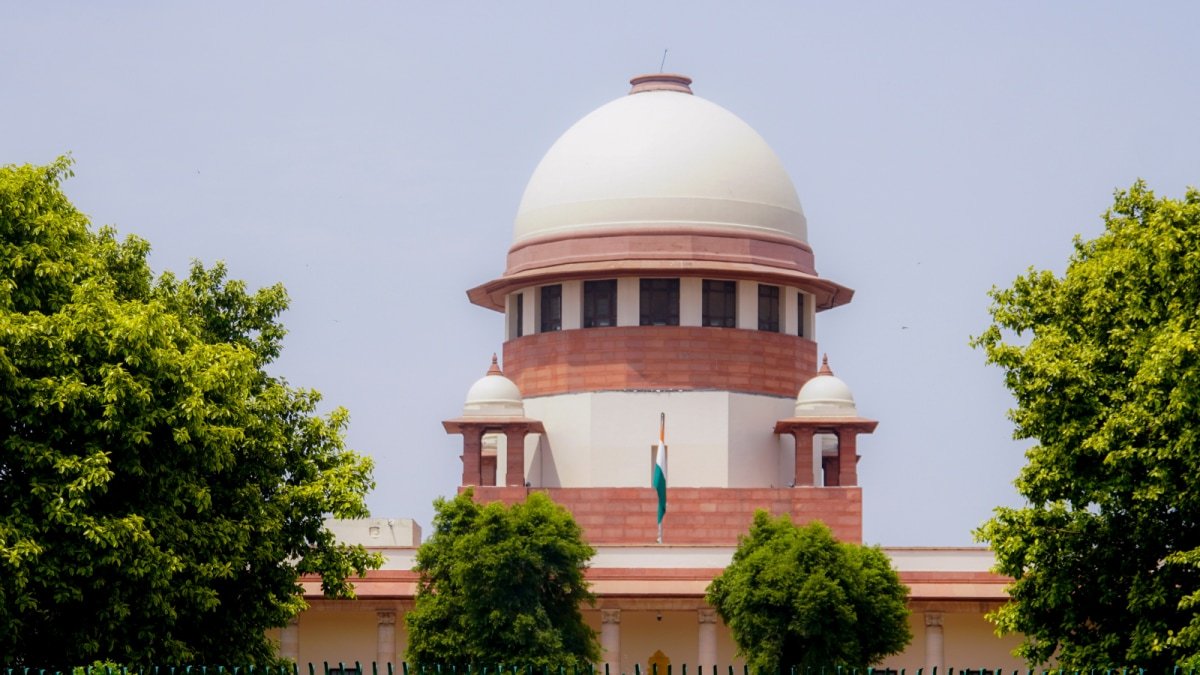
(Photo: PTI File)
Supreme Court Justice Dipankar Datta on Wednesday invoked a cricket analogy while expressing reservations about a 2023 law that excludes the Chief Justice of India (CJI) from the panel that selects the Chief Election Commissioner (CEC) and Election Commissioners (ECs).
The Supreme Court bench of Justices Dipankar Datta and Satish Chandra Sharma gave split opinions on whether a batch of petitions challenging the validity of the law should be referred to a larger Constitution bench.
After hearing the pleas for five days, the bench directed that the matter be placed before Chief Justice Surya Kant on the administrative side for constitution of a bench of appropriate strength for an “effective and authoritative adjudication”. The bench also requested the CJI to consider the possibility of constituting a permanent five-judge Constitution bench to decide seminal constitutional issues.
During the hearing, Justice Datta said that even if an umpire selected by one of the teams gives correct decisions, his neutrality could still be questioned because of how he was chosen.
“The bottom line of the argument runs thus: it would not be a fallacious metaphor if it is said that since the umpire is picked by the captain of one side in a cricket match and his team wins, even if the decisions taken by such umpire are correct, it has the patina of suspicion,” Justice Datta observed.
Also Read | CEC, ECs And The Power To Decide: What Are The Rules When The Election Commissioners Cannot Agree?
Justice Datta was referring to concerns over the composition of the selection committee under the 2023 law. He said the Union minister nominated by the prime minister as the third member of the committee, which is chaired by the PM, could not reasonably be expected to oppose the person who nominated him and risk losing his position on the committee.
He stressed that the Election Commission of India (ECI) must not only be independent but must also be seen to function independently.
“If free and fair elections are to be ensured, it is axiomatic that the ECI must not only be an independent body but also be seen to act independently,” Justice Datta said.
He added that while the 2023 Act “may possibly survive” the challenge arising from the exclusion of the CJI from the selection committee, it would also have to meet the “perception test”, which the Supreme Court has repeatedly recognised as important.
“There can be no gainsaying that free and fair elections, to a large extent, depend on a truly independent ECI. It is not enough for the ECI to be independent; it must also appear to be independent,” he said.
Justice Datta, however, clarified that the observations were only prima facie and that the court was not expressing any conclusive view on the validity of the 2023 law.
Justice Satish Chandra Sharma disagreed with Justice Datta’s views, resulting in the split opinion on the issue.
What Is The 2023 Law?
The legal challenge centres on the Chief Election Commissioner and Other Election Commissioners (Appointment, Conditions of Service and Term of Office) Act, 2023.
The controversy stems from a March 2023 Constitution bench judgment, which had held that the CEC and ECs should be appointed by the President on the recommendation of a selection committee comprising the prime minister, the Leader of the Opposition in the Lok Sabha and the CJI.
Parliament subsequently enacted the 2023 law, replacing the CJI with a Union Cabinet minister nominated by the prime minister on the selection committee.
The Supreme Court had earlier declined to stay appointments of election commissioners made under the 2023 law while petitions challenging its validity were pending.
Quick Answers
 Ask News18
The Chief Election Commissioner and Other Election Commissioners (Appointment, Conditions of Service and Term of Office) Act, 2023 governs these appointments. It replaced the Chief Justice of India with a Union Cabinet minister nominated by the prime minister on the selection committee.
Ask News18About the Author

Saurabh Verma is a Deputy News Editor at News18.com, specialising in Indian politics and breaking global news. With years of experience tracking election strategies, he decodes domestic issues for mil…Read More
September 23, 2026, 18:12 IST
Read More