
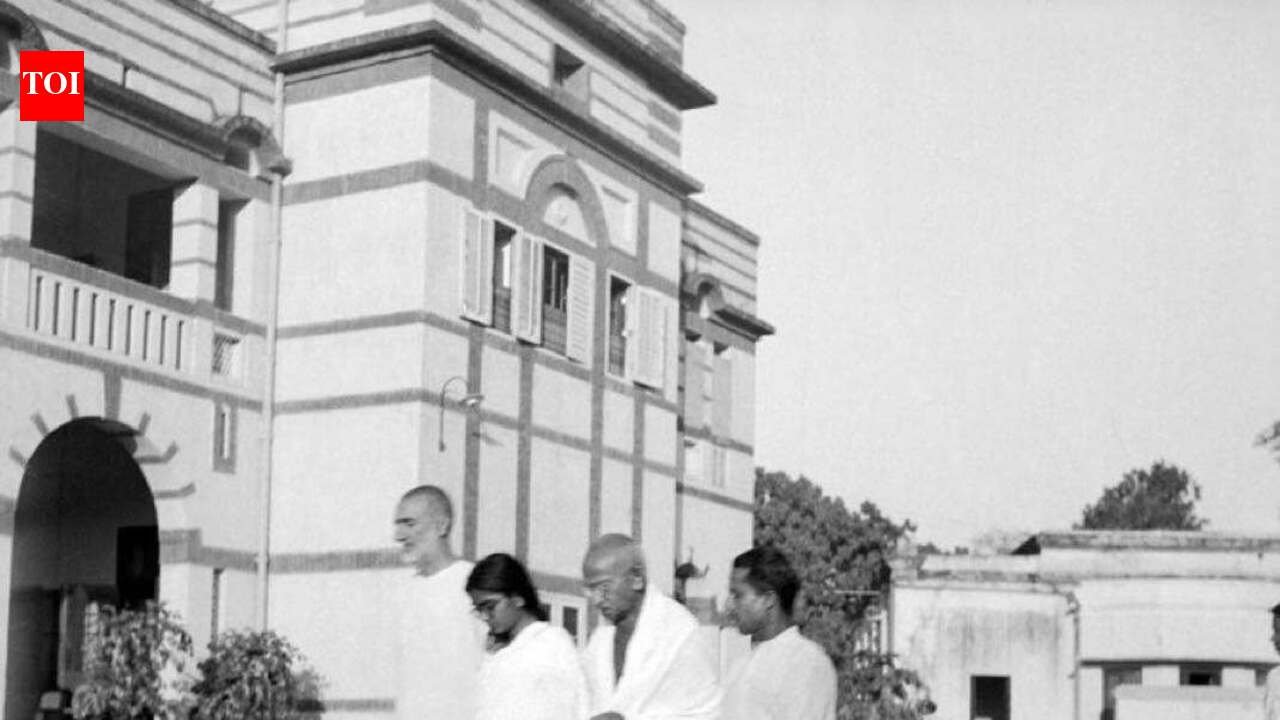
Patna: Mohandas Karamchand Gandhi was not only the pioneer of Satyagraha in India but also a catalyst for social and political change, particularly through schools and ashrams he helped establish in Bihar.For the people of Champaran, Gandhi became a revered figure. A British govt report sourced from Bihar State Archives said, “When Gandhi came to Motihari in 1917, people did not know much about the man and had no faith in him…his trial made him famous when Gandhi refused to obey the notice and showed his willingness to go to jail.”The report quoted a writer accompanying Gandhi: “More than one tenant told me that Gandhi is the second God of Champaran; one tenant told me Gandhi is like Ramchandra and carried the simile further and said that when Ramchandra went to Lanka the inhabitants of the place did not fear the powerful Rakshas by whom they were oppressed and so the tenants would not fear the Rakshasa planters now that Gandhi is there.”Gandhi considered education central to socioeconomic reform and political awakening. During the Champaran Satyagraha, he established school-cum-ashrams at Barharwa Lakhansen, Bhitiharwa and Madhuban.Bihar State Archives archivist Dr Rashmi Kiran, who has researched Gandhi, said the first school in Champaran was established at Barharwa Lakhansen on November 14, 1917. Shivgulam Lal, a local, allowed part of his house to be used for the school and provided other assistance.Gandhi’s association with Bihar continued beyond Champaran. In Dec 1920, he, Maulana Shaukat Ali and Maulana Azad toured the state during the Non-Cooperation Movement. His call to boycott govt schools and colleges highlighted the need for alternative education.National College (Rashtriya Mahavidyalaya) was subsequently established in a rented house on Patna-Gaya Road with Dr Rajendra Prasad as its principal. Several prominent figures, including Badrinath Verma, Jagannath Prasad, Prem Sundar Bose, Jagat Narayan Lal, Ram Charitra Singh and Prof Abdul Bari, were associated with it. Kiran said the college was funded with money collected during Gandhi’s Champaran visit.Patna’s Sadaquat Ashram also emerged from the movement. Inspired by the Non-Cooperation agenda, Maulana Mazharul Haque established a national school. After students of Patna Engineering School went on strike, they sought his guidance. He left his residence, Sikandar Manzil, and moved with them to a modest house near Digha.Initially, 110 students joined him. Through their collective labour, huts were built, workshops organised and brick-making started. The centre promoted Hindu-Muslim unity, religious tolerance and social equality.Maulana Mazharul Haque later named it Sadaquat Ashram. It became a centre for the freedom struggle, helping shape the political and social consciousness of Bihar and the wider national movement.