
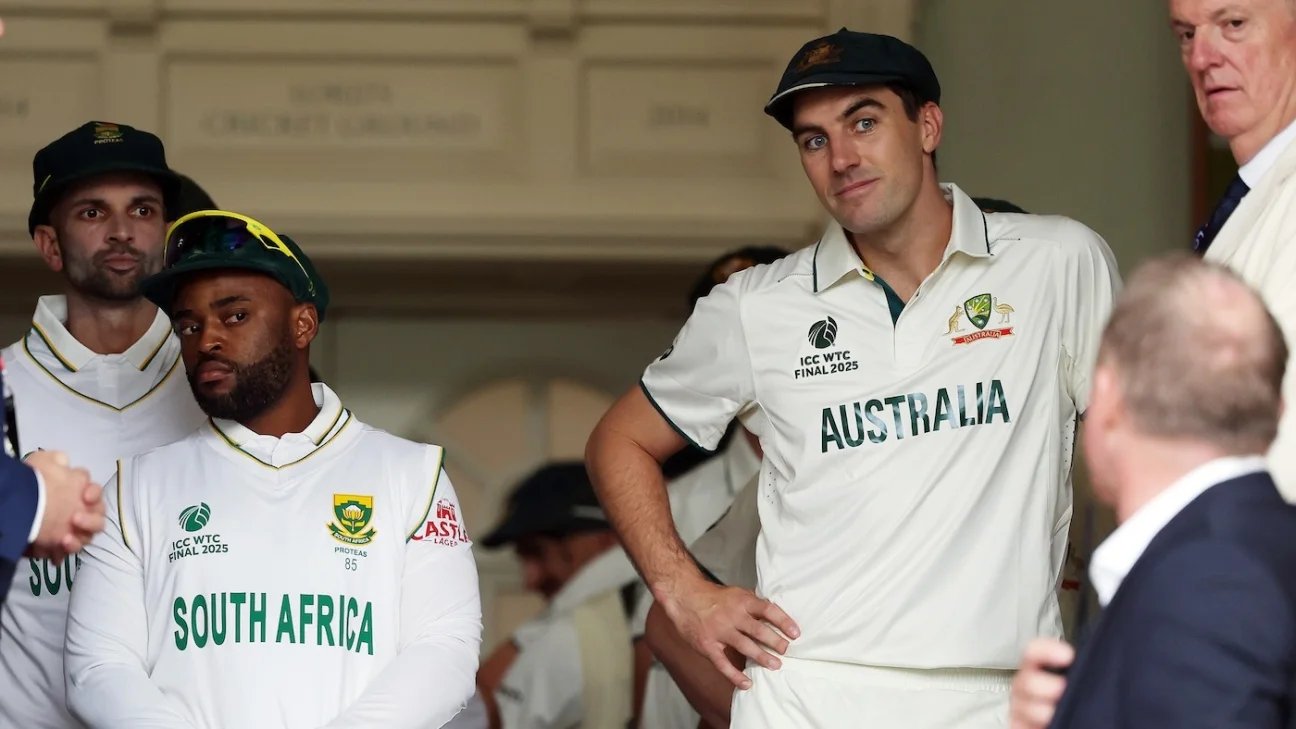
But the nature of a Test series that pits the No. 1 side against the reigning world champions will mean recollections of what happened in 2018 won’t be far away in the build-up. With use of Cricinfo’s extensive coverage at the time, this is how it all unfolded.
The Durban stairwell
After the relatively quiet opening day, it did not take long for the true nature of the 2018 contest to manifest itself. Before the series, Australia’s players had requested the stump microphones be turned down when the ball was dead, and they attempted to ensure that was done by audibly plugging rival sponsors. AB de Villiers played down what happened in the middle, though: “It was quite nice today,” he said. “They were very friendly compared to last time.”
Off the field, security had to step in as spectators shouted abuse at the Australians.
“I’m not going to say nothing will ever happen again, but as far as I’m concerned, we’ve just got to try to play within the spirit of the game,” Smith said.
South Africa’s team manager Mohammad Moosajee termed it “great for the series and for Test cricket” but Smith questioned the outcome. “The ICC have set the standard, haven’t they? There was clearly contact out in the middle,” he said.
At the midway point of the series there was also a change in officials; Andy Pycroft replaced Crowe as match referee. On-field and TV umpires Kumar Dharmasena, Chris Gaffaney and S Ravi, the latter two still relatively inexperienced, were replaced by Nigel Llong, Richard Illingworth and Ian Gould.
In his autobiography Gould said he believed the English group could have got control of the series earlier. “Hindsight is a wonderful thing but I’m absolutely sure the English trio, including me, would have got on top of things from the off,” he wrote in Gunner: My Life In Cricket. “More things had happened in those first two Tests than you normally have to deal with in a five-match series.”
He also recounted a message passed on by the initial group of officials. “The umpiring team had their suspicions that Australia were working a little too aggressively on the condition of the ball, and they had an informal word with the host broadcaster, SuperSport, asking that if their camera crew saw anything that looked unusual, they should let the umpires know.”
The ability to produce reverse swing had been a notable feature of both attacks throughout the first two Tests. After the opening day of the series, Warner said: “We didn’t assess for reverse [swing] in the first day – not after 24 or 25 overs.” Mitchell Starc, meanwhile, was lethal with the ball moving in the first Test in Durban, as was Rabada in the second. The amount of bandaging on Warner’s hands in Port Elizabeth was highlighted.
The first day at Newlands was mostly about the cricket. Dean Elgar forged a magnificent century, and Pat Cummins produced a superb spell of reverse, instigating a South Africa collapse. However, that vibe didn’t last long.
In the middle, Lyon limited Australia’s deficit to 56, but South Africa built solidly in their second innings. At the end of the 43rd over, with the score 129 for 2, the umpires converged in the middle, as noted by Cricinfo’s ball-by-ball commentary.
“The umpires have come together for a confab, which is always ominous news. They are having a chat with Cameron Bancroft, and there could be something afoot here… they wanted to know what was in his pocket… and he shows them a soft cloth, a sunglasses case by the looks of it … seems to have died down for now, whatever might have been brewing there… on we go. Will elaborate if needs be!”
The remainder of the day played out amid an increasing frenzy of questions and speculation, but the on-field umpires, Llong and Illingworth, had not felt the need to change the ball and no five-run penalty had been imposed.
Smith added that he intended to continue as captain. “I still think I am the right person for the job.”
“We all woke up this morning shocked and bitterly disappointed by the news from South Africa,” Prime Minister Malcolm Turnbull said. “It seemed completely beyond belief that the Australian cricket team had been involved in cheating.”
In a recent interview with Code Sports, Smith said he felt abandoned at that point. “I felt like I was kind of thrown to the wolves through the airport,” he said. “I didn’t have any support there at all.”
The scheduling of this series means the three Tests will follow the same order as in 2018. As evidence of their longevity, there is a good chance Australia will next week in Durban field the same front-line attack that featured in the first three Tests eight years ago: Starc, Hazlewood, current captain Cummins, and Lyon.
For South Africa, there are potentially five survivors, including current captain Temba Bavuma, although Rabada, who claimed nine wickets in last year’s WTC final at Lord’s, is doubtful due to injury.
“I haven’t seen a series go like that since that one,” Hazlewood said last month. “It was just so over the top, almost from ball one. I don’t know whether it was two teams at boiling point who had been on the road for a long time and were mentally drained and fatigued. Everything was really over the top. I can’t see any issues like that [happening] again.”
Andrew McGlashan is a deputy editor at Cricinfo