
This story is part of “How Tech Changed It” — The Better India’s series that looks at how technology has transformed the sectors, systems and everyday experiences around us. From how we travel and learn to how we farm, build, communicate and access healthcare, each story traces the journey from what it was like before to what it looks like today. Because technology isn’t just about new gadgets or breakthroughs — it can change how an entire sector works, making things faster, smarter, safer, more accessible and more efficient.
For a child in Sarai Tand, Bihar, a science lesson can now begin with something once missing from the classroom: a chance to see what the teacher is explaining.
In this village, nearly 63 km from Gaya’s district centre, students from six nearby villages walk or take shared vehicles to reach Government Higher Secondary School. For many, the school is their closest route to opportunities beyond their villages.
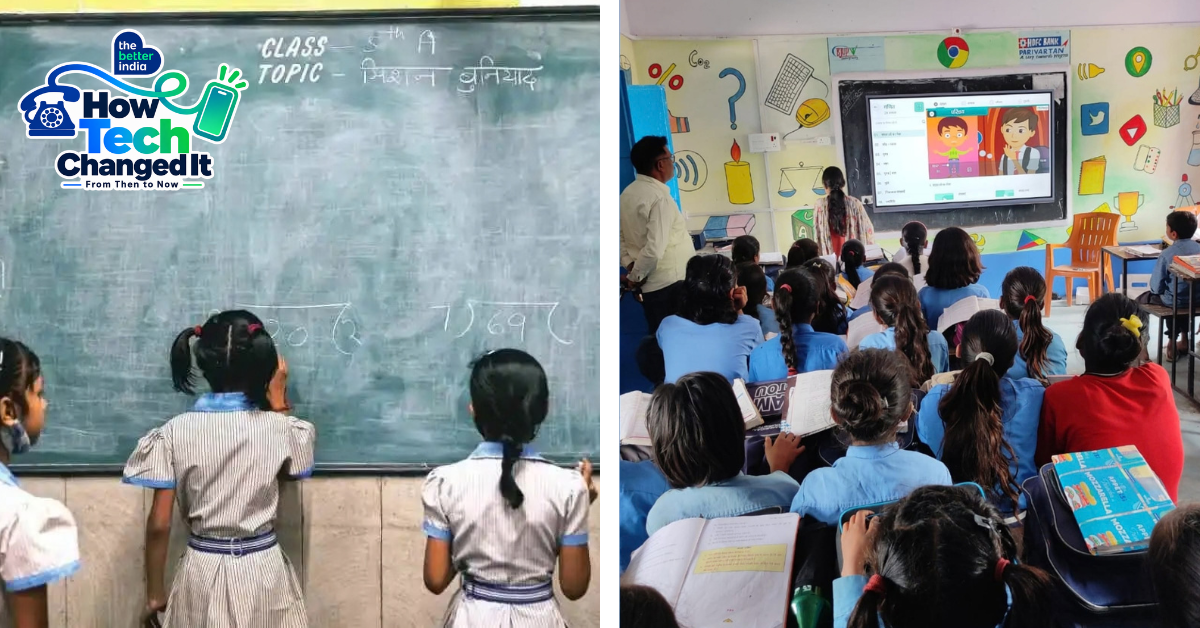
Today, one room in the school looks a little different from the rest. The school has created a dedicated Smart Classroom where teachers can use an interactive digital panel to bring lessons to life.
A chapter that once depended largely on a textbook, blackboard and verbal explanation can now include animations, visual demonstrations, practice activities and assessments.
For a student who finds a concept difficult to understand from words alone, seeing it unfold on a screen can make the same lesson easier to grasp.
/filters:format(webp)/english-betterindia/media/media_files/2026/10/06/bihar-education-2026-10-06-14-56-13.webp)
The classroom is now being used by 660 students and 14 teachers across grades. And because the learning content is stored offline, lessons can continue even without a reliable internet connection.
For 660 students, the classroom now looks a little different
Sarai Tand is part of a much larger transformation underway in Indian schools.
Across the country, more than 1.49 lakh schools are covered under government ICT and digital learning initiatives. The government has sanctioned over 1.76 lakh smart classrooms and 1.79 lakh ICT laboratories, bringing digital tools into classrooms that once depended almost entirely on conventional teaching methods.
/filters:format(webp)/english-betterindia/media/media_files/2026/10/06/bihar-education-2026-10-06-14-57-04.jpg)
The change is visible in smaller ways, too. A teacher can show a three-dimensional model instead of drawing a complicated diagram on the board. A student can revisit a difficult concept through a video. A lesson can include an interactive activity rather than ending with notes copied from the blackboard.
For children who learn differently, these additional ways of explaining a concept can make the classroom more accessible and engaging.
What does it take to make digital learning work in a school?
The bigger shift is that technology is creating a wider learning ecosystem around the classroom.
Computer availability in schools has risen to roughly 57–64.7%, while internet connectivity has expanded to around 53.9–63.5%. Some states, including Kerala, Tamil Nadu, Punjab and Haryana, report digital facility access of more than 98–99% in their government school systems.
At the same time, initiatives such as DIKSHA and PM e-VIDYA have expanded access to digital educational content, textbooks, television-based learning and other resources. Under Samagra Shiksha, government support is also being used to strengthen ICT infrastructure, smart classrooms and connectivity.
For teachers, this means having more tools to explain a lesson. For students, it can mean having more than one way to understand it.
How do you turn a new device into part of a daily lesson?
But putting a screen inside a classroom is only the beginning.
In Sarai Tand, the school prepared a separate room, arranged desks and electrical fittings, and created a space specifically for digital learning. Teachers were then trained to explore the content and understand how animated videos, practice modules and assessments could fit into their regular lessons.
That ownership matters. Technology becomes useful when it moves beyond being a new piece of equipment and becomes part of how a classroom actually works.
/filters:format(webp)/english-betterindia/media/media_files/2026/10/06/bihar-education-2026-10-06-14-58-31.png)
Photograph: (iDream Foundation)
The same is true across India. While some schools now have extensive digital infrastructure, others are still catching up on computers, internet access and basic connectivity.
Yet the direction of change is clear. For a child sitting in a classroom in Sarai Tand, technology does not erase the teacher, the textbook or the familiar blackboard. It simply adds another window to the lesson.