
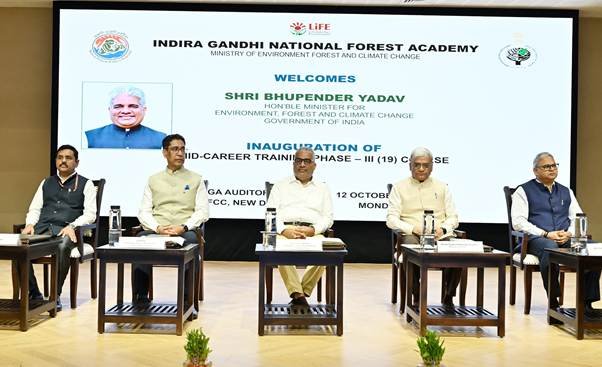
Union Minister for Environment, Forest and Climate Change, Shri Bhupender Yadav, interacted with the Indian Forest Service (IFSC) Mid-Career Training (MCT) Phase-III (19) officers in New Delhi today. Dignitaries present on the occasion included Secretary (EFCC), Shri Narendra Bhushan; Director General (Forests) and Special Secretary (EFCC), Shri Santosh Tiwari; ADG (Wildlife), EFCC, Shri Ramesh Pandey; Director, Indira Gandhi National Forest Academy (INGFA), Shri Rajendra Prasad Khajuria, and other senior officials of the Ministry.
Addressing IFS officers from various state cadres, Mr. Yadav commended their contributions to protecting India’s forests, wildlife, and ecological heritage. He highlighted India’s progress in wildlife conservation, forest and tree cover enhancement, carbon sequestration, forest/wetland conservation, and landscape restoration through citizen-engagement initiatives such as “Ek Ped Maa Ke Naam,” MISHTI, the Aravalli Green Wall, and the Nagar Van Yojana. The Minister emphasized that the vision of “Developed India @ 2047” requires integrating economic development with ecological protection. He cited human-wildlife conflict, forest fires, climate change, and the balance between development and conservation as key challenges that require a scientific approach and community participation.
Mr. Yadav noted that India is characterized by its diverse climate, ecosystems, and vast biodiversity. He emphasized that an IFS officer must be adaptable to effectively play a leadership role in forest and wildlife conservation at the grassroots level. He explained that biological resources are the planet’s most critical and essential resources, so officers are being provided with both grassroots implementation experience and extensive ministerial policymaking experience. He encouraged officers to find practical solutions to the challenges in their fields.
Shri Yadav, highlighting the changing role of the Indian Forest Service, urged officers to move beyond traditional regulatory functions to become leaders, innovators, and facilitators of sustainable development. He also emphasized the need for continued capacity building and community engagement, using emerging technologies, including GIS, remote sensing, and artificial intelligence, and traditional knowledge. The Minister called upon officers to strengthen institutions, adopt innovative approaches to efficient decision-making and prepare forest management plans, and fulfill their responsibility to protect India’s ecological future.
Mid-Career Training (MCT) Programme 2026
The Mid-Career Training Phase-III (19) program, being conducted by the Indira Gandhi National Forest Academy (IGNFA) from October 12 to November 6, 2026, is designed for IFS officers with 7-9 years of service. The 68 participants, from 18 cadres, have diverse field and policy experience. Their professional interests range from wildlife conservation governance, climate-resilient forestry, habitat restoration, landscape restoration, and environmental policy implementation.
The program is structured to strengthen leadership, strategic policy implementation, and grassroots forest governance, while also incorporating emerging technologies and contemporary approaches. Under the Line Ministry Module, officers will be introduced to key central ministries and organizations to enhance their understanding of inter-sectoral linkages and policy frameworks. Thematic visits to Uttarakhand and Uttar Pradesh will focus on best practices in wildlife management, biodiversity conservation, ecotourism, and community-based forest management.
The Management module will focus on leadership and decision-making, human resources and financial management, forest estate governance, consultation and dispute resolution, change management, communication, and ethical leadership. Finally, the Forestry module will discuss emerging issues, including environmental agreements, artificial intelligence in forestry, digital transformation, national wildlife stewardship, biodiversity governance, climate finance, Forest Rights Act (FRA) issues, watershed management, recent FCA amendments, and human-wildlife conflict.
