
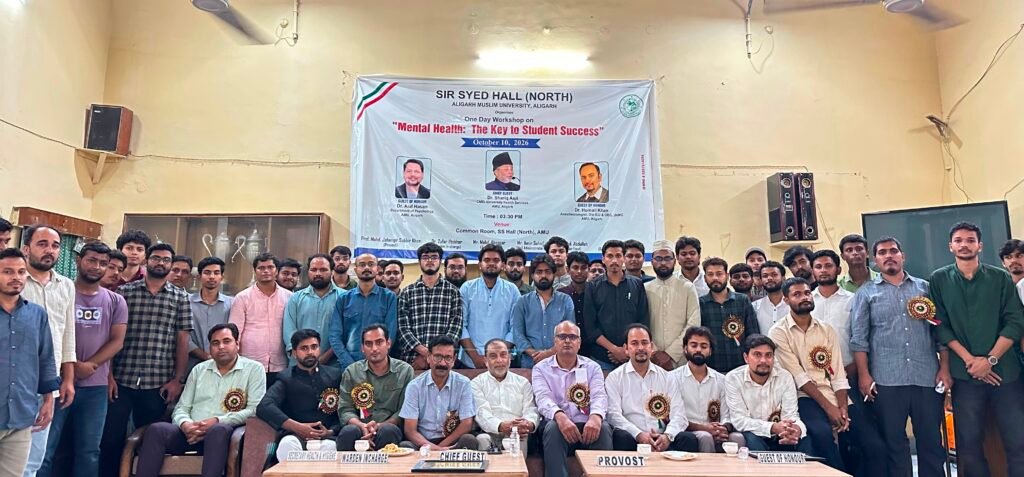
ALIGARH, October 12: Aligarh Muslim University (AMU) observed World Mental Health Day on October 10 through awareness programmes organised by the Department of Psychiatry, Jawaharlal Nehru Medical College (JNMC), Sir Syed Hall (North) and AMU City Girls’ High School. The initiatives highlighted emotional well-being, timely professional support and the importance of creating an environment in which students can discuss mental health concerns openly.
The Department of Psychiatry, JNMC, organised a special programme hosted by Dr. Anwer Hasan Siddiqui. Prof. Mohammad Khalid, Dean, Faculty of Medicine, JNMC, appreciated the department’s initiatives, while Prof. Anjum Parvez, Principal and CMS, JNMC, stressed that there is no health without mental health. Dr. M. Reyazuddin, Chairman of the department, emphasised that mental health issues should not automatically be equated with mental illness and cautioned against self-diagnosis. Dr. Faisal Shaan, Assistant Professor, delivered a talk on “Mental Health: Burden, Prevention and Management”. A key highlight was the lived-experience session in which research scholar Asif Adeeb shared his journey of recovery following mental health challenges after his father’s death. He attributed his recovery to counselling, medication, realistic expectations and goal-directed activities. Prof. Tamkin Rabbani, Coordinator, Medical Education Unit, highlighted the role of mentorship in addressing students’ mental health concerns. Dr. Jitendra Kumar, Assistant Professor, proposed the vote of thanks.
Sir Syed Hall (North) organised a workshop on “Mental Health: The Key to Student Success” in its Common Room. Dr. Shariq Aqil, Chief Medical Officer, University Health Services, AMU, attended as Chief Guest, while Dr. Humail Khan, Anaesthesiologist under NHM @HDU/ICU of OBG Department, JNMCH. was the Guest of Honour. The speakers highlighted the importance of managing academic stress, maintaining a positive outlook and seeking professional support when required. They also discussed how mental well-being contributes to concentration, confidence, emotional balance and academic success. The programme was organised under the guidance of Prof. Mohd. Jahangir Sabir Khan, Provost, with support from Dr. Zafar Iftekhar, Mr. Kamran Khan and Mr. Nurujjama Arshad, Wardens, and Mr. Tufail Khan, Secretary, Health and Hygiene.
At AMU City Girls’ High School, Class 7-A organised a special assembly to encourage students to express their feelings rather than suppress them. Conducted by Subhana Ansari and Nimra Khan, the assembly featured a skit about a young girl who struggles under constant criticism but gradually finds the courage to pursue her passion for painting. The performance conveyed the importance of self-expression and emotional support. The Vice Principal encouraged students to speak openly about their feelings and seek help whenever necessary. A student-created awareness poster carried messages promoting self-acceptance, resilience and emotional well-being. The assembly was prepared under the supervision of Class Teacher Dr. Samia Hamid and the guidance of Principal Mr. Md. Javed Akhtar.
Saiyyid Hamid Senior Secondary School (Boys) organised a programme featuring an expert talk by Prof. Roomana Siddiqui of the Department of Psychology, Women’s College, AMU. Principal Mr. Sabahuddin welcomed the gathering, while Dr. Naila Rashid introduced the theme and highlighted the importance of listening to people’s lived experiences. In her talk, “Mind Matters”, Prof. Siddiqui discussed stress and anxiety management, understanding and expressing emotions, seeking support and adopting healthy habits. She encouraged students to understand themselves, manage their thought processes and work towards overcoming negative thinking. The programme was managed by Captain Najaf Ali Khan and Ms. Ayesha Imran, with a vote of thanks proposed by Ms. Sadia Nasir. Vice Principal Dr. Mohd. Firdosh Khan and Warden In-charge of Allama Iqbal Boarding House Dr. Qamre Alam also participated in the programme.
The programmes collectively emphasised early recognition of mental health concerns, reduction of stigma and the importance of professional intervention, mentorship and supportive educational environments in promoting holistic well-being.
Make the headline more conciseTighten the programme details further
