
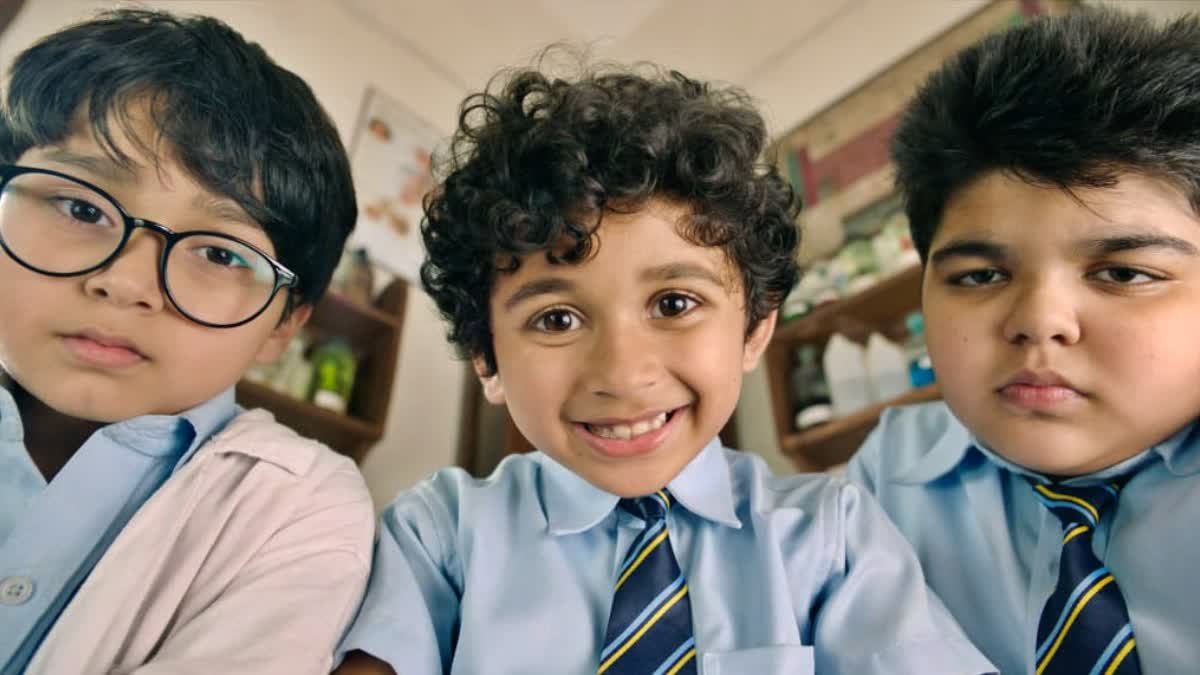
‘Adults Wrong Hai’ is a delightful children’s song from the movie ‘Little Thomas’ (ETV Bharat)
If a seven-year-old asks where babies come from, they may get an answer involving a stork, a hospital, or a mysterious trip to the market. Children have a habit of asking these questions at precisely the moment adults are least prepared to answer them. Now imagine turning that confusion into a song. That is the idea behind Adults Wrong Hai, the new track from Little Thomas, an upcoming film starring Gulshan Devaiah and Rasika Dugal, and directed by Kaushal Oza.
Adults Wrong Hai also raises a question beyond the film itself. When was the last time a Hindi movie gave us a memorable song entirely from a child’s point of view? Hindi cinema has a song for nearly every occasion, from falling in love, getting married, getting drunk to travelling overseas. But what about children? Hindi cinema has given us a few memorable songs about childhood, such as Lakdi Ki Kathi (in 1982 film Masoom) and Bum Bum Bole in Taare Zameen Par. Yet songs that let children express their own thoughts, questions and frustrations remain relatively uncommon in contemporary mainstream Hindi cinema.
Kids Don’t Get Enough Attention In Movies
Children appear in films, but their musical worlds often receive less attention than those of the adults around them. Rarely are children the emotional centre of a Bollywood story, and when they are, they don’t get many opportunities to express that world through music. This is ironic because children are natural storytellers. The challenge is to capture that voice without making it sound like an adult pretending to be a child.
For Little Thomas, that process took time. Composed by Shailendra Barve and sung by Anupam Barman, the song features lyrics by co-producer Ranjan Singh and Iago. Released by Junglee Music (a division of Times Music), it follows seven-year-old Thomas as he tries to make sense of the world and arrives at a conclusion that many children eventually discover for themselves: grown-ups don’t always know what they’re talking about.
90s Words And References
Ranjan Singh says he and Oza initially struggled to find the right approach to the song. The film is set in the mid-1990s, in Goa, against the backdrop of middle-class family life and financial pressures. The music and lyrics had to belong to that world. “We were first struggling. I mean, there was no plan for me or Kaushal to write it,” Singh tells ETV Bharat in an exclusive phone interview from Mumbai. “We were looking for the right kind of a thing because the film has a mid-90s vibe. It’s also set in mid-90s Goa.”
The breakthrough came when Oza wrote the opening lines around the idea that adults are wrong. He took the mukda to composer Shailendra Barve, and the two began working on the music. Barve was a particularly relevant choice. He had composed Mera Jahan for Taare Zameen Par, a song that captures a child’s view of the world. The Little Thomas team wanted that level of sensitivity to the way children think and feel, without repeating what had been done before.
Co-producer Ranjan Singh wrote the lyrics to ‘Adults Wrong Hai’ along with Iago (Special arrangement)
Once Singh heard the initial composition, the words began to fall into place. “I quite liked it. And then some words came about in my mind and I wrote them. And then, by surprise, they both liked it,” he recalls. What began as an unplanned contribution turned Singh into one of the film’s lyricists. Barve liked the voice and tone he brought to the song enough to ask him to write another track for the film.
Adults Wrong Hai has a lively children’s chorus, acoustic instrumentation and the kind of cheerful disbelief that comes naturally to a child who has been given one too many unsatisfactory explanations. Thomas has spent much of his life asking adults where babies come from, only to receive vague answers. Now, he has advice for his younger sibling: eat what you like, play as much as you can, and don’t believe everything the adults tell you. The joke works because children are often better at spotting contradictions than adults give them credit for. A parent might insist that a child eat everything on the plate but refuse to explain where babies come from. To a seven-year-old, both situations deserve further investigation.
Singh tells us the song had to emerge naturally from the film’s narrative. Thomas isn’t delivering a lecture about childhood or adult hypocrisy. He is just talking to his sibling in the way a child might, based on what he has experienced. Since the film is set in 90s Goa, the vocabulary and references would be different from today. “We had to talk to children as in millennials, who were growing up in the 90s. We had to get the mood and the vocabulary right,” he says.
Also read: ‘Goan Music Has A Whole History That Has Nothing To Do With Anybody’s Vacation’: Tsumyoki
The Goa setting added another layer. The easy mixing of Hindi and English, with the influence of the region’s multilingual culture, helped shape the song’s language and title. The result is not a nursery rhyme dressed up as a film song. It is closer to the way a child might actually speak: a little irreverent and sometimes illogical.
Adults Wrong Hai is composed by Shailendra Barve and sung by Anupam Barman, with lyrics by Ranjan Singh and Iago (Special arrangement)
Are Indian Children Growing Up Too Quickly?
For Singh, the shortage of children’s content in India was one of the reasons for making Little Thomas in the first place. “Yes,” he says when asked whether childhood innocence is missing from today’s entertainment landscape. “That was the reason number one we wanted to make this film. Because there is not enough content for children in India.”
He believes children are growing up too quickly, partly because of their exposure to the internet. They have access to information from an early age, but that doesn’t necessarily leave them with more room to explore the world at their own pace.
Singh points to Bluey, the Australian animated series that has become a global hit, as an example of how stories about children’s everyday experiences can find a large audience. The show’s appeal comes from its attention to family life, play, relationships and the small dramas that matter enormously to children.
India has no shortage of stories about childhood either. Songs such as Adults Wrong Hai allow children to recognise themselves in popular culture, while reminding adults that a child’s perspective can be worth listening to.
For Singh, the film and its songs are part of a larger need for stories that take children seriously. That doesn’t mean every children’s film has to be educational. It means giving young characters the freedom to be curious, funny, and occasionally wrong. Hindi cinema doesn’t need every children’s song to become a chart-topping phenomenon. It does need more songs that allow young characters to speak in their own voices, with their own questions, humour and imperfect logic.
Also read:
- Mithoon: “The Soundtracks of Subhash Ghai’s Films Shaped A Major Part Of Who I Am As A Composer”
- When Words Were Not Enough, Suchitra Krishnamoorthi And Raju Singh Created The Song ‘Hey Ram’ for A Friend Going Through Hard Times
- Singer Jaspreet Jasz Says His Success In Telugu Films Comes Down To Two Things: Versatility And DSP
