
4
General Studies-2; Topic: Issues relating to development and management of Social Sector/Services relating to Health, Education, Human Resources.
Introduction
- India is undergoing a structural spatial contradiction where the geography of higher educational supply does not match the geography of youth demographic demand.
- The Two Indias:
- The High-Cohort North & East: States like Uttar Pradesh, Bihar, Madhya Pradesh, and Rajasthan possess high youth cohorts, with demographic dividends lasting well into 2040–2050.
- The Transitioned South & West: States like Tamil Nadu, Kerala, Karnataka, and Maharashtra have completed their fertility transitions, with Total Fertility Rates (TFR) below the replacement level of 2.1, leading to a shrinking school-going base.

Evidence of Spatial Disparity (Data Trends)
- College Density (AISHE Data):
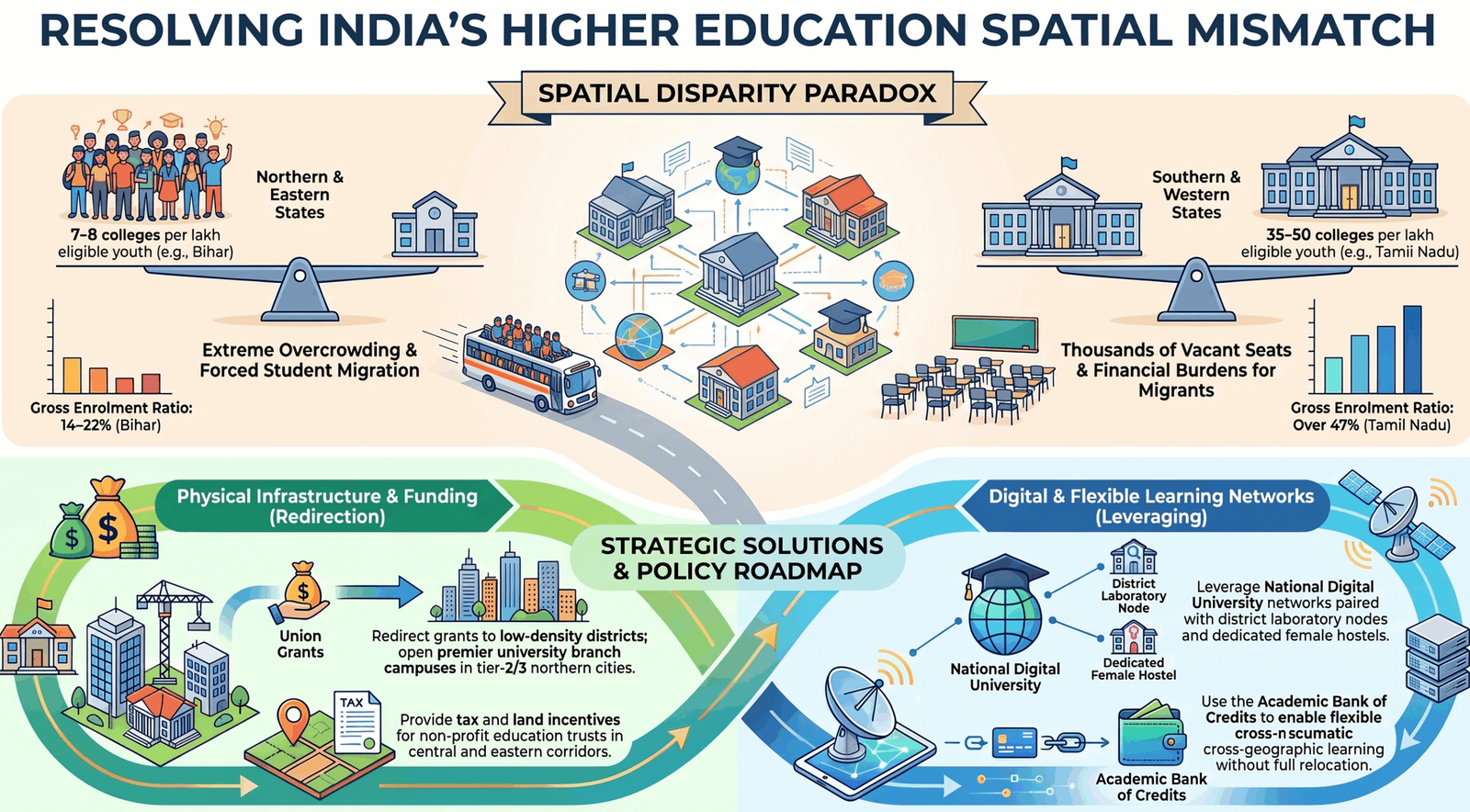
- Southern states consistently record between 35 and 50 colleges per lakh eligible population (18–23 years).
- Conversely, populous states like Bihar (around 7–8) and Uttar Pradesh (around 19) operate well below the national average of ~30.
- Gross Enrolment Ratio (GER) Divide:
- National higher education GER hovers around 28%.
- Tamil Nadu exceeds 47–50%, whereas Bihar, Jharkhand, and parts of Uttar Pradesh lag at 14–22%.
- The Vacancy Paradox:
- Private technical colleges in southern states report thousands of vacant engineering seats annually due to local cohort contraction.
- Northern universities face hyper-competitive cut-offs, exam administrative pressures, and severe classroom overcrowding.
Multi-Dimensional Analysis of the Mismatch
- Demographic & Geographic Factors
-
- Youth growth will stem almost entirely from northern states over the next two decades; institutional assets built over the last 40 years remain fixed in the south.
- Millions of students are forced to migrate away from home states to educational clusters (e.g., Delhi-NCR, Bengaluru, Pune, Kota), putting immense pressure on transit and urban housing.
- Socio-Economic & Gender Implications
-
- Relocation adds living and transit costs that low-income families cannot bear, limiting tertiary access to wealthier urban youth.
- Distance forms a structural barrier for young women due to safety concerns, lack of state-run secure hostels, and lingering social conservatism in rural districts, suppressing female GER.
- Affluent northern students purchase private seats in southern knowledge corridors, while underprivileged students rely on understaffed district colleges.
- Economic & Human Capital Dimensions
-
- Without quality tertiary education and vocational training, high-youth states risk producing uncredentialed or poorly skilled labor, escalating youth underemployment.
- Skilled talent clusters attract capital; industries continue to invest in peninsular India, worsening inter-regional economic inequality.
- Governance & Fiscal Federalism
-
- Education falls under the Concurrent List (7th Schedule). High-burden states have lower per-capita GSDP and weaker tax bases, hindering major capital expenditure on new state universities.
- Private education trusts favor coastal or industrial belts with higher purchasing power, stable power, and corporate links, bypassing central/eastern interiors.
Evaluating the Current Landscape
- Rationales & Strengths of the Existing Setup
-
- Southern education hubs succeeded due to decades of state land support, active industry-academia links (IT, manufacturing, biotechnology), and steady policy continuity.
- North-to-south student migration fosters linguistic exchange, inter-regional mobility, and broad-based national integration.
- Building multi-thousand-seat static campuses in high-cost areas carries risks if demographic peaks pass within 25–30 years without long-term industrial absorption.
- Unintended Consequences & Risks
-
- Educated youth rarely return to their home states, depriving northern public administration, local schools, and regional businesses of skilled talent.
- Commercial education operators often charge high capitation fees for sub-par degrees, shifting student resources away from productive family investments.
Way Forward
- Reallocate Union infrastructure grants under the Pradhan Mantri Uchchatar Shiksha Abhiyan specifically to districts with low college density rather than using uniform per-capita formulas.
- Direct premier central institutions (IITs, IIMs, Central Universities) to open branch faculties in tier-2/3 northern cities (e.g., Gorakhpur, Darbhanga, Gaya, Jabalpur).
- ffer land-concessions and tax incentives for accredited non-profit higher-education trusts willing to construct greenfield universities in eastern and central corridors.
- Establish institutional partnerships allowing state universities in Bihar, MP, and UP to send students to underutilized accredited public colleges in southern states via government-supported living stipends.
- Scaling Hybrid Infrastructure (NEP 2020):
- Leverage the National Digital University (NDU) model: pair top-tier digital instruction via SWAYAM with district-level physical laboratory nodes.
- Utilize the Academic Bank of Credits (ABC) to permit flexible learning across geography without demanding full-time physical relocation.
- Fund secure working-women and female student hostels across urban centers to directly address gender-based educational dropouts.
Conclusion
- The demographic dividend is time-bound. Achieving the National Education Policy 2020target of a 50% Gross Enrolment Ratio by 2035 depends on resolving this spatial divide.
- Equipping high-fertility states with accessible, high-quality tertiary education is both a social justice necessity and an economic prerequisite for India’s long-term human development.
