
This is a rush transcript. Copy may not be in its final form.
AMY GOODMAN: This is Democracy Now!, democracynow.org, The War and Peace Report. I’m Amy Goodman in Los Angeles, with Nermeen Shaikh in New York.
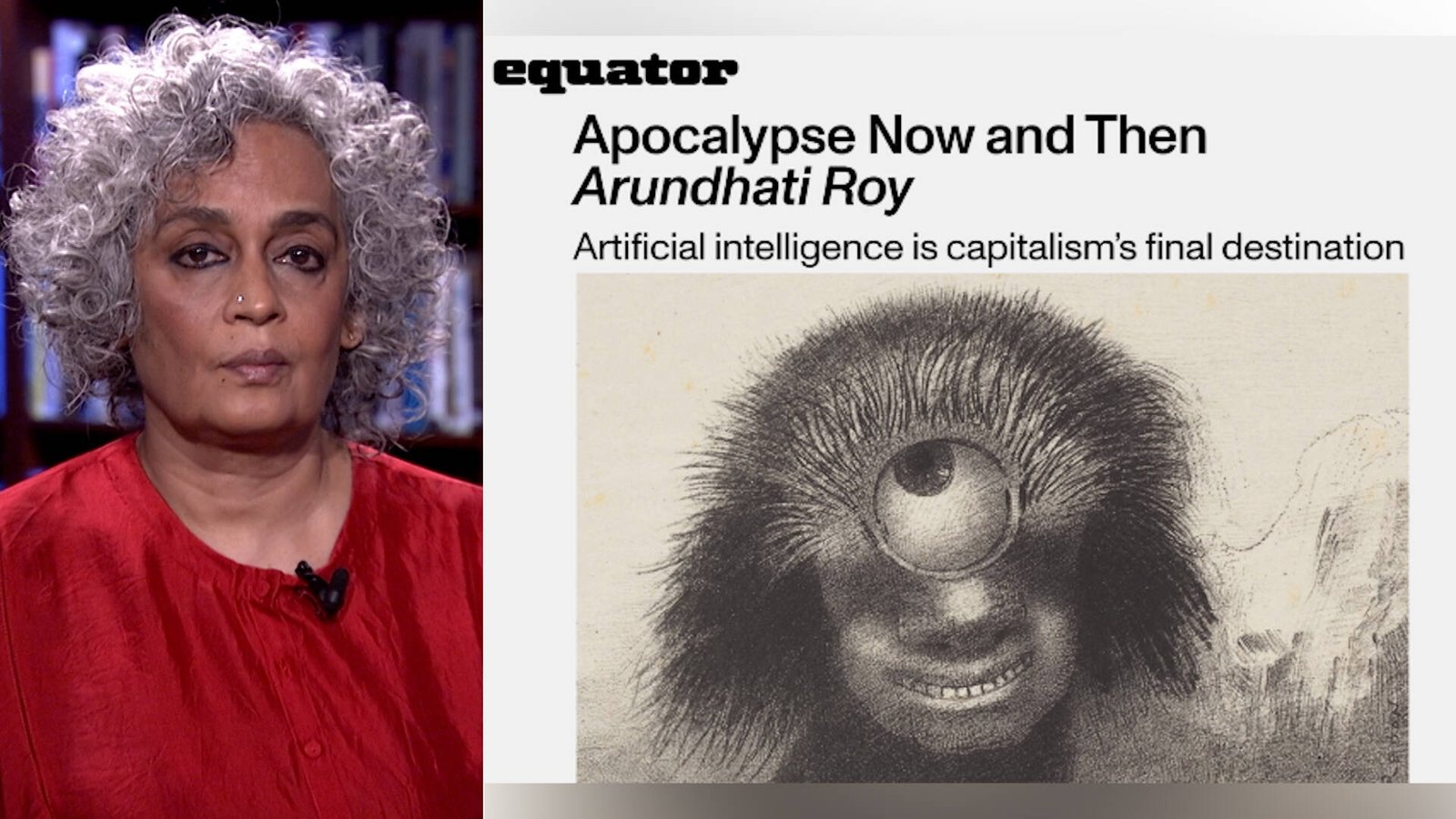
We’re continuing our conversation with the acclaimed writer Arundhati Roy. She spoke in New York earlier this week at the People’s AI Summit, and she has a new essay on AI in Equator magazine. It’s headlined “Apocalypse Now and Then.”
Arundhati, thanks so much for staying with us. Why, in an essay on AI, do you say “Apocalypse Now and Then”?
ARUNDHATI ROY: Well, when I started thinking about writing this piece, I just saw that young whistleblower who came out of Anthropic, Jacob Coxon, you know, warning us that they were building something that sounded like the Manhattan Project on steroids, except that the scientists were all driven by, you know, the idea of profit and “we’ve got to get there first.” And then I was bemused by the fact that all the CEOs came out and discussed it and sort of, more or less, informed us that, you know, our future as a species was in their hands, but they were going to take care.
And then you realize that somehow this had a little to do with, obviously, the fact that AI did contain risks — they say around 10% or something — of eliminating the human race, but it was also something that was being put on the market, our apocalypse. You know, we were — they were going to have an IPO. And, you know, the more lethal they sounded, the more dangerous they sounded, the more irreducible they sounded, you know, it was going to drive up their value. So, initially, it was called “Apocalypse Now: Buy Ours, Get Yours Free.” You know? And then, so, that’s why I call it that.
NERMEEN SHAIKH: But you also ask, right at the beginning of the essay, “Are we being gradually locked out of language?” Explain what you mean by that and why you think that is what may eventually happen.
ARUNDHATI ROY: Well, because, as a writer, I’ve watched what’s happening in the world of literature, in public — in the publishing industry with agents, with students, and AI has just crashed into it like a brick through the windscreen, you know? So, you’re seeing publishers having to look at new writers’ work like detectives inspecting crime scenes. You’ve had scandal after scandal of, you know, prizes being given to works that were then done by AI. Yesterday, I read that there’s a new prize for AI writing.
And you have — and I also said it because you have myself as one of hundreds of thousands of writers whose work was just taken without our permission by Anthropic to train their large language models. And then I get a notice, because of a class-action suit, saying, “Oh, we’ll give you 2,000, you know, dollars per book,” or something. I mean, books that people like myself have spent a lifetime trying to write, a lifetime trying to develop a language that is yours, a lifetime trying to explain your background, your culture, your thoughts, your way of living. I mean, this complete lack of understanding of literature. They’ve done the same, you know, with taking people’s voices, people’s likeness, people’s paintings.
And now what? You press a button and say, “Write a novel like Arundhati Roy,” or “Give me this, you know, in such and such a style.” It’s a kind of — you know, these are supposed to be intelligent people, but you see a kind of absolute, opaque denseness to understanding what human beings are, what human civilization is. It’s like corporatizing and privatizing the history of human endeavor, the history of literature, the history of civilization. I mean, it’s the same thing. I know even mathematicians are feeling the same as writers are. You know, what do you think of? Everything’s just a product to be sold on the market, owned by you? I mean, Sam Altman said intelligence — “We see intelligence as a commodity to be sold by the meter”? You know, whose intelligence? Not yours, certainly. Ours, our collective intelligence, stolen from the human race and corporatized by these handful of white men, you know?
NERMEEN SHAIKH: And how do you think? Because you also write that “disrupting and vitiating the fundamental relationship between humans and language will undermine all semblance of social coherence.”
ARUNDHATI ROY: So, I actually, in the next paragraph, quote The Gospel According to St. John. I said it’s not because of my faith, but more as a writer’s ego, where he says, you know, “In the beginning was the Word, and the Word was with God, and the Word was God.” And if you cannot understand what language — and I’m not just talking about the written word, you know? I’m just talking about language, communication, the telling of stories. All the — all the most beloved religious texts, whether it’s the Bible or the Qur’an, everything has to do with stories that have been told.
And now you’re taking that, you’re skinning it, you’re stuffing it, and you’re selling it, a dead thing, to people who can now no longer — you can no longer trust that I have written this or I am saying this. You know, I have to watch videos of myself that are not me, saying the things I’ve never said. You know, you have to sort of end up being in a space with — all the paths are moving, nothing can be trusted.
And we at least are people who belong to a generation that knew otherwise. But what is going to happen to the younger generation? Are they never going to experience what it is to strive, to fail, to create something flawed, or the ecstasy of creating a piece of art? You know, I see us already moving towards a tidal wave of mass psychosis. Like, you’re looking in the mirror, and it’s someone who looks like yourself looking back, but it’s not you. You’re looking — you’re looking at me, and you don’t know whether it’s me or not. I don’t know whether it’s you or not.
So, apart from the corporate stuff, the climate impact, the pollution from data centers, the AI bubble that’s about to burst and smash the economy in so many ways, I see, fundamentally, something really, really — it’s not just about the destruction of the human race. It’s about the destruction of humanness.
AMY GOODMAN: And, you know, Arundhati, the subtitle of “Apocalypse Now and Then” is “Artificial intelligence is capitalism’s final destination.” If you can explain that? And also, as people talk about what it can mean, it is, yes, a tool, but isn’t the real issue here is who controls that? And if you can talk about the billionaire tech bros, the trillionaire tech bros, the people who surrounded President Trump, stood behind him, in his second inauguration? It’s not so much about whatever the technology is, right? It’s about who controls it.
ARUNDHATI ROY: Well, I think it’s about both. I mean that what that technology is is extremely important. But the reason I said it’s capitalism’s final destination is, you know, as a writer, apart from being a literary writer or a novelist, I am someone who, for years and years, has followed the process of the corporatization and neoliberalism, mining, dams. It’s all the same thing, you know, the story of big dams and how you basically steal a river, centralize the water, and then decide who can get it and who can’t get it. But you’re mining water, you’re mining minerals, you’re mining — you know, you’re destroying mountains to pull out the uranium, not understanding what that uranium does in an ecosystem when it’s still in the mountain. But now you’ve moved to literally mining the mind and the organs of human beings, you know?
So, it’s — and, of course, colonization has always come bearing shiny gifts, so you have these consumer apps, as they are called. So, in the essay, I say it’s a bit like, you know, during the tsunami when the sea drew back and people saw these miles and miles of shining, glistening beach full of beautiful shells and castles and secrets, and those are the consumer apps. You know, I can be your therapist. I can be your mother. I can be your lover. I can write you a novel in a minute. I can get it translated. I’m just a miraculous doctor to you. Whereas far away, a huge tidal wave is building up of stupidity that’s going to just take us over. And that tidal wave is controlled by men who are openly talking about wanting to overthrow the government, wanting to overthrow the finance system. One of them, who I quote, says, “Everyone on the internet needs to be policed and stack-ranked.” You know? We are going to have massive unemployment. In India, you have already millions of people having to work with cameras on their foreheads so that they can record their movements to train a robot that’s going to replace them. And they can’t not do it, because there are millions waiting to take their place. So, we are being invited to delete ourselves in some way. And we are moving further and further into that ocean as the tidal wave builds.
And yes, of course, there are these five or six people who are controlling the buttons, who’ve already disaffiliated themselves from the human race. They’ve already made themselves, you know, homes in far-flung areas, stacked with food and water and ammunition. They’re already talking about data centers in space.
So, it’s, I say — that’s what I said in the beginning of the essay. AI is actual idiocy. You know, it’s like: Why are we — why are we thinking it’s some wonderful thing that’s going to be of great benefit to the human race? It’s not. It’s going to suck the beating heart and the spirit and the soul out of us.
NERMEEN SHAIKH: So, let me ask you, Arundhati, because, obviously, as you say yourself, I mean, one doesn’t necessarily have to say that it’s all at this point inevitable, but I think it’s fairly certain that it’s not irreversible. In other words, I don’t see how this will go back, recede, much less disappear. So, the question is, as you ask in the piece: “How are we supposed to react? By calling for regulations? How do you discipline an industry that makes Francis Ford Coppola’s Apocalypse Now – racist tropes included – look like a current affairs documentary?” So, what is called for now?
ARUNDHATI ROY: So, I think, you know, we are looking — I don’t agree that it’s, you know, irreversible and inevitable — not reversible or inevitable, because what you’re seeing now is a crisis for them, which is that the amount of land, the amount of money, the amount of data, the amount of energy, the amount of water that they need to feed the data centers and set them up and feed their supercomputers means that they are not viable, you know, which is why they are trying to fuse themselves into the government, so that you’re not — you’re not just another company. You’re something that is essential to national security. “We’re going to make you weapons. We’re going to make you, you know, lab-grown viruses. We’re going to save you from wherever.” And it’s — when that bubble bursts, the problem is that that money has been circulated into so many spaces that when it crashes, it’s going to cause a crisis. And so, what they are trying to maneuver themselves into is a space where they are too big to fail. But they are going to fail. And how are we going to deal with the fallout is really the question.
NERMEEN SHAIKH: So, you feel it’s likely that all of them will fail. It’s not like the dotcom moment where the vast majority failed, but then things like Google —
ARUNDHATI ROY: Well, I don’t — I mean, I don’t know whether all of them will fail or how it’ll actually pan out, but I just know that this picture that is being painted for us of this kind of miraculous revolution of progress is just absolute nonsense.
NERMEEN SHAIKH: Well, you talked about — and this is something that comes up in every conversation about data centers, is the climate impacts — how much water, how much power, electricity, etc., is needed. If you could — we’ve talked about data centers in some parts of the world, but I don’t believe yet about India. If you could talk about where they’re being built and what local communities are experiencing?
ARUNDHATI ROY: They are being built in Visakhapatnam, and the clearance is being given to them as if they are just buildings, you know, without really talking about exactly what’s going to happen around them and what’s going to happen with the groundwater. And there is a big resistance taking place. But the problem is, you know, Nermeen, that you can go and set it up in Ladakh, where there are no people. Then, where is there going to be a resistance? But the glaciers, the world’s water tower, is going to melt, you know?
But so, you are — and as I said — I was saying at the AI people’s meeting that people here are fighting data centers. So, what’s going to happen? They’re going to say, “OK, let’s just move them to a place like India or a place which is ready to accept the toxic waste,” as always been traditionally, you know? So, but it’s — what I was saying is that we are all on the frontline. It’s not just the communities around the data center. We are all on the frontline, or we are firewood. You know? So, we’ve got to understand what’s going on. Often what happens is that we understand too late. You know?
NERMEEN SHAIKH: So, what do you think, ultimately, those of us on the frontlines — which is everyone — what should people be doing?
ARUNDHATI ROY: We should be spreading the awareness, and we should be pretty brave about saying no, you know, saying that we — you know, this thing about, “Oh, it’s too late. They’re too big. They’re already here,” I think we need to just understand that it is really a tidal wave of stupidity that’s about to inundate us. Anyway, I write what I write, and I’ll go down having said what I have to say, you know. It’s not that I’m at — you know, but there has to be somewhere where you put down the peg and say this is what it really is. Now, if we are helpless or not helpless, that’s up to us to decide. But let’s just say it, you know? Let’s just say it really loudly.
NERMEEN SHAIKH: So, Arundhati, we’d like you to read. We’d like to end by asking you to read a little bit from your essay, “Apocalypse Now and Then.”
ARUNDHATI ROY: OK. So, I’m going to just read the end of it.
“While there is so much debate about what AI can and cannot do for humans, there is too little talk about what it’s doing to humans. Studies have warned of a relationship between AI and cognitive decline in human beings. Human intelligence looks set to plunge in proportion with the rise of artificial intelligence. Perhaps our unused brains will atrophy, our heads will shrink and our fingers will turn into undulating prompt tentacles.
“Those of us who have already lived our lives in a different kind of world know what we are losing. But what of the generation that is about to come of age? Will it have its own language, its own thoughts, its own grief? Will it have the right to strive? To fall? To fail? To be imperfect? Will it experience the impossible pain and ecstatic pleasure of solving a math equation or creating art or literature or music of its own — however flawed?
“The triumph of AI will be a crime against humanness. It will bottle our brains in formaldehyde. It will destroy the world as we know it. The men who promote it and profit from it are cognisant of this, and have already made arrangements to exit into another realm.
“The oligarchs are announcing the battle lines proudly, loudly: that it is us against them. They suggest, without flinching, that for AI to thrive, humanity may have to die. The young generation that is rising up to fight it understands this. I know that, earlier in this essay, I suggested we should ‘regulate with extreme prejudice’. But what I really want to say about those AI companies is this: terminate with extreme prejudice.”
NERMEEN SHAIKH: Thank you, Arundhati Roy, for reading from your new essay, “Apocalypse Now and Then.” We’ll link to the essay at democracynow.org. Arundhati Roy’s critically acclaimed memoir, Mother Mary Comes to Me, is now out in paperback. To watch the full interview, visit democracynow.org. I’m Nermeen Shaikh, with Amy Goodman.