
Why a country producing research across a wide range of technologies is unable to create a startup ecosystem.
Professor Abhay Karandikar, former secretary of the department of science and technology and NITI Aayog member, said at a recent conclave that India has more than 1,500 higher education institutions that submit research data, but only a small fraction of them account for most of the published work. Similarly, he said, India competes on global critical technology rankings, but only a small slice of its two lakh-plus startups actually work on frontier technologies.
In short, he was saying that India has research capability, but that capability is concentrated in a tiny number of institutions. But what would India’s research output look like if this scenario changed, even somewhat? First, a look at the present situation.
What the concentration actually looks like
The Indian government’s National Institutional Ranking Framework (NIRF) finds in its 2025 report that 20 Indian higher education institutions were the most productive – they released over 1.57 lakh publications over 2021-23. The average annual research productivity of institutions in this top rank was 7,888.
However, the remaining 1,737 institutions also brought out 4.53 lakh publications, but at significantly lower average output. A group of 136 institutions showed no publication at all over this period.
This is not just about having a few good institutions while everyone else lags behind. The top 20 most productive institutions and the 1,420 least productive institutions (which still had some output) produced almost the same number of papers – 1.57 lakh against 1.46 lakh. In other words, just 20 could match the combined output of seventy times as many.
How India compares globally
The Australian Strategic Policy Institute’s Critical Technology Tracker measures countries that produce the most highly cited 10% of research across a wide set of technologies considered strategically important, from artificial intelligence and quantum computing to biotechnology and advanced materials. Its most recent update, published in December 2025 and covering 74 technologies using 2020–24 data, gives a country-by-country picture.
The first takeaway from the above table is encouraging. India places among the global top five in 50 of 74 tracked technologies, a jump from 43 the year before. It has overtaken the United States as the second-ranked country in five of these technologies. That puts India ahead of the United Kingdom, Germany, South Korea and every other country on the list except China and the US, in terms of breadth of presence in high-impact research.
At the same time, the rankings show that China’s 66 leads plus the United States’s 8 add up to exactly 74. In other words, they hold the first place all these 74 tracked technologies. India does not lead in any particular field.
A separate ASPI finding in 2024 showed that only two Indian institutions, IIT Bombay and IIT Roorkee, placed within the global top 20 across the tracker’s 64 technological fields. The report flagged this as evidence that India’s research capability was thinly spread across institutions rather than concentrated in a small number of standout performers capable of competing for the top spot.
Taken together, the two datasets, the NIRF rankings and the ASPI Critical Technology Tracker, show that India’s national-level breadth in frontier research doesn’t yet translate into a wide base of productive institutions at home (the NIRF data) or a small set of globally dominant ones abroad (the ASPI institutional data).
What happens if more institutions become productive?
The NIRF numbers make it possible to probe Karandikar’s question further. If a larger share of India’s 1,757 ranked institutions reached the average output of its top 20, this author found, the national total would move as follows. These are the results, based on NIRF and ASPI data:
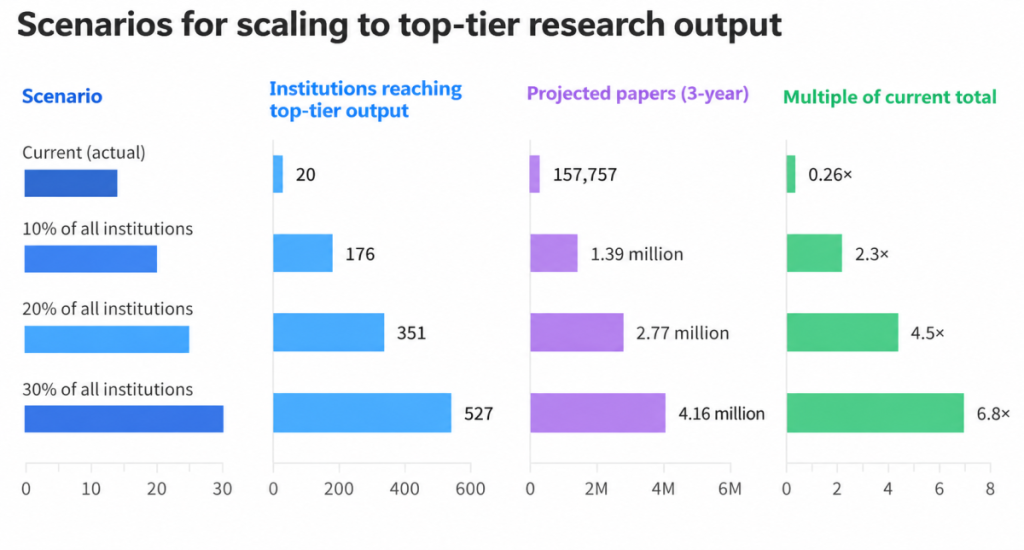
If even 10% – fewer than 180 institutions out of 1,757 – can reach the bar these 20 set, India’s research output would more than double. At 30%, the number climbs to nearly seven times the present total.
Paper count alone does not measure scientific value, and a university publishing thousands of papers a year is not automatically doing better science than one publishing a few hundred carefully chosen ones. However, the arithmetic shows how much of the country’s institutional capacity currently sits idle, with 1,420 of them producing only 103 papers a year on average.
The research-to-startup gap
India’s registered startup base recently crossed two lakh, and by Karandikar’s account, only around 8,000 of them work in cutting-edge deep-tech territory, the kind of work that would draw directly on the frontier research the ASPI tracker measures.
Published estimates of India’s deep-tech startup count have varied over the past several years, landing anywhere between 3,000 and 8,000, depending on the definitions used.
It shows that a country producing research across half of the technologies that matter globally is not converting that research into a startup ecosystem.
That is the translation gap: If research capacity is spread across a genuinely wide base of institutions, more of the country’s regions, disciplines and problems get a shot at producing something a founder, a company or a government lab can pick up and work on. If it stays locked inside 20 institutions, the number of possible bridges between a lab and a market shrinks.
What the numbers add up to
Twenty institutions producing at the rate of the world’s serious research systems is proof, at least, that Indian faculty, students and labs can compete if they are provided with labs, manpower and funding. That India ranked second to only China and the United States in the breadth of its high-impact research is also proof of capability.
The question is whether more higher education institutions will get access to the same conditions that built the top 20. Even more effort will then be required to equip the already capable institutions to lead a technology and take it to market. If both these happen, the arithmetic suggests more than incremental gains are possible.
Bupinder Singh Bali is a writer and educator based in Kashmir and a PhD scholar at Ashoka University.
This article went live on September seventeenth, two thousand twenty six, at ten minutes past nine at night.
The Wire is now on WhatsApp. Follow our channel for sharp analysis and opinions on the latest developments.