
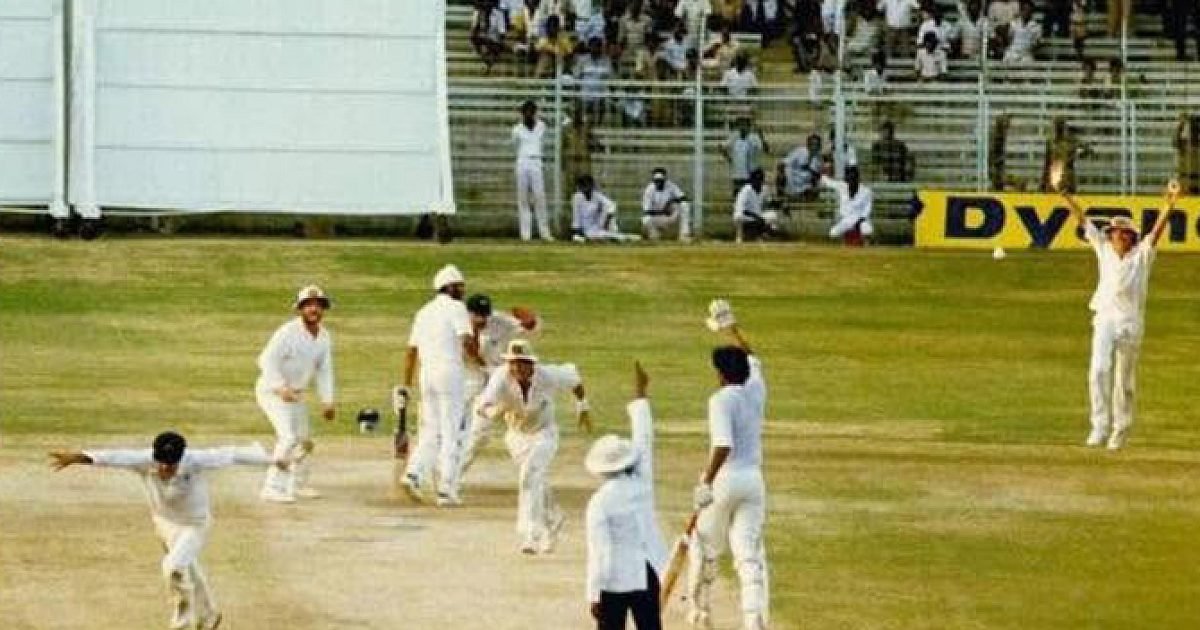
The only previous tie had occurred at Brisbane back in December 1960 between Australia and the West Indies.
In the 40 years since the Madras Test there have been a further 1,583 Test matches. But there has never again been a tie.

IMAGE: Maninder Singh was the last man to be given out controversially by lmpire V Vikram Raju with the scores exactly level at the Test at Chennai (then Madras) between India and Australia during the 1986-1987 series. Photograph: Facebook
Key Points
- When the mandatory 20 overs count began, India remarkably found themselves strongly placed to win with 118 runs needed and only three wickets down.
- But then wickets began to tumble in a heap and when Greg Matthews began the last over of the match, the final pair of Ravi Shastri and Maninder Singh were at the crease.
- Maninder had three balls to face with one r̥un to win. He somehow kept out the fourth ball and then came the shock decision that ended the match with the scores tied.
“Even after 150 years there have only been two Tied Tests so even after I die I will be remembered for my part in the second one and my place in cricket history,” says Maninder Singh with a chuckle when I remind him about the anniversary of the famous Test at Madras (now Chennai) which began forty years ago today (September 18, 1986).
Maninder, who had made his Test debut four years earlier in Pakistan as a promising 17-year-old left-arm spinner, was the last man to be given out controversially by Umpire V Vikram Raju with the scores between India and Australia exactly level.
Raju died in June aged 92; the other umpire standing at square leg at the time, Dara Dotiwala, died in 2019.
Though there was the immediate shock of being out lbw to off-spinner Greg Matthews off the penultimate ball of the match, Maninder says it did not take him long to get over it.
“Besides, there is no point in mulling over something that happened so long back as one has to move on”, he adds.
The dispute centred round Maninder’s — and non-striker Ravi Shastri’s — strong conviction that he got an edge to the delivery so should not have been given out.
Umpire Raju on the other hand maintained till his last days his decision, which created a slice of cricket history at the M A Chidambaram stadium in Chepauk, was the correct one.
With hi-tech aids like Super-Slo Mo, Ultra Edge and Hot Spot which all aided DRS (Decision Review System) nearly twenty years away, there was no recourse for the shocked batsman and the decision was final.
“Absolutely, I did nick the ball, it was an inside edge onto the pads,” insists Maninder.
Being an umpire himself in his post-playing days Maninder was sympathetic to Raju. “It’s not easy to get hold of those little nicks with all that background noise of the crowds.”
It was Maninder’s misfortune that just a year later he was again last man out with India just one run short of the winning total against the same country and at the same venue in India’s opening match of the 1987 Reliance World Cup.
There was no controversy this time though as Steve Waugh sent his stumps cart-wheeling. Australia would go on to win the World Cup for the first time.
Maninder’s Spell Changed Australia’s Strategy
Unknown to many, Maninder also played a pivotal though inadvertent role in the match ending as it did.
It was the turn he got on the fourth day as he picked up three of the five Australian second innings wickets — including that of Captain Alan Border — that convinced Border his spinners Matthews and left-armer Ray Bright would get enough assistance on the final day Chepauk pitch to force a favourable verdict.
So on the final morning as we made our way to the press box we were as surprised as everyone in the stadium and the Indian dressing room that Border had decided to declare on the overnight total of 170 for five.
With a first innings lead of 177 runs that meant the Indians now were set the improbable target of 348 for victory in a maximum of 90 overs including the mandatory final 20 overs.
Improbable because scoring at close to four runs an over on a final day turning pitch would have been a tough task, if not exactly Mission Impossible for a side that had made chasing big fourth innings scores a habit since 1976.

IMAGE: Dean Jones. Photograph: Kind courtesy ICC/Facebook
Australia’s huge first innings total of 574 for 7 declared was largely due to Dean Jones’ 210 and opener David Boon’s 122.
Jones’ inclusion at number three was a late night decision by Border. What transpired over the next 502 minutes was one of the most heroic performances seen on a cricket field.
Jones battled the unbearable heat and humidity inside the concrete bowl of the stadium where even the cooling sea breeze from the nearby Marina had been blocked by the stands.
Even the spectators in the stands and us journalists in the open press box were gasping for air as the humidity hung around the arena like a wall.
Jones lost control of his bodily functions and almost his mind but played on through sheer will power and determination till he was out late on the second day — and was immediately rushed to hospital and put on drip.
Tragically he died in 2020 aged 59. A few years earlier I met him in New Delhi and told him I had watched every ball of that Test.
He grimaced and said, “Well, that’s more than me.” In fact he missed the whole of the third day under doctor’s orders when India batted in the first innings.

IMAGE: The late Umpire V Vikram Raju, left, with Gulu Ezekiel. Photograph: Kind courtesy Gulu Ezekiel
Maninder’s Controversial Final Wicket
When the mandatory 20 overs count began, India remarkably found themselves strongly placed to win with 118 runs needed and only three wickets down.
But then wickets began to tumble in a heap and when Matthews began the last over of the match, the final pair of Shastri and Maninder were at the crease.
Shastri had held the bottom half of the innings together with an expertly paced knock. He ran two runs from the second ball and then took the calculated and fateful decision to take a single off the next to level the scores, thus ensuring India could not lose.
However, this meant Maninder now had three balls to face with one r̥un to win. He somehow kept out the fourth ball and then came the shock decision that ended the match with the scores tied.
This was Test number 1,052. The only previous tie had occurred at Brisbane back in December 1960 between Australia and West Indies — Test number 498.
In the 40 years since the Madras Test there have been a further 1,583 Test matches. But there has never again been a tie.
Gulu Ezekiel is a senior sports journalist and author based in New Delhi.
Gulu’s 20th sports book First Tour: The Indian Cricket Team’s Historic Maiden Test Visits: From England 1932 To Bangladesh 2000 (Sachin Bajaj/Global Cricket School, Mumbai) was released recently.
Feature Presentation: Aslam Hunani/Rediff