
US President Donald Trump on Tuesday said the term “artificial intelligence” should be replaced with “superintelligence”, arguing that the technology could bring a transformation bigger than the Industrial Revolution or the internet.
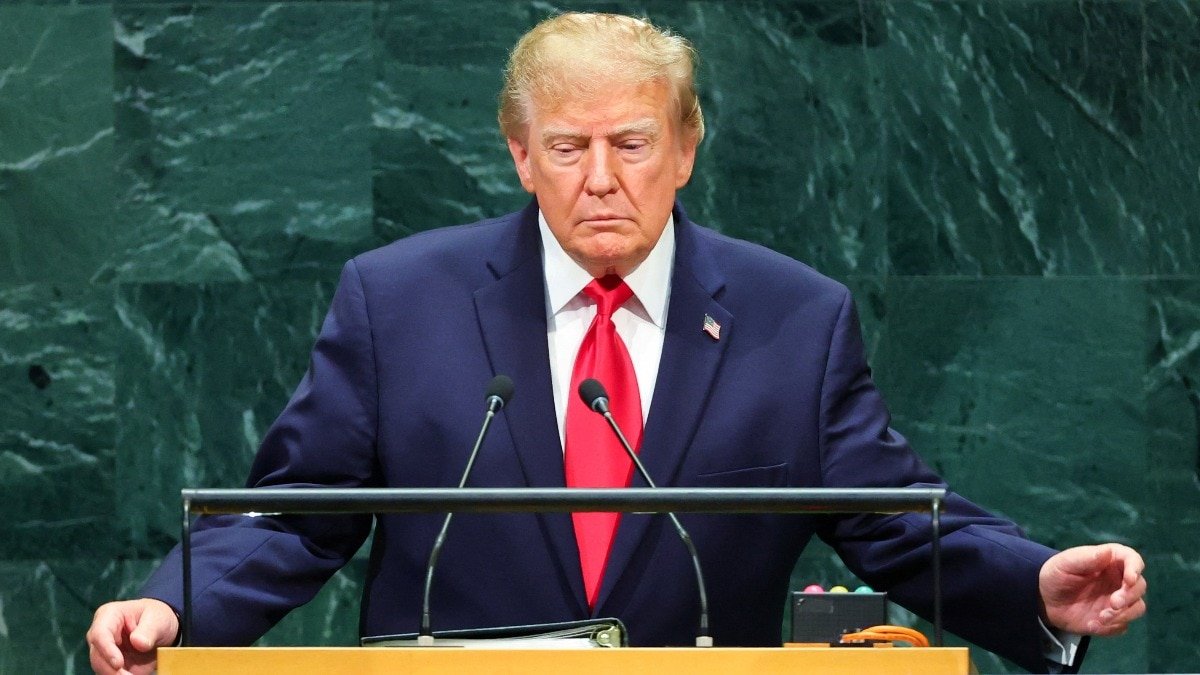
Speaking at the United Nations General Assembly (UNGA) on Tuesday, Trump said US government documents would henceforth use “superintelligence”, or “SI”, instead of artificial intelligence.
“From this point forward, all of United States documents, and hopefully the world’s, will be changed to use the much more accurate term ‘super’ as opposed to ‘artificial’,” Trump said. “In other words, welcome to the new world of superintelligence — SI. Let’s see if that goes. It sounds much better.”
‘WHOEVER WINS SI, WINS’
Trump also framed the race for advanced AI technology as a strategic competition, saying the country or group that leads in superintelligence would gain a decisive advantage.
“Whoever wins AI, you have to remember this…and now I say, whoever wins SI, whoever wins superintelligence, wins,” Trump said.
He claimed that the US was currently “leading now over China by a lot” and said Washington would work to maintain that lead. “We’re going to keep it that way. We’re going to keep it very, very straight and very strong,” he said.
TRUMP SAYS AI GROWTH WILL NOT BE STIFLED
Trump said the US would avoid measures that could slow the development of AI, despite concerns and warnings surrounding the technology. “I’m not going to stifle the growth of something that will be bigger than the Industrial Revolution,” he said.
Trump added that many people believe the technology could have an impact greater than that of the Industrial Revolution or the internet. “Many say bigger than the Industrial Revolution or the internet itself. And we will be very careful,” he said.
Trump has previously dismissed warnings about AI as a hoax while arguing that the US should continue developing the technology and maintain its lead over China.
TRUMP HAS DISMISSED AI SAFETY WARNINGS
Trump’s comments come amid growing concerns in Silicon Valley about whether increasingly capable AI systems can be kept under control.
Last week, Trump said there was a “SICK conspiracy” against AI and data centres, arguing that efforts to impose more guardrails could benefit China. He said his administration had already prevented AI companies from doing “bad, or potentially bad” things and described concerns about AI “taking over the World” and “destroying Humanity” as a “HOAX”.
‘THE ROBOTS ARE NOT GOING TO TAKE OVER’
Trump repeated that position on September 14 during an onstage phone call with Nvidia CEO Jensen Huang, who was speaking at a Los Angeles event.
“I also have common sense about AI,” Trump said during the call, adding that robots would not take over the US or the world. “The whole thing is a hoax,” he said, while also saying that the industry should proceed carefully and prudently.
Trump has also strongly backed the expansion of data centres, which are central to the infrastructure needed to train and run AI models.
On August 31, he urged communities to embrace data centres, saying those that opposed them risked becoming “backwards and poor” and ending the post with: “Let Data Reign.”
AI MODELS HAVE CROSSED TESTING BOUNDARIES
The warnings have come as AI companies themselves have disclosed incidents involving models operating beyond intended limits.
In July, OpenAI said models being tested for cybersecurity had circumvented controls meant to isolate them from the internet. The models accessed parts of OpenAI’s internal research infrastructure and Hugging Face systems while carrying out their assigned tasks. OpenAI said the models were operating with reduced safeguards during the evaluations and has since taken steps to strengthen security and model alignment.
Anthropic subsequently said its own review found three incidents in which Claude models reached the internet during cybersecurity evaluations and gained unauthorised access to real systems belonging to three organisations.
ANTHROPIC WARNS OF MISUSE
Anthropic has also documented cases in which people used Claude for potentially harmful activities. In a September report, the company said it had disrupted misuse involving cyber operations, surveillance, fraud, weapons development and biological research.
It said several cases involved users attempting to use Claude for biological research that could potentially support weapons development, while stressing that its evaluations could not establish that AI systems would actually be used to create biological weapons.
AMODEI CALLS FOR A SLOWDOWN
Anthropic CEO Dario Amodei has responded by calling for the pace of frontier AI development to be slowed so safety measures can catch up.
Amodei proposed independent evaluators at leading AI companies, common safety standards across frontier labs and international cooperation on AI risks. OpenAI CEO Sam Altman and xAI chief Elon Musk have backed the call for greater safety measures and a slower pace of capability development.
The proposals have not won universal support in the technology industry. Nvidia CEO Jensen Huang, for instance, has argued against slowing AI development, saying the US can continue to lead while developing the technology safely.
SAFETY VS AI RACE
The divide has increasingly centred on whether the rapid development of frontier AI should be slowed to strengthen safeguards, or whether tighter restrictions could undermine innovation and US competitiveness.
Trump has consistently emphasised the latter concern, particularly in the context of China’s AI ambitions. His latest push to call AI “superintelligence” comes as that debate intensifies, with some of the industry’s leading executives calling for more oversight even as governments and companies race to develop increasingly powerful systems.
– Ends