
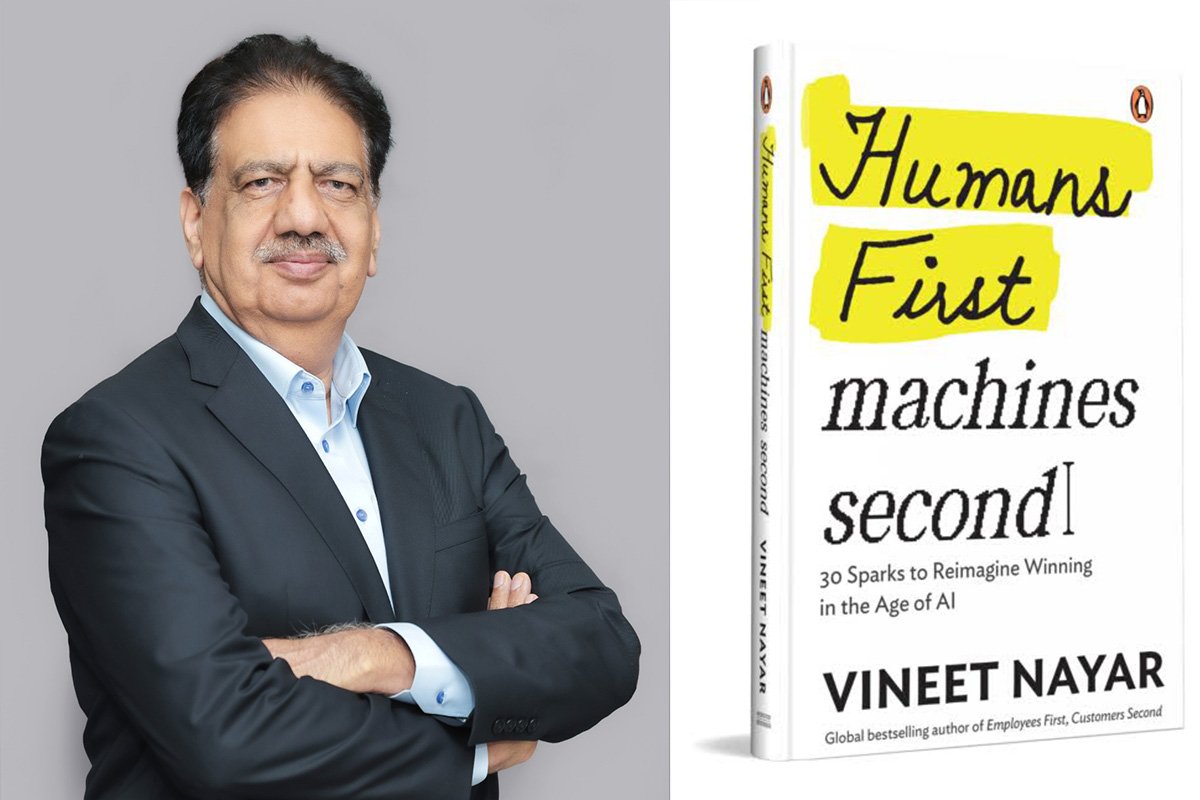
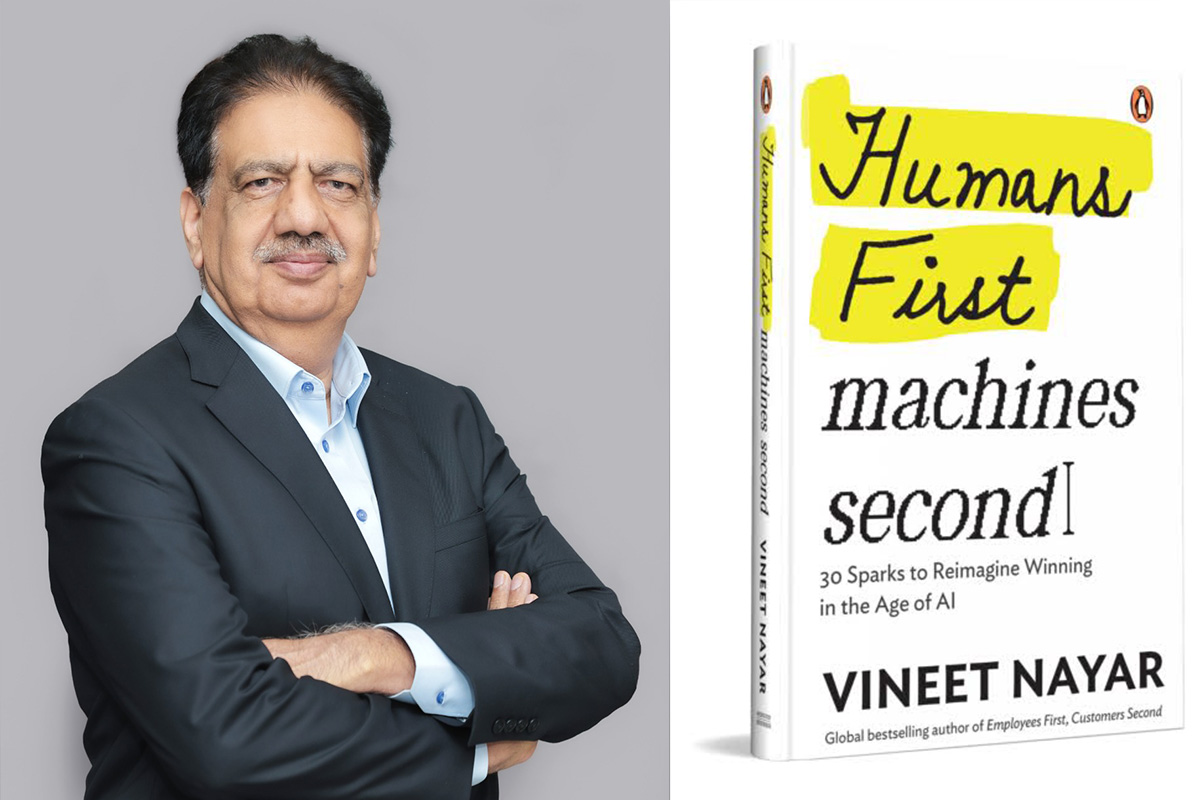
The most valuable idea in the book may therefore be contained in its title. ‘Humans First, Machines Second’ is not an argument against machines. It is an argument against reversing the order.
Published Sep 22, 2026 | 8:00 AM ⚊ Updated Sep 22, 2026 | 8:00 AM


Make Us Your Preferred Source on Google
Synopsis: Machines can process enormous quantities of information, identify patterns and perform repetitive tasks at extraordinary speed. Human beings, however, operate in spaces where information is incomplete and circumstances cannot always be reduced to measurable variables. They bring intuition, empathy, imagination, moral judgment and the capacity to question the assumptions underlying a decision.
The way corporations talk about artificial intelligence (AI) is revealing. The language almost always focuses on acceleration, disruption, optimisation, and scale. AI is expected to make decisions faster, reduce costs, transform workplaces and create new forms of competitive advantage. The question of what happens to the human being inside this accelerated workplace often arrives much later, if it arrives at all.
Vineet Nayar’s Humans First, Machines Second: 30 Sparks to Reimagine Winning in the Age of AI begins at precisely this point of unease. Its argument is not that machines are about to take over the world, nor that businesses should resist artificial intelligence. Nayar is interested in a more intimate and consequential question: what happens when human beings begin to distrust their own judgment because machines appear to know more, process faster and predict better?
That shift in confidence, he suggests, may prove more consequential than automation itself.
Nayar brings considerable experience in corporate transformation to this conversation. As former CEO of HCL Technologies, he became associated with a management approach that challenged conventional hierarchies, most famously through Employees First, Customers Second. His new book extends those ideas to an age in which the relationship between employee, organisation and technology is being radically altered.
Also Read: Will AI rule or serve India? What economic models actually say
Beyond the fear of replacement
The most useful aspect of Humans First, Machines Second is its refusal to join either of the two familiar camps in the AI debate. One predicts mass human obsolescence; the other imagines artificial intelligence as an almost magical solution to every organisational problem. Nayar is sceptical of both.
For him, the more important question is not whether machines are becoming increasingly capable. They plainly are. The question is whether organisations understand what human beings can still do uniquely.
The distinction matters. Machines can process enormous quantities of information, identify patterns and perform repetitive tasks at extraordinary speed. Human beings, however, operate in spaces where information is incomplete and circumstances cannot always be reduced to measurable variables. They bring intuition, empathy, imagination, moral judgment and the capacity to question the assumptions underlying a decision.
Nayar’s concern is that organisations may confuse efficiency with intelligence. An algorithm can make an existing process faster without making the process wiser. A poorly designed organisation equipped with sophisticated technology can become a more efficient version of itself.
This is where the book’s human-centred argument acquires its force. AI does not automatically transform organisational culture. It often magnifies what is already there.
Also Read: Ancient India’s vision of Artificial Intelligence
Thirty sparks, four directions
The book is organised around 30 concise “Sparks”, arranged under four broad ideas: Trust, Empower, Reimagine and Amplify. The structure gives the book the quality of a handbook without reducing it entirely to management formulas.
Trust matters because AI creates a peculiar organisational dilemma. Employees are expected to use machines, yet they must also know when not to trust them. An AI-generated answer can appear authoritative even when it is incomplete, biased or simply wrong. The ability to interrogate the machine therefore becomes as important as the ability to use it.
That requires a culture in which employees can question both managerial decisions and technological outputs. Empowerment, in Nayar’s formulation, cannot mean simply giving people access to another digital tool. It means giving them the authority and confidence to exercise judgment.
This is a significant distinction. The workplace of the AI era will not necessarily need less human judgment. In many situations, it may need better judgment.
Also Read: What the Pope’s AI Encyclical means for India
Technology cannot repair a broken culture
One of Nayar’s recurring insights is that technology cannot compensate for organisational dysfunction. If an organisation is governed by fear, hierarchy and bureaucratic inertia, introducing AI does not necessarily make it innovative. It may simply automate existing dysfunction.
The observation is simple, but its implications are substantial.
Corporate India has witnessed successive waves of technological enthusiasm, from enterprise software and digitisation to cloud computing and now generative AI. Each wave has produced predictions of transformation. Yet technology is rarely the sole determinant of whether an institution changes. Questions of leadership, trust and organisational culture remain stubbornly human.
Nayar’s experiences at HCLTech and Comnet provide the practical foundation for this argument. His emphasis is less on technological sophistication than on the conditions that allow people to use technology intelligently.
The result is a book that is more interested in organisational behaviour than in explaining the machinery of AI itself.
Also Read: The power of serendipity in learning
From the boardroom to classroom
The book becomes particularly interesting when Nayar moves beyond corporate examples. His association with the Sampark Foundation offers another dimension to his argument about technology.
The Foundation’s work with primary education and teachers in rural India illustrates a different model of technological intervention. Here, technology is not imagined as a replacement for the teacher. It is positioned as an instrument that can strengthen the teacher’s capacity.
This distinction between substitution and augmentation runs through the book. It also provides one of its most persuasive practical lessons. The question should not always be, “What human task can AI eliminate?” It can equally be, “What can a human being accomplish with AI that was previously difficult or impossible?”
The second question produces a very different vision of the future.
Also Read | What AI can’t teach: The power of serendipity in learning
Practical book with deliberate limits
Nayar writes as a practitioner. His prose is direct, accessible, and designed for readers more interested in application than theoretical argument. The 30 Sparks make the book particularly suitable for managers, entrepreneurs and young professionals trying to understand how rapidly changing workplaces might affect them.
The format, however, is also the book’s limitation.
Because the Sparks repeatedly return to ideas of trust, empowerment, curiosity and human agency, some arguments begin to feel familiar before the book reaches its conclusion. Readers looking for a sustained engagement with the technical dimensions of artificial intelligence, the political economy of automation, labour displacement or the regulation of generative AI will find relatively little here.
Nayar also does not attempt to resolve some of the harder contradictions surrounding AI in the workplace. Human-centred technology sounds persuasive, but implementing it inside organisations driven by quarterly performance, cost reduction and shareholder expectations is considerably more difficult. The book points towards this tension without always dwelling on its structural dimensions.
That does not necessarily weaken its central proposition. It clarifies what kind of book this is. Humans First, Machines Second is not a technical manual for understanding AI. It is a management argument about how human beings should understand themselves while living and working alongside increasingly capable machines.
Also Read: As AI grows more powerful, can governance keep up?
The human question
The most valuable idea in the book may therefore be in its title. Humans First, Machines Second is not an argument against machines. It argues against reversing the order.
AI will certainly shape the future workplace. Some jobs will disappear, others will change, and entirely new forms of work will emerge. But technological capability alone cannot determine what those workplaces should become. That remains an organisational and ultimately human choice.
Nayar asks leaders to reconsider what they measure, what they reward and how much authority they leave with the people closest to a problem. He also asks employees to resist the temptation to treat machine-generated answers as substitutes for thought.
In that sense, the book is less about artificial intelligence than about human confidence.
The real challenge of the AI age may not be learning to compete with machines. It may be learning where competition is irrelevant. Machines can calculate, classify and accelerate. Human beings still have to decide what is worth doing, why it matters and what should not be done at all.
Nayar’s book is at its strongest when it reminds us of this distinction. In an age increasingly fascinated by what machines can do, Humans First, Machines Second makes a modest but important intervention: technological progress becomes meaningful only when it enlarges human possibility rather than diminishing human agency.
Title: Humans First, Machines Second: 30 Sparks to Reimagine Winning in the Age of AI
Author: Vineet Nayar
Publisher: Penguin Random House India, Penguin Business
Price: ₹799
Also Read:
Casino Capitalism: Inside the financial architecture powering the AI boom
Fresh AI concerns: Did researchers push Claude to the brink of biological misuse?
(Views are personal. Edited by Majnu Babu).