
Scientists have captured, for the first time, the moment of bacteria succumbing to preservative attack. Using advanced imaging and chemical analysis, the team revealed how preservatives disrupt bacterial cells from within. The breakthrough opens the door to designing smarter and safer preservation technologies across home and personal care categories.
Both Sodium benzoate (SB) and Phenoxyethanol (POE) are effective preservatives. Sodium benzoate (SB) has been keeping foods such as pickles, ketchup and fizzy drinks safe since the early 1900s, being the very first food preservative approved by the US FDA, back in 1908. Phenoxyethanol (POE) is the newer addition, having been used in shampoo, moisturiser, sunscreen and even certain vaccines for decades. Despite more than a century of widespread use, the molecular mechanisms underlying the anti-bacterial activity of these two lead preservatives, SB and POE, remain poorly understood.
Researchers at Institute of Nano Science & Technology (INST) Mohali, an autonomous institute of the Department of Science and Technology, in collaboration with Unilever R&D Bangalore, addressed this knowledge gap by integrating transmission electron microscopy (TEM) with complementary biochemical analyses to elucidate the antimicrobial mode of action of preservative systems. The study investigated preservative-induced cellular and biochemical responses in two representative bacterial pathogens: the Gram-positive Staphylococcus aureus and the Gram-negative Pseudomonas aeruginosa.
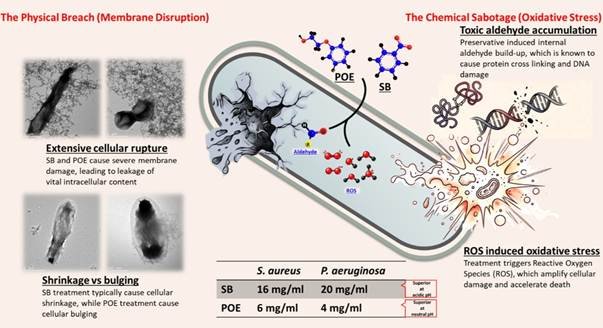
The researchers found that preservatives attack bacteria on multiple fronts. The microbial cell envelope becomes physically compromised, while reactive aldehydes and oxygen-derived species accumulate inside the cell, disrupting essential proteins, genetic material, and other critical cellular functions. Rather than a single mode of action, the preservatives deliver a coordinated multi-target assault, providing one of the clearest views yet of how bacterial cells are inactivated.
Advanced imaging revealed that sodium benzoate and phenoxyethanol follow distinct pathways to bacterial inactivation. Sodium benzoate induced cellular shrinkage and collapse, whereas phenoxyethanol caused membrane expansion and eventual rupture. The researchers further showed that sodium benzoate becomes significantly more potent in acidic environments, exhibiting an approximately sixteen-fold increase in activity, while phenoxyethanol displayed consistent efficacy across a wide pH range. These findings provide important insights into how preservative performance can be optimized for different formulation conditions.
The team consisting of Ishani Sharma, S M Rose, Madhu Lata, Somnath Das, Nagaraja IS Acharya, Maheshwara Naik, Samiran Mahapatra and Sharmistha Sinha ran bacteria through a gauntlet of tests like inhibition zone and MIC assays to see how much preservative it takes to knock growth down, electron microscopy to literally watch cell shape fall apart, a dye leakage test to catch membranes springing leaks, and two biochemical assays (MBTH and DCFDA) to measure the internal chemical chaos, across two very different bacteria, and both neutral and acidic conditions. Together, these methods helped the researchers connect what a bacterium looks like on the outside to what’s actually going wrong on the inside, at the same moment. It was published in the journal: Letters in Applied Microbiology
Knowing exactly how these preservatives work can help industry chose the correct one for a particular product format, (sodium benzoate is suitable for anything acidic and phenoxyethanol is suitable for cases where pH swings shouldn’t matter), use just the right amount instead of guessing, cut down on spoilage and waste, and stay a step ahead of bacteria that might otherwise evolve resistance.