

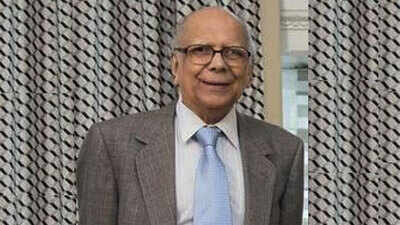
Long before artificial intelligence became part of everyday conversations, an Indian-born mathematician and computer scientist was examining how machines could solve problems. Ranan Bihari Banerji published Theory of Problem Solving: An Approach to Artificial Intelligence in 1969, when AI was still an emerging research field. But his life extended beyond computational science. He was also associated with Hindu religious practice and the Quaker community in the United States.Banerji’s career brought together mathematics, computer science, physics and an enduring interest in the relationship between science and spirituality.
The Indian scholar who explored AI before the technology boom
Born in 1928, Banerji pursued higher studies in India before earning his PhD in Physics from the University of Calcutta in 1956.He began his academic career in India and subsequently moved to the United States, where he joined Case Institute of Technology in 1961. He became a professor in 1968 and later taught at Temple University and Saint Joseph’s University in Philadelphia.According to the author’s biographical note in his 2006 book, Banerji published around 90 technical papers covering ionospheric physics and different branches of computer science. He also served as a visiting professor at institutions in Paris, Vienna, Calcutta and Prague.His academic work covered mathematical methods, pattern recognition, computational systems and the representation of problems.
How his 1969 book explored artificial intelligence
Banerji’s Theory of Problem Solving: An Approach to Artificial Intelligence, published by American Elsevier in 1969, examined how mathematical methods could help machines solve problems.The book discussed problem representation, solution methods, games, patterns, learning and generalisation. These were important questions for early AI researchers attempting to understand how computers could go beyond numerical calculations and work through abstract problems.The book’s title itself reflected the research challenge of the period: how to represent a problem in a form that a computer could process and how to develop systematic methods for finding solutions.Banerji later published Artificial Intelligence: A Theoretical Approach, extending his work on the mathematical and computational foundations of the field.He was also a Fellow of the American Association for Artificial Intelligence, now known as the Association for the Advancement of Artificial Intelligence (AAAI).
The computer scientist who was also a Hindu priest
Outside academia, Banerji maintained a deep interest in religion and spiritual practice.Biographical accounts describe him as an ordained Hindu priest who performed religious ceremonies, including weddings, for members of the Indian community in the United States. He was also associated with the Quaker community, formally known as the Religious Society of Friends.His interest in both traditions was reflected in his later writing about meditation, consciousness, scientific reasoning and religion.Rather than treating scientific inquiry and spiritual practice as necessarily incompatible, Banerji explored whether the two could contribute to a broader understanding of human life.
His later book connected science and spirituality
In 2006, Banerji published Society, Scientists and the Spirit. The book examined the relationship between scientific thought, consciousness and social responsibility.He argued for a broader conversation between science and spiritual ideas, including compassion and ecological balance. These were his philosophical arguments, rather than established scientific conclusions.His life thus extended from mathematical approaches to artificial intelligence to questions about consciousness, religion and society.For Banerji, the computer scientist who studied how machines could solve problems, scientific inquiry and spiritual reflection remained connected areas of intellectual exploration.Disclaimer: This article is based on publicly available biographical and bibliographic sources. TOI Education does not independently verify the author’s philosophical or scientific conclusions.