
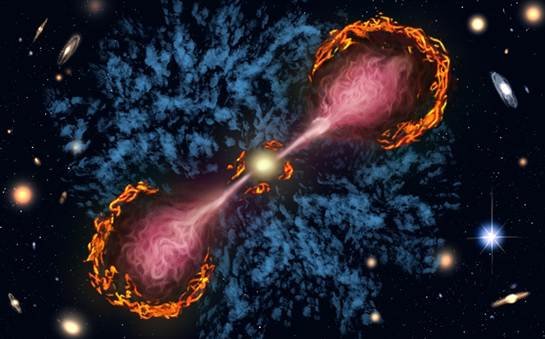
Astronomers have discovered a possible mechanism by which the black holes at the hearts of galaxies could be influencing the humongous, faint reservoir of gas surrounding their host galaxies, ultimately shaping the fates of galaxies.
When one thinks of a galaxy, one imagines dust and stars sparkling within beautiful spirals. But beyond the galactic disk’s edge lies a diffuse, ghostly envelope spreading out as far as 10–20 times the size of the galaxy. This gaseous reservoir is called the circumgalactic medium or CGM. This CGM provides the fuel for star formation.
But if all the gas existing within the boundary of the CGM did end up clumping together into stars, extremely luminous galaxies with a huge number of stars would form. But such galaxies don’t really exist. For more than a decade now, astronomers have proposed that energy from supermassive black holes (SMBHs) sitting at the hearts of galaxies could be preventing the gas from cooling and collapsing into stars. But there’s no consensus yet on how this may be happening. Before going into how, it helps to put into context the relative sizes of the SMBH and the galaxy to understand the scale of influence being talked about.
Though an average SMBH could be the size of the solar system, it is still tiny compared to the galaxy, which could host 100 billion such stellar systems.
A team of researchers from institutions like the Raman Research Institute (RRI), an autonomous institute of the Department of Science and Technology (DST) and Arizona State University found one way in which the tiny black hole at the centre could energetically influence the ginormous CGM of its host galaxy.
While black holes conjure the image of monstrous voids gobbling up gas and dust from their surroundings, they also often burp out jets of seething hot plasma, which is a soup of charged particles. The team, composed of scientists from India and USA, explored if this jet modifies the gas all the way up to the CGM.
They found that when a jet from a black hole first encounters the CGM, it bumps on the gas in the CGM creating a jerk which kindles the gas. This bright, energised gas in the CGM can prevent star-formation in the galaxy.
Energised and ionized gas — gas that has atoms with electrons added or removed which imparts the atoms charge — emits a particular glow. The team looked for this glow in the CGM. They didn’t detect a signal when they averaged the measurements over all directions around the galaxies. “However, when we probed along the direction of the jet, we detected a strong signal.
This told us that the jet was illuminating only the gas in its path, rather than affecting the gas equally in all directions,” said Namrata Roy, assistant professor in the Astronomy and Astrophysics division at RRI and the lead author of the paper published today in The Astrophysical Journal Letters.
Further, they found that the signal is strongest in two places — at the edge of the stellar disk, where the jet first encounters the CGM, and next at the CGM’s outer boundary, where the already slowed down jet fist-bumps the gas in the CGM. This is akin to punching something hard and getting a jerk. There’s a deposition of energy, and this energy is what kindles the gas preventing star formation.
Cool gas clumps together to form stars. But the jet launched from the black hole fires up and disturbs the gas along its path, preventing it from clumping together and suppressing star formation. In this way, the black hole at the galaxy’s centre governs the galaxy’s fate, making it quiet and passive. “The wider implication is that black holes can shape the lives of galaxies far beyond the small central region where they sit,” says Sanchayeeta Borthakur, associate professor at Arizona State University and a co-author of this work. “[It’s like] the ant sitting in India is making a huge mark somewhere in the USA.”
For now, Roy, Borthakur and colleagues can take satisfaction in the fact that they did not miss the blazing trail this ant of a black hole left on the mammoth galaxy in which it resides.
Publication Link: DOI 10.3847/2041-8213/ae9cbd