
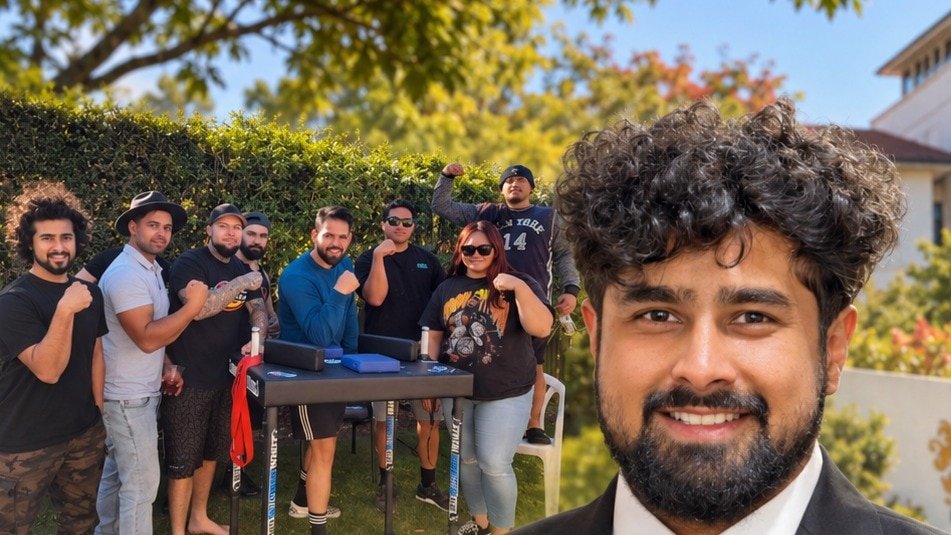
For Shivansh, 26, a young student from Ahmedabad, Gujarat, studying in New Zealand, the journey began with a simple discovery: a university could feel less like an institution that merely provides a degree and more like a community. He arrived in 2020 for a one-year, research-based master’s, expecting the familiar rhythm of lectures and textbooks. What he found was markedly different – practical learning, research-led assignments and professors who, in his experience, were as much mentors as teachers.
He is now completing his master’s programme in Auckland.
For many Indians who leave home with a study-abroad dream, the experience can at times be difficult and uncertain. Only a few manage to turn that dream into the life they had imagined.
New Zealand, however, offers an academic experience that extends beyond the classroom – through campuses, student clubs, research, networks and the opportunities that follow. Shivansh’s journey offers a glimpse of what that experience can mean for a student.
The change was not merely academic. Much of Shivansh’s education happened outside the classroom, in study clubs and student groups that gradually became part of his support system.
During orientation, he joined MOSA, the Massey University Student Association and Organisation, and a postgraduate student club. The groups connected students with senior students, alumni and teaching assistants.
Weekly meetings became places to discuss coursework and the unfamiliar business of learning in another country.
“They help connect students with senior students, as well as guide us on how the study journey could be,” Shivansh recalls. The clubs, he says, were particularly useful for international students trying to understand “this is the course structure, this is how you need to study, and this is how you need to spend your time.”
WHERE STUDY MEETS LIFE
Then there was the campus of Massey University, which in itself is green, spacious and, at times, almost pastoral. Lakes and gardens sat alongside lecture halls; sports and hiking clubs offered an alternative to the seriousness of academic life.
Shivansh, who struggled to secure the required IELTS score due to his handwriting, had to take the PTE, an online-based test to prove English proficiency. The challenge was greater for him, but he prepared and eventually secured a place at his chosen educational institution.
Shivansh remembers, in a free-wheeling conversation with India Today, professors joining students for games and hikes, making the distance between faculty and students seem rather less formidable.
“Even professors will be with you, playing games, doing a hike with you,” he says.
The philosophy, as he experienced it, was not to make academia the whole of one’s existence. Students were expected to study, certainly, but also to participate, explore and live. “You won’t find yourself just in academia,” Shivansh says. “You’ll find yourself living a proper life as well, out of studies.”
For an international student, however, this freedom came with a price: one had to be proactive. The unfamiliarity could be disorienting; the first months could bring culture shock and loneliness, and building a social and professional circle did not happen overnight.
FROM AGRICULTURE TO ARTIFICIAL INTELLIGENCE
New Zealand’s academic appeal, Shivansh says, also lies in the breadth of its industries.
“New Zealand is an agrarian country like India,” he says, pointing to the country’s agricultural sciences, dairy industry, environmental science, marine engineering and civil engineering as fields that have traditionally remained important.
But another current has begun running alongside these established fields: artificial intelligence.
“Recently, I again started my second master’s part-time while working, as a master’s in applied artificial intelligence,” Shivansh says, describing AI as one of the newer areas changing the academic landscape.
THE FIRST JOB IS NOT ALWAYS THE DREAM JOB
His own professional journey was hardly an overnight success. Networking, he says, played an important role. University clubs connected him with peers, supervisors and alumni, while his first job in New Zealand was a blue-collar manufacturing role — not the engineering position he ultimately wanted.
“Initially, I had to work as a blue-collar job, although in manufacturing,” he says. “I created a foundation and a base for which I can apply for my role.”
The lesson, he says, was patience. “In the very first go, they won’t hire you as an engineer. There’s a base-level experience and then there is a payoff, so you have to be patient for that.”
There was also the harder arithmetic of studying abroad. Part-time work could help meet everyday expenses, but Shivansh cautions against imagining that such work could easily finance another year of university fees.
“Your living expenses – rent, electricity, Wi-Fi – all that will be covered,” he says of part-time work. But paying another year’s university fees from such work is a different matter, he adds.
AN EDUCATION BEYOND THE DEGREE
Perhaps what stayed with Shivansh most was not one particular subject, but the manner in which education was conducted. Most assessments, in his case, were written research assignments rather than examinations. “There was only one examination throughout my course,” he says. “The rest of it was research assignments.”
That system also demanded original work. Plagiarism was taken seriously, but students were guided rather than simply punished. Library staff and supervisors could help students understand how to paraphrase and improve their work.
“Professors and supervisors are aware that not all students come from the same background,” Shivansh says. “They are mindful of it, and they are not harsh. They are very supportive and very helpful.”
His story, therefore, is not quite the conventional tale of an Indian student going abroad for a degree and a job.
It is the story of a young man entering a different academic culture, learning to stand on his own, finding mentors among professors and peers, working through an unglamorous first job – and eventually returning to the classroom to study artificial intelligence.
In that sense, New Zealand offered Shivansh something beyond a foreign qualification: an education in how to build a life around learning.
– Ends