
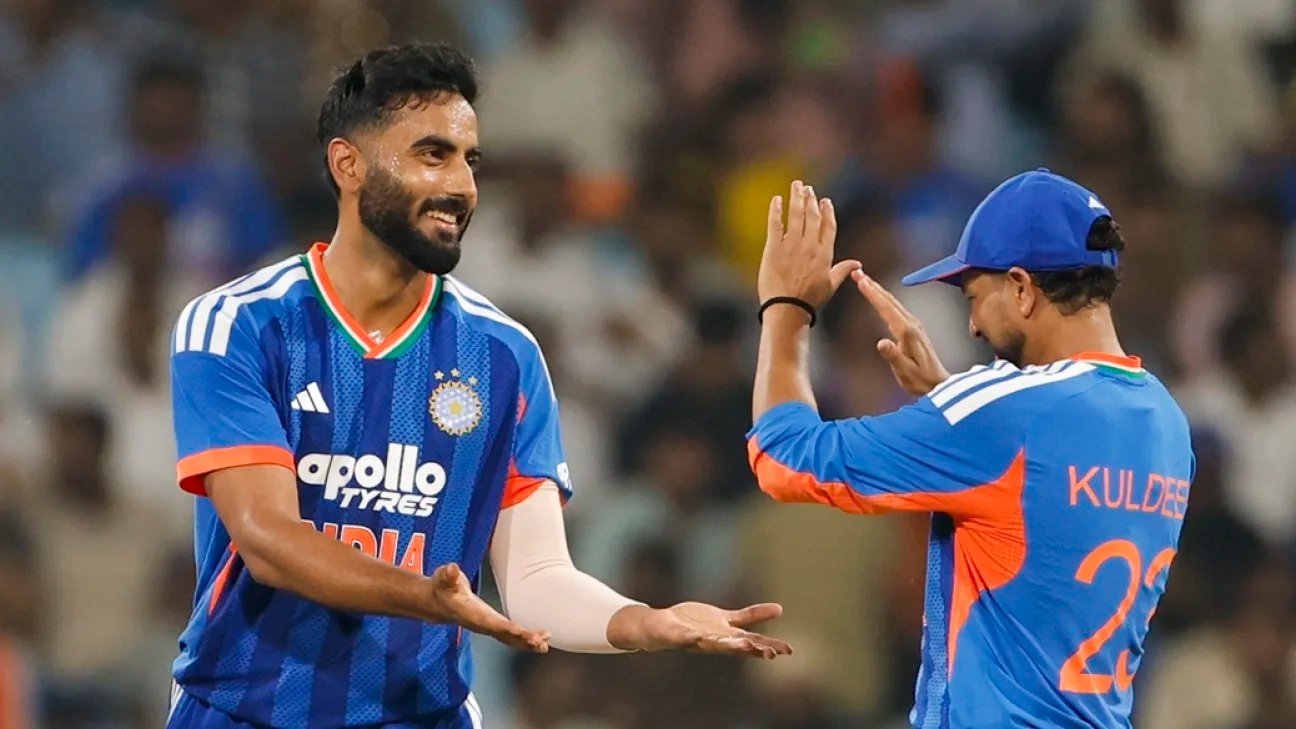
West Indies were 76 for 3 batting first when Dhir came on after nine overs. Three wickets towards the end of the powerplay had checked West Indies’ start, but Hope and Sherfane Rutherford, who would both make half-centuries, were rebuilding. Kuldeep Yadav’s previous over had cost 15, with a six from either batter. India asked Dhir to bowl against two batters beginning to take control of the opening T20I of the five-match series.
Dhir’s first over offered encouragement. Rutherford cut a short, wide ball for four, but was then beaten by one that turned and bounced past his outside edge. Dhir conceded six, with three dots to Rutherford. There was something in the surface for him.
West Indies reached 100 for 3 after Axar Patel’s next over went for 18. Hope and Rutherford had settled in, and Dhir returned with the partnership gathering momentum.
Hope cleared his front leg and launched him over wide long-on to reach a 36-ball fifty. Dhir landed the next one on a length outside off and turned it in. Hope went back to pull, found himself cramped and miscued to Axar at deep midwicket. The partnership was over at 63.
Against Shepherd, Dhir found a different answer after a full delivery on leg stump, right in Shepherd’s hitting arc, disappeared over deep square-leg. Dhir slowed the next one down and moved it wider outside off. Shepherd had to reach for it, and Tilak Varma judged the catch well at long-off.
For Springer’s dismissal, Dhir went from around the wicket to over the over after being hit over long-on. He tossed the next ball up, much slower, and the little inward turn prevented Springer from getting fully underneath it. Axar ran in from long-on to take the catch.
“I have seen him bowl in MI. That time he was more like a part-timer. But looking at his seam position, the way he was bowling today… you usually go defensive after being hit for six, but he was giving extra flight today”
Ishan Kishan
West Indies had fallen from 107 for 3 to 135 for 8. Dhir had taken three of those five wickets. Based on available ball-by-ball data, only Luxembourg’s Shameek Vats has the same record: taking a wicket immediately after conceding a six three times in a men’s T20I.
All three of Dhir’s wickets were of right-hand batters, rather than the left-hand batters an offspinner would conventionally be expected to match up well against. For aficionados of fingerspin, Dhir’s willingness to keep offering flight after being hit was worth watching.
Speaking at the press interaction after the game, Dhir said he had always put as much work into his bowling as he did for his batting, even if the latter had attracted greater recognition.
“Even if you haven’t seen me bowling, I am bowling the same amount that I have done here. I have practised the same amount,” he said. “It’s not like I am a batting allrounder or a bowling allrounder. Yes, my batting is a plus point, but at the same time, I am working as hard at bowling.”
This was also a timely audition. Washington Sundar was withdrawn from the T20Is to prepare for the Test series in New Zealand and Dhir filled the space normally given to a lower-order batter who can offer a fifth or sixth bowling option. If India can trust him for overs alongside his death-overs power-hitting, it gives them another way to balance their T20I XI.
“If you are representing the country and your name is mentioned in the team, then it’s a big deal. I am from a small town [Ambala in Haryana]. No one has played [for India] from there yet, so it’s a big deal for me”
Naman Dhir
For those familiar with Dhir mainly because of the IPL, this was a more complete introduction to his bowling. Across three IPL seasons, he had bowled just 8.4 overs without taking a wicket. But his domestic record includes 5 for 19 against Hyderabad in the Syed Mushtaq Ali Trophy.
On Tuesday, he completed four overs, none costing more than nine runs, and finished with 11 dots despite conceding three sixes.
Such an opportunity had seemed distant during Dhir’s years outside Punjab’s senior setup. In early 2022, he had considered leaving cricket and moving to Canada, where his sister lives. His father Naresh, who works at a chemist’s shop, asked him to give himself another year. That December, Dhir made his Ranji Trophy debut for Punjab.
Getting that far had required help. Naresh’s earnings were supplemented by Dhir’s maternal grandfather, Dharam Pal Sethi, a schoolteacher, while his childhood coach Gagan Sidhu stood by him through setbacks in age-group selection. Dhir lost both of them not long after breaking into senior cricket: his grandfather died after his Ranji debut, and Sidhu died in 2023, aged 36.
MI bought Dhir for INR 20 lakh ahead of IPL 2024 – he was another big find on the part of their scouting system. The following season, they retained him with a right-to-match card for INR 5.25 crore. Last month, his 173 off 64 balls in the Sher-e-Punjab T20 League helped propel him towards India selection.
The first person he rang after learning about his call-up for the West Indies white-ball games was his father. “It was a great feeling when I got the call,” Dhir said. “I was in the Ranji Trophy camp at PCA [Punjab Cricket Association]. It was a surreal feeling. I was with my friends, so right away I called my father. He was emotional. I got a little emotional.
“Every kid has a dream to play for the country. If you are representing the country and your name is mentioned in the team, then it’s a big deal. I am from a small town [Ambala in Haryana]. No one has played [for India] from there yet, so it’s a big deal for me.”
Sreshth Shah is a sub-editor at Cricinfo. @sreshthx