
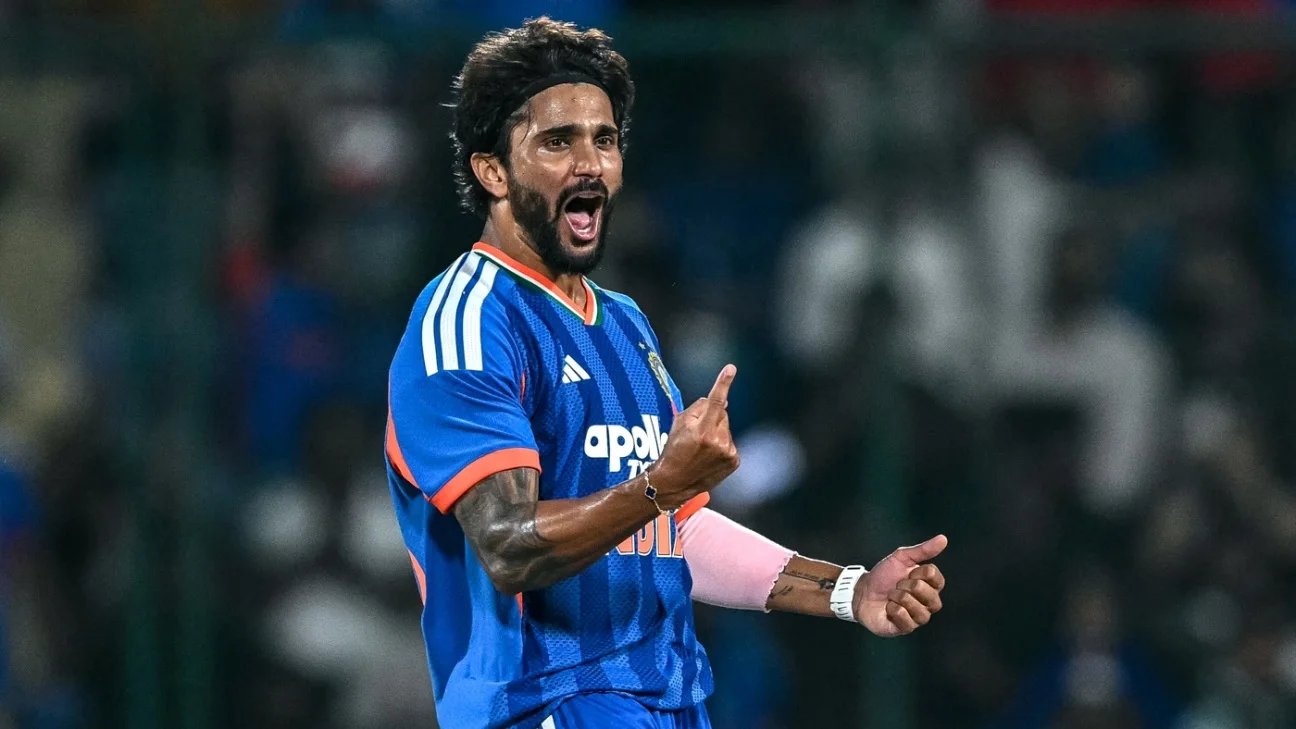
Reddy started tightly, conceding just two singles off his first two balls. He then bowled one full and wide outside off. Sampson went after it but could only hit it flat to Tilak Varma at long-off. Despite conceding a six later in the over, Reddy gave away only ten runs, further extending India’s advantage.
He did not bowl again, and finished with 1 for 19 from two overs – solid figures for a team defending 223. Earlier in the match, he had scored a useful 21 off 14.
That Reddy delivered under pressure was no surprise. India bowling coach Morne Morkel has publicly backed him across formats, calling him the player to “keep an eye on”, the guy who can bowl that “magical ball” and the one with the “talent and ability to compete for the allrounder’s spot”.
What was surprising was this: Indore was India’s 61st T20I since Reddy’s debut, but only his eighth match in the format. There are two major reasons for this. One, for all his talent, Reddy isn’t an automatic pick, particularly whe Hardik Pandya is available.
And the bigger obstacle has been fitness. Although Reddy is an excellent athlete who nearly matched Glenn Phillips in a run-a-three challenge a couple of years ago, his body has repeatedly let him down.
His maiden India call-up, for the Zimbabwe tour right after the 2024 T20 World Cup, was spoiled by a hernia injury. Three months later, there was an ankle issue, and the following year, a side strain. Then he hurt his left knee while training in the gym. This was followed by a left quadriceps injury, neck spasms, and another quadriceps injury, which ruled him out of the UK tour earlier this year.
“The biggest limitation to what his ceiling could be is going to be his body,” Ryan ten Doeschate, then India’s assistant coach, had warned last year.
When fit, Reddy has shown he can be handy with both bat and ball. In the recent T20Is against Afghanistan, he took 3 for 24 and 3 for 25 in successive games and finished as the highest wicket-taker in the series.
With the ODI World Cup less than 12 months away, he is also the frontrunner to be the back-up for an equally injury-prone Hardik. This is probably why India withdrew Reddy from the Asian Games squad and included him in the side for the West Indies ODIs.
He even shared the new ball in the first game in Thiruvananthapuram, but went out of the attack when his first over went for 17. He later returned for four more overs and finished with 1 for 45 but was dropped for the second ODI. He played the third ODI and conceded 50 in 6.5 overs before being left out for the first two T20Is.
There is no doubt that Reddy is a work in progress as a bowler. And since he has played only eight ODIs so far, every opportunity matters, both for him and for India as they figure out what role suits him best.
“He should be playing every single one-day game and maybe a few T20I games,” Aakash Chopra said on Cricinfo after the ODI series, “because when it comes to white-ball cricket, I won’t distinguish between the two too much. And game time doesn’t only mean being in the playing XI. Keep bowling him and keep batting him – that’s non-negotiable. Sometimes you will have to compromise on the result but so be it.”
This is another thing the team management could do more of. Even when India’s win was all but sealed in Indore, with West Indies needing 37 from the final over, Iyer chose to give the ball to Axar Patel rather than Reddy. It was a minor decision, but with two more T20Is coming up, India have a chance to make amends.
Hemant Brar is a sub-editor at Cricinfo
