
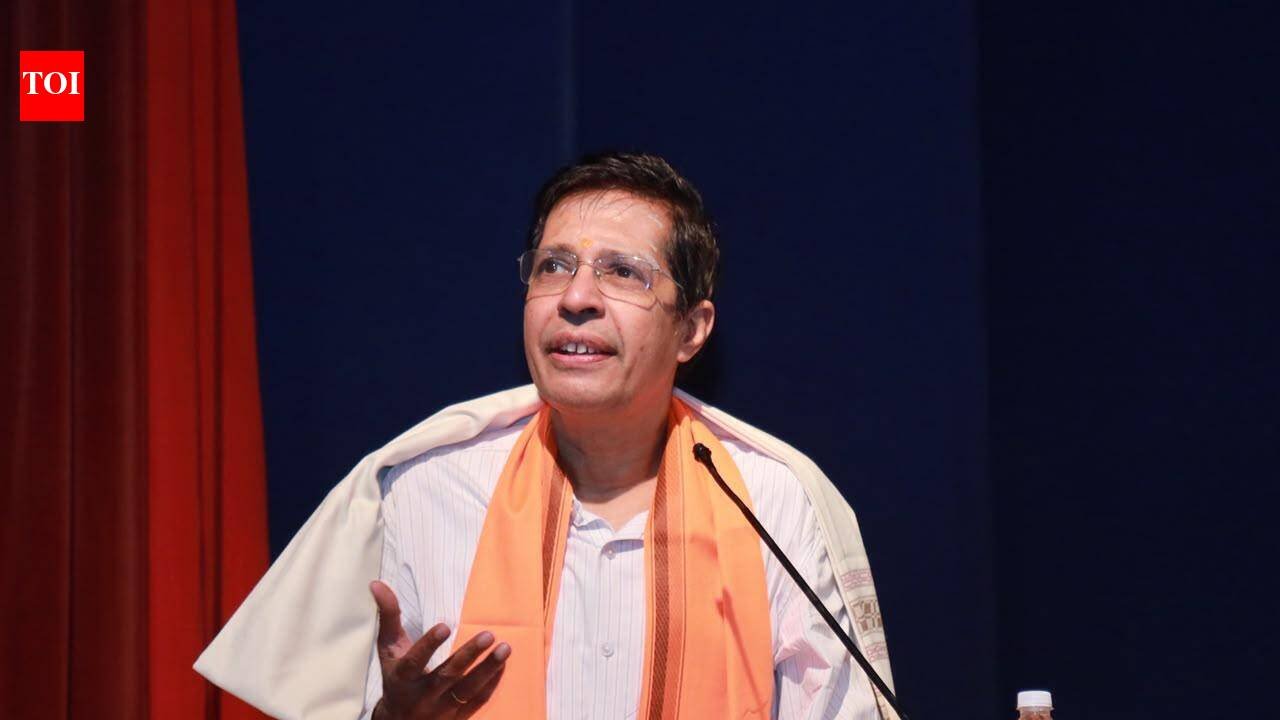
Nagpur: Director of the Indian Institute of Technology (IIT), Madras, V Kamakoti, on Sunday said that India faces the risk of being among the least educated countries if the current enrolment ratio in higher education doesn’t go up in the next decade.“Currently, the gross enrolment ratio (GER) in higher education stands at 30%. India has the largest population in the 15-35 age group, but inadequate access to quality education remains a major concern. If this issue is not addressed, India could become one of the most uneducated countries,” Kamakoti said at the Saptarishi Awards organised by Hindu Research Foundation here.The National Education Policy (NEP) envisages increasing the GER in higher education to 50% by 2035, Kamakoti said. “While govt is formulating policies, citizens must also contribute actively to achieving this goal,” he said.Kamakoti highlighted the importance of preserving India’s traditional knowledge while advancing modern technology. He also recalled IIT Madras’s efforts to develop indigenous microprocessors, which began in 2012. The institute successfully booted its first processor on Sept 21, 2021, he said, adding that he received news of another processor being booted just before arriving in Nagpur.The foundation honoured seven eminent personalities for their contributions to literature, science, technology, art and medicine. Marathi litterateur Bhalchandra Nemade received the Maharshi Valmiki Award, Kamakoti the Aryabhata Award, IIT Madras professor Thalappil Pradeep the Nagarjuna Award, architect and sculptor Anil Sutar the Vishwakarma Award, entrepreneur Suyash Singh the Acharya Bharadwaj Award, Vedprakash Mishra the Acharya Sushruta Award and physics professor Sanjay Dhobale the Acharya Kanada Award.Nagpur-born Suyash Singh, CEO and co-founder of GalaxEye Space Solutions, said India currently offered an excellent ecosystem for startups, particularly in space, defence, artificial intelligence and medical technology.“Entrepreneurship is the best option to pursue now. There is considerable support available, with initial funding readily available,” Singh said. GalaxEye is developing OptoSAR, a satellite imaging technology that combines optical and synthetic aperture radar capabilities, he added.Bhalchandra Nemade emphasised the need to recognise India’s intellectual and literary legacy rather than give disproportionate importance to Western traditions. Citing India’s contributions to mathematics, medicine and literature, he urged people to learn from the past while carrying its strongest ideas forward.Chemical scientist Thalappil Pradeep said India’s knowledge traditions encourage debate. Referring to ancient texts and archaeological discoveries, he said a civilisation’s greatness lies not merely in what it discovered but also in what it shared to enable others to make discoveries.Sutar, known for his contribution during the construction of Statue of Unity, recalled creating the Swami Vivekananda statue at Nagpur’s Ambazari memorial. He also said he was currently working on a 350-foot statue of BR Ambedkar.(Inputs by Sumit Kumar Singh)