
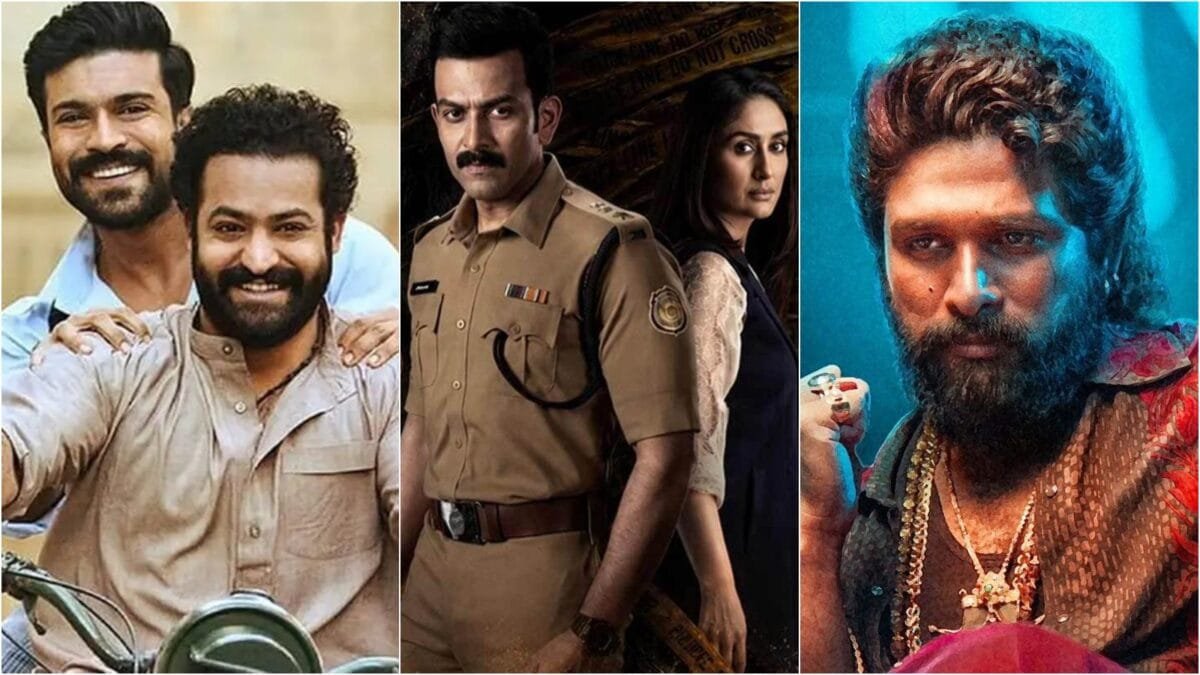
A few years ago, this would have been called a crossover. Today, it is simply casting. For decades, Indian cinema had a clear pecking order. You could be a huge star in Chennai, Hyderabad, Bengaluru or Kochi, but if you wanted to become a national star, the road usually led to Mumbai.
Bollywood was the big door. But today, that door is no longer the only one. Prabhas became a national star through Telugu cinema. Yash did it through Kannada. Allu Arjun found a huge Hindi-speaking audience with Pushpa, without first making a Bollywood film. Ram Charan and Jr NTR became household names across India through RRR.
The audience moved first
The change did not begin with the stars, it began with viewers. Rajinikanth and Kamal Haasan were national stars long before anyone used the phrase “pan-India”. But their generation still had to enter Hindi cinema to broaden its reach. Today, audiences are much more willing to make the journey themselves.
Television had been showing dubbed South Indian films in Hindi-speaking homes for years. YouTube and social media made songs, scenes and actors familiar far beyond their original markets. Streaming made subtitles and dubbed versions part of everyday viewing.
Then Baahubali, KGF, Pushpa and RRR took that habit into theatres. These films did not have to become Hindi films to travel. KGF stayed Kannada. Pushpa stayed Telugu. RRR stayed rooted in Telugu cinema. Nobody asked them to change. The language barrier was never quite as formidable as the industry thought.
The crossover isn’t much of a crossover anymore
You can see the change in the way actors build careers. Deepika Padukone appearing opposite Prabhas in Kalki 2898 AD did not feel like the kind of event that once accompanied a Bollywood star entering another industry. Alia Bhatt stepping into S.S. Rajamouli’s Telugu cinema felt equally natural. In fact, Prithviraj is an even better example. Malayalam cinema remains his home, but Hindi and Telugu films sit naturally alongside his work as an actor, director and producer.
He has also recalled Karan Johar telling him that Indian cinema was moving towards “one big film industry”. The industries are not going to stop being Tamil, Telugu, Malayalam, Kannada or Hindi cinemas. But careers are becoming less neatly divided.
Earlier, moving from one industry to another was a career move. Now, it is just work.
Why Daayra matters
This is what makes Daayra interesting. The films that first made the pan-India idea impossible to ignore were mostly spectacles: Baahubali, KGF, Pushpa, RRR. They came with enormous stars and the kind of scale that travels well. Daayra is a crime thriller. It has Kareena Kapoor and Prithviraj directed by Meghna Gulzar. There is no fantasy universe or giant action franchise doing the selling for it. Yet it is being released in Hindi and Malayalam.
Parvathy dubbing Kareena for the Malayalam version is a small but revealing choice. The film acknowledges the language difference without treating it as a barrier. Perhaps that is the more interesting future for Indian cinema. Not every film needs to arrive announcing itself as a giant “pan-India” event. Sometimes you put the right people together and let viewers decide.
Bollywood is still powerful. It just isn’t alone.
None of this however, means Bollywood is going anywhere. Hindi cinema remains hugely powerful, with stars such as Shah Rukh Khan, Salman Khan, Aamir Khan and Ranbir Kapoor still commanding enormous audiences.
What has changed is the equation between “Bollywood star” and “national star”. For a long time, the two were almost interchangeable. Now they aren’t. Hindi cinema had advantages beyond box office. Mumbai had the money, distribution networks and media attention. It also had cultural authority. “Indian cinema” often meant Hindi cinema unless somebody specifically said otherwise. That position has weakened because the rest of Indian cinema became harder to ignore.
Baahubali, KGF, Pushpa and RRR changed the idea of where a national audience could come from. A film did not have to originate in Mumbai to become a mainstream Indian success. Audiences simply became less concerned about where a film came from. They wanted the film.
The Indian Star
That is why the old idea of a crossover is starting to feel dated. A Hindi audience can turn a Telugu actor into a national star without that actor first establishing himself in Bollywood. A Malayalam actor can lead a Hindi film without it being treated as a major career gamble.
For decades, Bollywood was the centre of Indian cinema. If a star from another industry wanted a truly national audience, the road eventually led to Mumbai. That equation has changed.
