
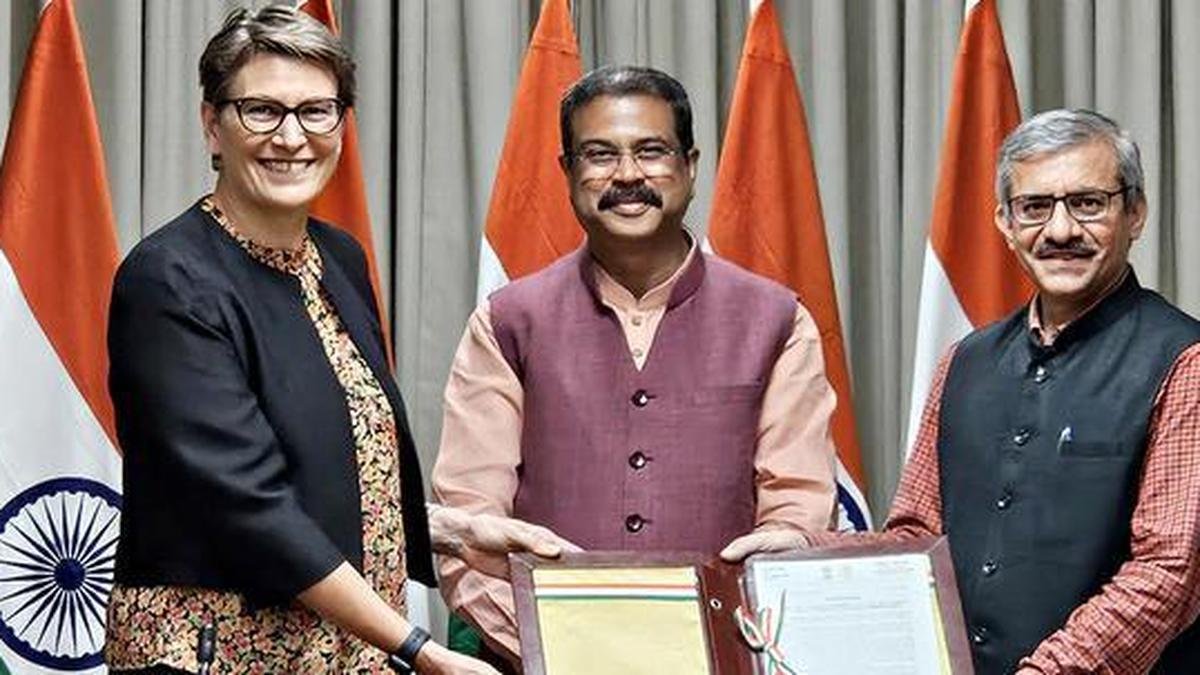
The University of New South Wales (UNSW), one of the world’s top 20 universities, opened its India campus in Bengaluru this August, welcoming its first batch of students across four programmes: the Bachelor of Business, Bachelor of Science in Computer Science, Bachelor of Data Science and Decisions, and Master of Cyber Security. According to a report in The Hindu, UNSW had planned to admit around 30 students to each programme for its inaugural intake. However, the university enrolled a total of 90 students across the four programmes it had envisaged.
UNSW is not alone; it is one of 13 foreign higher education institutions (FHEIs) that have commenced operations in India since 2024, following the introduction of the National Education Policy (NEP) 2020, which paved the way for eligible foreign universities ranked among the world’s top 500 to establish campuses in the country.
According to information available from the University Grants Commission (UGC), the Ministry of Education and the respective universities’ portals, these 13 institutions comprise seven from the United Kingdom, five from Australia, and one from the United States, with a presence across 14 locations in five major Indian cities. Mumbai hosts five campuses, followed by Bengaluru and Gujarat International Finance Tec-City (GIFT), with three each. Gurugram hosts two, while Chennai has one.
Out of these, only three of the 13 institutions began operations in 2024 and 2025, while the remaining institutions either began operations or were scheduled to commence their first academic sessions in 2026. According to a recent report by DrEducation Research on the landscape of international university campuses in India, the institutions together have an estimated intake capacity of around 3,000 students for 2026 across more than 91 undergraduate (UG) and postgraduate (PG) programmes, with offerings largely concentrated in Science, Technology, Engineering and Mathematics (STEM) and related fields.
However, Rahul Choudaha, Managing Director of DrEducation Research, says the projected student intake at these campuses is only about half of estimated intake capacity.
Mr. Choudaha added that all this comes with no entrance examinations, only eligibility criteria based on Class 12 marks and an English-language requirement. The number, he said, is small in relation to the 40 million students enrolled in higher education, according to the All India Survey on Higher Education, and nearly 1.25 million Indian students pursue higher education abroad, according to the Ministry of External Affairs.

Exorbitant fees
Explaining the possible reasons for the lower turnout, Mr. Choudaha cited pricing as one of them. According to information available from these universities, annual fees for a single programme for an undergraduate or postgraduate course range from ₹10 lakh to ₹20 lakh. Mr. Choudaha shares that, “Though these fees are lower than the cost of studying abroad, including living expenses, they are at least twice what top-tier Indian institutes charge. Since these campuses have only recently begun operating, there is also little evidence yet of what it is like to study there.”
Further, speaking about placements, he said that the campuses have seen only modest placements so far, as these universities are still in an emerging, formative phase.
According to a press release from Deakin University’s GIFT City campus, its first cohort of 43 Master’s students graduated in March 2026. Of these graduates, who hold postgraduate degrees in cyber security and business analytics, about three-quarters have secured positions. At the University of Southampton’s campus in Gurugram, a press release suggests that more than half of the postgraduate students seeking employment had found roles as of 2026. He added that these campuses now face the test of meeting expectations, both for the university experience and for employment outcomes.

Kevin McCole, Managing Director of GEDU Global Education, a U.K.-headquartered holding company for about 15 education institutions, said the concept of international branch campuses is still relatively new in India. “It is therefore understandable that enrolment may take time to build as these institutions establish their presence and demonstrate the value of their programmes. What will be particularly exciting is seeing foreign universities bring their expertise to India and build on it by drawing from India’s strengths in high-growth, globally oriented sectors such as the creative industries,” he said.
Mr. McCole further added that two things are critical for any international branch campus coming in. “First, students should still get the same quality they would have at York, Aberdeen, Liverpool or Southampton, but in an Indian context. It has to blend the best of the Indian context with the best of the home campus. Getting that blend right will be important. Second, every student and their parents are looking at return on investment, and that means jobs. So building connections with employers will be really important. A subset of that is running the programmes employers are looking for and giving students not just the technical qualification but more,” he said.
(Bhaskar Basava is an independent journalist based in Hyderabad)
Published – October 14, 2026 04:21 pm IST
