
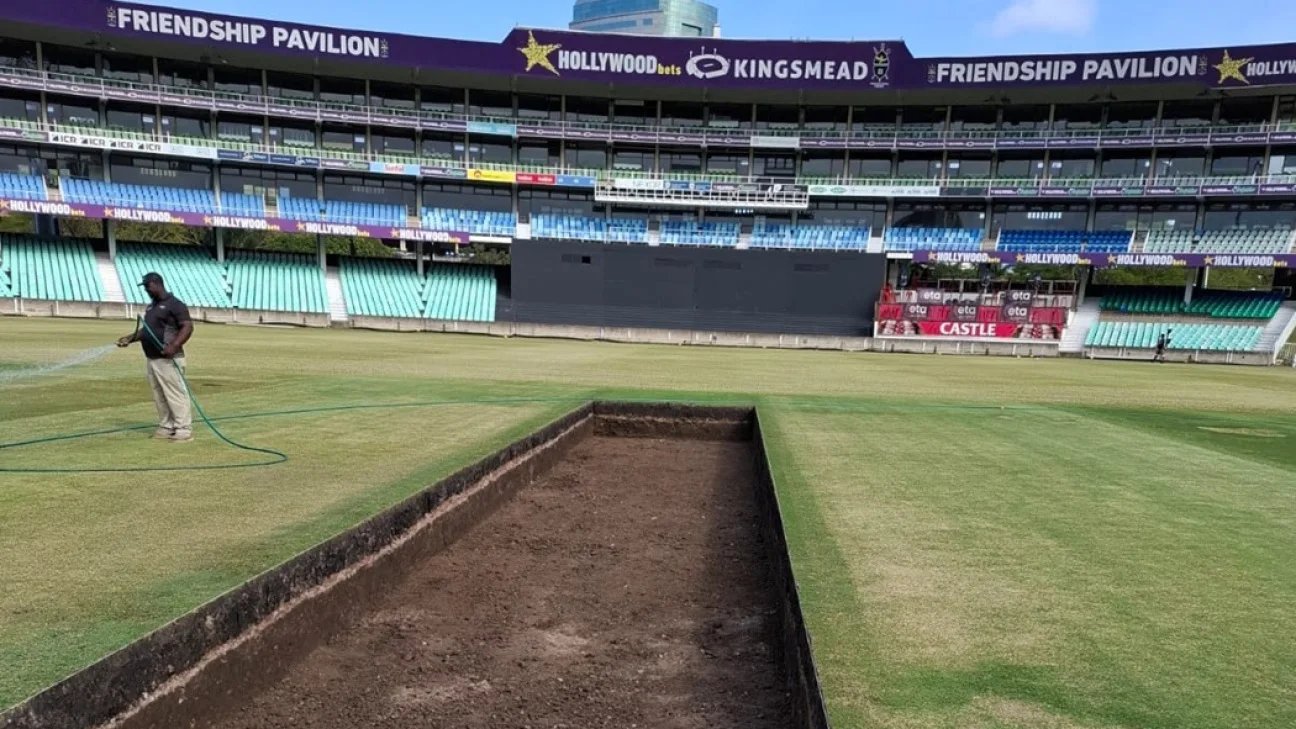
There’s talk of tracks ageing, slowing down or behaving inconsistently so Cricket South Africa (CSA) have invested in a medium and long-term solution: EPS, the exchangeable pitch system
Unlike in Australia, where pitches are dropped in to play cricket and then taken out for other sports, South Africa are pioneering a different method. Their busier stadiums will have surfaces they can swap in and out as needed without having to relay entire squares or take grounds out of circulation for extended periods of time.
“In South Africa, we haven’t really installed new pitches for many years, because we can’t. We can’t just take one of the pitches out for a season because that will reduce capacity, and we just don’t have that luxury. So we are introducing an exchangeable pitch system and we don’t want to call it drop-ins because that’s not what it is,” Hilbert Smit, Cricket South Africa’s long-time pitch consultant, told Cricinfo.
The system relies on every ground using their usual bulli soil and grass to create bespoke surfaces for their venue. “Everybody thinks it’s all the same but it’s not. Everybody kind of chooses their variety and the supplier (a nursery in the Kwa-Zulu Natal Midlands) ships them off all over the country,” Evan Flint, former Newlands and Wanderers groundsman who now works two days a week as a consultant at Kingsmead explained. “The grasses are all Cynodons (a grass species), but then everyone will alternate a little bit as to what they prefer and what grows best in their conditions.”
The result is that the natural qualities of South African pitches, which typically offer good bounce and carry, will be retained or even enhanced with the creation of new pitches which are prepared in steel trays on the outfield, independently of the square. “On the turf side, there is absolutely nothing different to building a new pitch. It’s your fertility levels, it’s moisture content, and then just planting the grass and growing it,” Smit said. “The difference is that these pitches are being built in a confined area. They are not interacting with what happens next door with the other turf and with Mother Earth, so now you can control it better.”
“There was the usual kind of Wanderers bounce,” Flint said. “And obviously, with the spinner doing well there was enough purchase but I wouldn’t say it was turning square.”
The clear change in South Africa’s thinking over spin was driven largely by Imran Tahir, who played the bulk of his career at Kingsmead (and was also in action in the exchangeable pitch in March) and he was followed by Keshav Maharaj, South Africa’s most successful post-readmission spinner Simon Harmer, Tabraiz Shamsi, Senuran Muthusamy, Prenelan Subrayen and Bjorn Fortuin.
None of the exchangeable pitches will be used for Test matches at the moment and it is understood that only the Wanderers, whose pitch has been in the square for the last year, may use their exchangeable for the 2027 ODI World Cup. The Wanderers could also be the first to use their exchangeable pitch for the SA20, with talks in place for the upcoming season. The other grounds will begin testing out their exchangeable pitches in domestic matches this season, with the exception of SuperSport Park, who will wait until after the World Cup to put their exchangeable in. Newlands is likely to be the next to see a match played on the exchangeable pitch. “At Newlands, because this pitch is in such good condition, they want to play on it. I won’t be surprised if they play on it before Christmas,” Smit said.
Newlands is in the slightly unusual position of having their exchangeable pitch further on the square than the other grounds. That may mean it is not central enough to be used for televised games because of the camera position, though their camera platforms at the stadium are also big enough to accommodate it.
The exchangeable pitches have been designed as what Flint called “white-ball solutions,” though even the 2027 World Cup is too soon for most grounds and CSA are intent on playing the long game. “If you rebuild a new pitch in the middle of the square, we have found 18 months minimum before you use it,” Smit said. “If you build it now and grow it outside, there’s no interference now in this growing process so it could be quicker.”
Both Smit and Flint agree that anything less than 12 months would not be risked, and with Newlands, Kingsmead, Paarl and St George’s Park at the cusp of that, the World Cup will likely be played on the already-existing surfaces. But in the long term, the exchangeables will be used with frequency, especially once the process of getting them in and out speeds up.
At the Wanderers, it took the ground staff 11 days to put the first exchangeable in “because it was a brand new experience,” Smit said. Already, they have got that down to less than a day, which is what it took at Kingsmead recently and the method of doing it is specific to South Africa.
Unlike in Australia, where a large “transporting vehicle,” as Smit puts it, brings the pitch into the ground, South Africa had to find another solution because the vehicle itself is too big to fit into the grounds and too costly. “It would have cost us, on a thumb-suck, but ten times what it’s costing us now and there’s just no space for the vehicle to come into our stadiums. So we’ve got a unique transportation system based on air.”
The exchangeable pitch weighs 32 tonnes and is moved on a hovercraft principle on a truck. An industrial fan generates air, which creates an air cushion under the pitch tray, making it as light as two or three tonnes. Then, once it reaches its position on the square, air cushions (or pontoons) are used to lift the pitch tray up and then down. “We put a cover down and some water so it can slide across,” Flint said. “A big truck was used this time, but eventually those guys are saying you can put a winch onto the roller and transport it that way.”
Once an exchangeable pitch is in, it needs between five and six days on the square before it can be played on. Then, it can be used for the usual five to eight days of high-level cricket in the summer and swapped out to essentially double a ground’s usage. This is how Flint sees it potentially playing out:
“Let’s use the SA20 as an example. You would go into the SA20 with a fresh, fully grassed wicket that’s ready to play three to four matches on it in the SA20, and then at the end of the SA20, you would exchange it for the one that’s on the edge of your field, and you would bring that one in for either your international, maybe an ODI or a T20I or even a domestic match which is televised and you won’t be going back to that used surface. One-day international or a T20, or even domestic men’s matches which are televised. At least you’re not then going back to that used surface. You’ve got now a fresh surface that’s been rehabilitated on the edge of the field, and it’s essentially almost like a brand-new pitch halfway through your season.”
The possibilities the EPS system offers bode well for a busy future and South Africa are basking in the knowledge that they created it themselves, with lessons from what went wrong in the USA and no dependence on Australia, who have a longer history with pitch creation.
“With New York, it showed us that you can have the best but the one thing you can’t buy is time,” Flint said. “For whatever reason, they were rushed and they didn’t settle enough. So we learnt and it was valuable to see that you do need to take time. In terms of the Australian model, that’s been around for many, many years but generally I think it’s common knowledge. It helped to know that it can be done.”
Firdose Moonda is Cricinfo’s senior correspondent for Africa and women’s cricket