
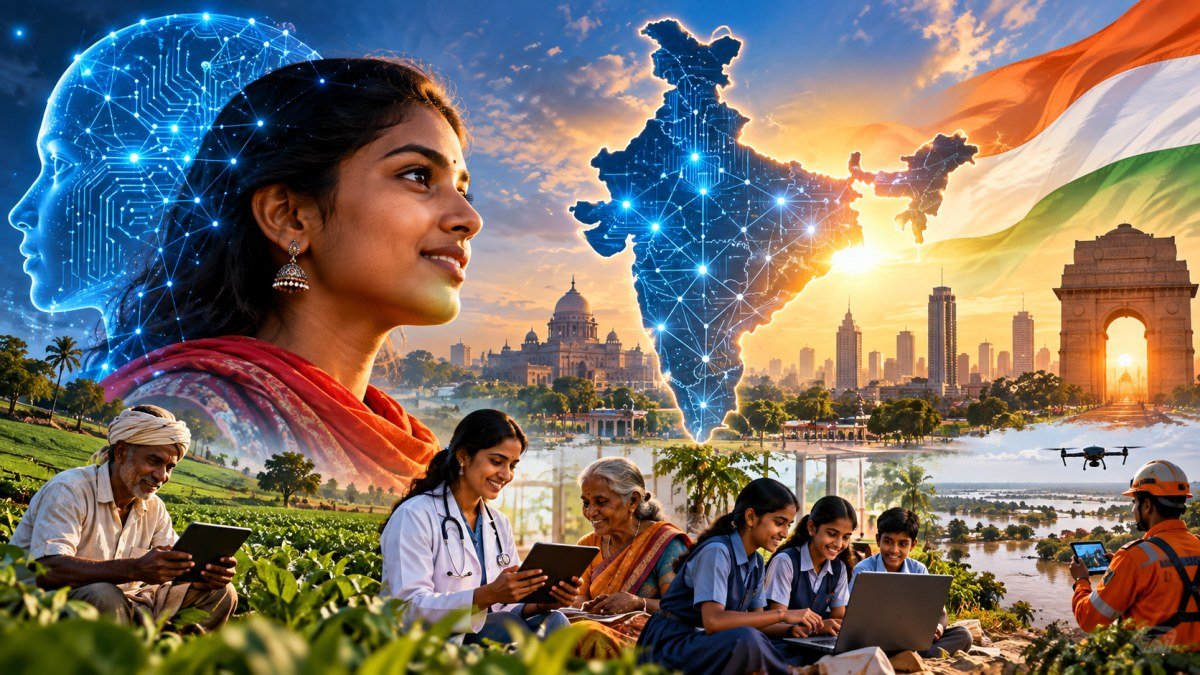
247 – India is building an artificial intelligence strategy based on the principle of “AI for all”, aiming to democratize access to technology, reduce inequalities, and use new digital tools to tackle some of the country’s main social and economic challenges. The initiative is linked to India’s development horizon through 2047, the year the country will mark a century of independence.
This assessment comes from Anirban Sarma, director of the Digital Societies Initiative at the Observer Research Foundation (ORF), and Dr. Vanita Sharma, Strategic Initiatives advisor at the Reliance Foundation. In their analysis of AI development in India, the experts highlight that the country seeks to combine technological innovation, shared infrastructure, population training, and practical applications focused on community needs.
This progress is happening amid rapid expansion of India’s AI ecosystem. India already holds prominent international positions in professional skills and sector dynamism, while companies are increasing adoption of AI-based solutions and startups attract investments. Estimates cited by the authors indicate that the technology could add about US$1.7 trillion to the Indian economy by 2035.
One of the pillars of this strategy is building accessible infrastructure. Through its national AI mission, the Indian government provides subsidized computing capacity and develops shared repositories of data and models. The goal is to lower entry barriers for startups, universities, researchers, companies, and public institutions, preventing AI development from being restricted to large corporations able to finance their own infrastructure.
However, the priority is not only to develop increasingly sophisticated models. India aims to transform artificial intelligence into a tool to solve concrete problems. Projects already explore applications in areas such as agriculture, health, education, disaster management, the justice system, and social inclusion, creating solutions that, according to Sarma and Sharma, could also be adapted to the needs of other developing countries.
This feature makes the Indian experience especially relevant for the Global South. Many challenges faced by India—great linguistic diversity, income inequality, regional differences, limited connectivity, and the need to provide public services on a large scale—are also present in countries in Africa, Latin America, and other parts of Asia. Technologies developed under these conditions can therefore produce models more easily replicable in other emerging economies.
AI in hundreds of languages
Linguistic diversity appears as one of the great challenges and, at the same time, one of the most promising fields of the Indian experience. Models trained with local data, translation systems, and interfaces adapted to different languages seek to enable people who do not master English to also access the benefits of artificial intelligence.
The strategy is accompanied by training programs aimed at preparing citizens not only to use AI tools but also to participate in their creation. In this way, the country seeks to expand the social base capable of producing technological innovation and avoid the new digital economy deepening existing inequalities.
The projects analyzed by Sarma and Sharma also indicate that technology works better when built in dialogue with the communities themselves. Rather than simply introducing an external tool, successful initiatives seek to integrate artificial intelligence into services and institutions that users already trust, as well as develop interfaces suited to the languages, cultural realities, and material conditions of each region.
Another principle considered fundamental is maintaining human oversight. AI systems can analyze large amounts of data, identify patterns, and produce recommendations, but sensitive decisions should not be automatically delegated to algorithms. Areas such as veterinary care or determining beneficiaries of social policies, for example, require human review mechanisms.
Technology must reach those without computers
Democratizing AI also depends on overcoming basic infrastructure limitations. In communities where internet is unstable or access to computers is limited, solutions based solely on sophisticated cloud services may increase, rather than reduce, digital exclusion.
For this reason, Indian initiatives have been exploring tools capable of working offline, applications adapted to mobile phones, and different forms of interaction that do not necessarily depend on personal computers. The logic is to make technology adapt to users’ conditions, rather than require communities to adapt beforehand to the demands of technology.
However, the accelerated expansion of artificial intelligence also produces new challenges. Large data centers demand significant amounts of energy and water, placing environmental issues at the center of the debate. At the same time, mechanisms will need to be established to ensure security, equity, affordable pricing, and returns for communities whose data, languages, and knowledge are used in training models.
The Indian experience also points to the importance of partnerships between the state, companies, and civil society organizations. The combination of public infrastructure, private technological knowledge, and the experience of organizations working directly with communities can reduce costs and accelerate the transformation of experimental projects into services available to millions of people.
More than just participating in the international race for the most powerful models, India’s strategy suggests a distinct vision for the future of artificial intelligence: measuring its success also by its ability to improve public services, expand opportunities, and reach populations historically excluded from major technological transformations.
For Global South countries, the experience may represent an important reference. Rather than being mere consumers of technologies produced by major digital powers, emerging countries can develop their own models, trained with their data, adapted to their languages, and oriented toward their social challenges. It is in this combination of technological sovereignty, inclusion, and cooperation that India intends to transform artificial intelligence into a development tool.