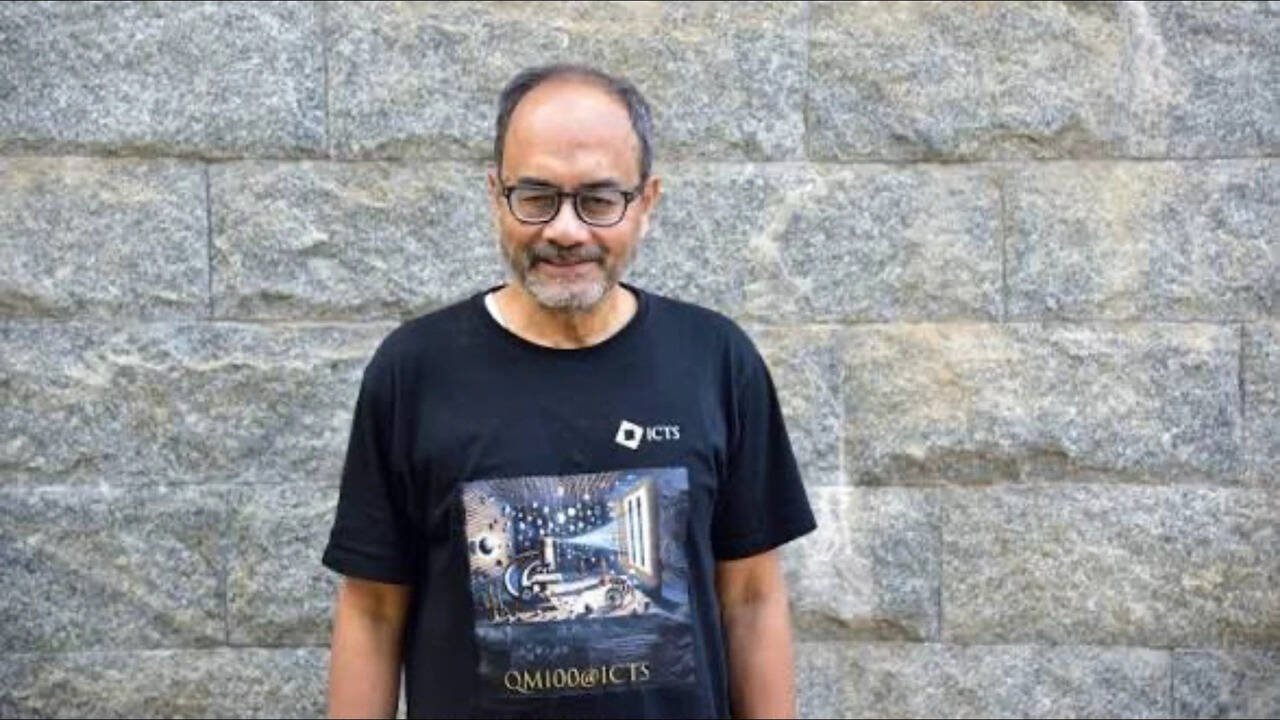
The International Centre for Theoretical Sciences (ICTS) has announced that Professor Ashoke Sen has been awarded the 2026 Oskar Klein Medal, making him the first Indian physicist to receive the honour. The recognition highlights a career of more than four decades devoted to some of the deepest questions in string theory and has further strengthened India’s standing in fundamental physics.
Ashoke Sen was born on July 15, 1956 in Kolkata, West Bengal. He is the elder son of Anil Kumar Sen, a professor of physics at Scottish Church College, Kolkata, and Gouri Sen. A scholarly atmosphere at home, together with his father’s vocation, appears to have shaped his early interest in science. He completed his schooling at Sailendra Sircar Vidyalaya in Kolkata and went on to Presidency College, then affiliated with the University of Calcutta, where he earned his Bachelor of Science degree in 1975. At Presidency he was greatly inspired by the teaching and research of the physicist Amal Kumar Raychaudhuri. He received his master’s degree from IIT Kanpur in 1976, and pursued doctoral studies in physics at Stony Brook University in the United States under the supervision of George Sterman.
Professor Sen held research positions at institutions including Fermilab and the Stanford Linear Accelerator Center, and later returned to India, where he worked at the Tata Institute of Fundamental Research and then the Harish-Chandra Research Institute in Prayagraj, where he served as a distinguished professor. He has also been associated with the National Institute of Science Education and Research and the Indian Institute of Science Education and Research, Bhopal. He is currently the ICTS-Infosys Madhava Chair Professor at ICTS, Bangalore, and holds visiting appointments as Morningstar Visiting Professor at the Massachusetts Institute of Technology (MIT) and distinguished professor at the Korea Institute for Advanced Study.
His research has centred on string theory, the framework that seeks to unify quantum mechanics and gravity. His landmark work on strong-weak coupling duality, known as S-duality, proved influential in changing the course of research in the field. It contributed to the realisation that the various string theories are different limits of a single underlying theory.
Professor Sen also pioneered the study of unstable D-branes and formulated the celebrated Sen conjecture on open string tachyon condensation.
His description of rolling tachyons has been influential in string cosmology. In addition, he has co-authored important papers on string field theory and contributed new developments in superstring perturbation theory. His work on black holes includes the entropy function formalism for extremal black holes, applications to the attractor mechanism, and the precision counting of black hole microstates, an achievement that has deepened understanding of the quantum nature of gravity.
Over the years, Professor Sen has received many of the highest honours in science. These include the ICTP Prize (1989), the Shanti Swarup Bhatnagar Prize (1994), the G.D. Birla Award for Scientific Research (1996), the TWAS Prize (1997), and the Padma Shri (2001). He received the Infosys Prize in Mathematical Sciences in 2009. In 2012 he was among the first recipients of the Breakthrough Prize in Fundamental Physics, recognised for contributions to establishing the unifying structure of string theory. He was awarded the Padma Bhushan in 2013 and the Dirac Medal in 2014. He is a Fellow of the Indian Academy of Sciences, the Indian National Science Academy, and, since 1998, the Royal Society.
The Oskar Klein Medal, named after the Swedish theoretical physicist Oskar Klein, is awarded annually by Stockholm University and the Nobel Committee for Physics of the Royal Swedish Academy of Sciences. Established in 1988, it recognises distinguished contributions to physics. Its first three recipients were the Nobel laureates Chen-Ning Yang, Steven Weinberg and Hans Bethe, which indicates the stature of the honour.
Professor Sen was cited for his pioneering work on S-duality, the precision counting of black hole entropy and string field theory, all of which have helped shape modern string theory. As part of the award, he delivered the 2026 Oskar Klein Memorial Lecture, titled “Gravity from Strings and Strings from Gravity,” at Stockholm University’s AlbaNova Centre in October 2026.
Rajesh Gopakumar, Director of ICTS, conveyed the institution’s congratulations, noting how wonderful it has been to have Professor Sen at the centre, where he has helped set the tone for excellence.
Ashoke Sen’s journey from a school in Kolkata to the forefront of global theoretical physics reflects intellectual rigour, originality and sustained dedication. His ideas have altered the direction of string theory, and his presence in Indian institutions has nurtured generations of researchers. The Oskar Klein Medal is a fitting tribute to his contributions, and a source of pride for the Indian scientific community.