
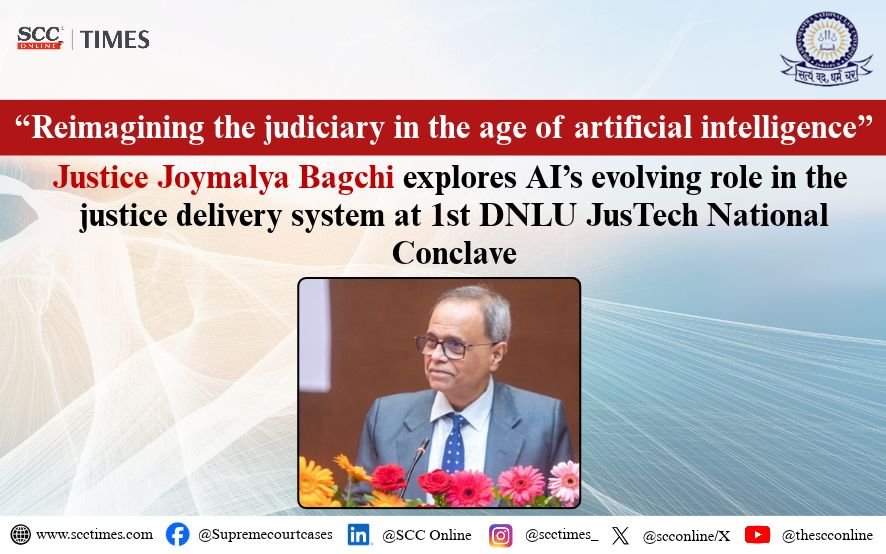
Justice Joymalya Bagchi examines how AI can address judicial pendency and support case management while preserving human agency and constitutional values.“The real challenge is not whether artificial intelligence can administer justice, but whether it can understand the very essence of justice. Justice demands more than the application of established rules or the prediction of outcomes; it requires the courage to question precedents, challenge existing assumptions and evolve with society. Machines may process the law, but the human conscience must preserve its spirit. For, ultimately, justice is not an algorithm to be executed, but a human ideal to be upheld.”-Justice Joymalya Bagchi, Judge, Supreme Court of India 1st DNLU JusTech National Conclave.
Dharmashastra National Law University (DNLU), Jabalpur, hosted the 1st DNLU JusTech National Conclave, on 21 November, 2026 (Saturday) at the IIITDM, Jabalpur. Centred on the theme “The Intersection of Technology, Artificial Intelligence & Access to Justice in the Indian Context,” the conclave examined the evolving role of technology and AI in the legal system. The conclave was graced by Justice Joymalya Bagchi (Judge, Supreme Court of India) as the Chief Guest, and Justice Alpesh Y. Kogje (Chief Justice, High Court of Madhya Pradesh) as the Presiding Guest.
The event was conducted in two sessions, each focusing on a distinct aspect of the intersection between technology and access to justice. The first session was titled as “Algorithmic Justice on the Driver’s Seat: Reincarnating the Judiciary through AI and Technology,” which explored the transformative role of artificial intelligence and emerging technologies in judicial processes and the future of the justice delivery system. The second session, titled “Bridging the Justice Gap: Democratisation of Legal System through Tech Tools” focused on the potential of technological tools to make legal services more accessible, inclusive and affordable, thereby addressing existing barriers to access to justice.
The entire session can be viewed at: https://www.youtube.com/watch?v=Jfy3qNQd7hA
Delivering his address during the first session of the 1st DNLU JusTech National Conclave, Justice Joymalya Bagchi reflected on the evolving relationship between AI and the justice delivery system, examining whether technological advancements could transform judicial functioning while preserving the fundamental human element of justice.
The Evolving Relationship Between AI and Human Agency
Beginning with the changing perception of AI, Justice Bagchi referred to the Cambridge and Collins Dictionaries’ Words of the Year for 2023, namely, ‘AI’ and ‘Hallucination’, contrasting them with the Cambridge Dictionary’s Word of the Year for 2026, ‘Human’. Highlighting the growing apprehension surrounding AI, he remarked:
“We humans are feeling threatened by AI and therefore it’s a ‘we vs. they’ game. If you see all of us speaking, we say, Okay, AI is good, but up to this and not beyond this. Beyond this, we are the best.”
Describing this changing relationship, he further observed that “We feel threatened today, that our friendly Aladdin genie is becoming a Frankenstein monster.” He then posed a question for everyone to ponder: whether humans continued to remain in the driver’s seat or whether algorithms were gradually assuming that position in the administration of justice.
Understanding Algorithmic Justice
Explaining the concept of algorithmic justice, Justice Bagchi drew an analogy with the mathematical principles of BODMAS to demonstrate that algorithms were not entirely new to human civilization. He observed:
“A finite set of rules to solve a particular problem is an algorithm and nothing else and we have been doing it for ages. The thing is, we have just transported it from our mind to something which we call a machine, but is now as powerful as our minds.”
The significant development, he noted, was that processes traditionally undertaken through the human mind were now being transferred to machines capable of performing increasingly complex computational functions. Illustrating this through the multiplier method, employed in determining compensation under the Motor Vehicles Act, he questioned whether such computational exercises could be transferred from human judges to AI-assisted systems, particularly in view of judicial pendency and the shortage of judges.
The Reincarnation of the Judiciary: Preserving the Foundations of Justice
Thereafter, Justice Bagchi addressed the idea of the ‘reincarnation of the judiciary’, questioning whether AI would merely transform judicial functioning or fundamentally alter its underlying character. He cautioned that reincarnation, if understood as a replacement of the existing system by a new ‘Avatar’, it could risk eroding the foundational principles of justice in the pursuit of speedy and efficient adjudication.
“If it is a reincarnation, friends, it might be a problem, because then the reincarnated judiciary may forget the very tenets of justice itself. In the mad humdrum of achieving speedy and perfect adjudication, we might forget that justice is fairness. We may forget that justice is for common good. We may forget that justice is the realization of rights and we may finally forget that justice is for the persons who seek justice, that is human beings.”
He accordingly emphasised that:
“AI can sharpen our response to the justice-seeking population, but not reincarnate the justice delivery system.”
He further explained the evolution of AI through its deterministic, predictive and generative forms, highlighting the increasingly autonomous nature of generative AI. He underscored the importance of protecting human identity through privacy safeguards and inalienable rights, emphasising that individuals must benefit from the use of data generated by them and not merely have protection through consent-based frameworks.
AI in Procedural Justice and Judicial Case Management
Turning to the application of AI in the judiciary, Justice Bagchi identified procedural justice as one of the most significant areas for technological intervention. Referring to the pendency of over five crore cases in India, he highlighted the limitations of existing judicial infrastructure and human resources in ensuring timely justice. He suggested deploying AI-based case-management tools for categorising cases, identifying optimal disposal timelines, detecting delays and flagging matters requiring priority attention.
Referring to a study undertaken in collaboration with the Indian Statistical Institute, Kolkata, concerning the case clearance ratio in the Calcutta High Court, he explained that merely disposing of as many cases as are instituted during a given period would not be sufficient to address accumulated arrears. Emphasising the urgency of technological intervention, he remarked:
“If this challenge is to be dealt with, I feel an inhuman challenge requires AI to aid human agency and that is where the most important intervention of AI is necessary.”
AI-Assisted Adjudication and Predictive Justice
Moving beyond procedural justice, Justice Bagchi discussed the possibility of transferring routine and predictable matters to AI-assisted adjudication. Referring to traffic challan cases, he suggested exploring the establishment of 24/7 AI-enabled courts for mutual consent divorce matters, observing that:
“there will be easy access to justice and no wastage of valuable human resources on completely non-adjudicatory exercises.”
He addressed the recurring applications seeking early hearings before the Supreme Court and High Courts, which could be assessed through AI-based procedural tools that account for optimal timelines, the age of litigants, special circumstances and other relevant factors, including matters involving women. This would enable the system to generate predictive assessments of urgency and prioritise cases without requiring routine human intervention at every stage.
Elaborating further on the use of predictive AI in adjudication, he referred to cheque dishonour cases, land acquisition disputes and straightforward commercial disputes involving recovery of money or goods sold and delivered. He suggested that once pleadings, affidavits and relevant evidence had been placed on record, AI systems could analyse the available material and generate predictive outcomes for the parties and the judge. This would enable arguments to proceed from a more informed position, allowing human judges to concentrate on the substantive issues requiring judicial determination. He thus advocated transferring routine and narrowly adjudicatory functions to AI-based systems so that human judicial resources could be reserved for matters demanding deeper legal reasoning and judicial intervention.
Preserving Human Agency in Constitutional Adjudication
Concluding his address, Justice Bagchi emphasised that the human element remained indispensable to the development of constitutional jurisprudence. Referring to landmark decisions such as Kesavananda Bharati v. State of Kerala, State of West Bengal v. Anwar Ali Sarkar, Maneka Gandhi v. Union of India and Marbury v. Madison, he highlighted how constitutional principles evolved through judicial creativity and the ability of judges to move beyond established patterns. Emphasising the limitations of an AI system trained on past data, he observed:
“If an AI trained in past data were to predict outcomes or where to adjudicate these disputes, friends, Marbury versus Madison wouldn’t have come, which wouldn’t have evolved to create pragmatic living tree constitutions. We must admit that without human beings Kesavananda Bharati wouldn’t have been delivered.”
…
“Human agency must be preserved as the most precious virtue and the tool of adjudication and used sparingly where necessary in a country overpopulated as India, where specialized human resources are rare.”
His address underscored the need to employ AI as an instrument of judicial assistance, ensuring that technological efficiency strengthens the justice delivery system without displacing human reasoning and constitutional values at its foundation.
Conclusion: ‘Justice Without Replacing the Human Element’
Justice Bagchi’s address offered a nuanced perspective on the growing role of AI in the justice delivery system, emphasising that technological advancement must remain guided by the fundamental principles of fairness, human dignity and constitutional morality. While recognising AI’s potential to address judicial pendency, streamline procedural functions and facilitate more efficient adjudication, he cautioned against allowing technological efficiency to become an end in itself.
His address underscored that the purpose of integrating AI into the judiciary must not be to replace human judges or diminish human agency, but to strengthen their capacity to deliver justice. Ultimately, he highlighted that “the future of the judiciary lies not in choosing between human intelligence and AI, but in ensuring that the latter remains an instrument in the hands of the former,” with human reasoning, compassion and constitutional values continuing to guide the administration of justice.