
3
The Government of India has made a wide range of efforts to increase investment in the pharmaceutical sector for enhancing manufacturing capabilities, to prevent disruption in supply of critical APIs used to make critical drugs and to promote medical device industry through provision of financial assistance under the Production Linked Incentive (PLI) Scheme. The scheme has strengthened domestic manufacturing, reduced import dependence and encouraged technology adoption which has helped to build globally competitive manufacturing capabilities in Pharma & MedTech Sector.
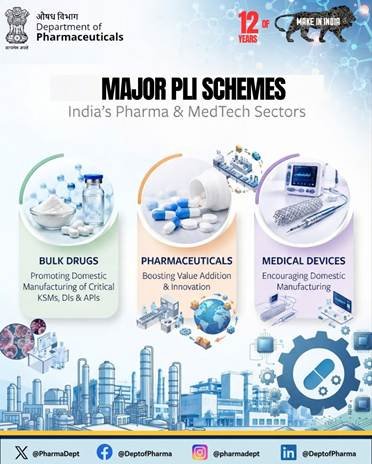
Aligned with the vision of Make in India and Atmanirbhar Bharat, the PLI schemes viz., a) PLI Scheme for promotion of domestic manufacturing of critical Key Starting Materials (KSMs)/ Drug Intermediates (DIs)/ Active Pharmaceutical Ingredients (APIs), commonly known as the PLI Scheme for Bulk Drugs; b) PLI Scheme for Pharmaceuticals; c) PLI Scheme for Promoting Domestic Manufacturing of Medical Devices implemented by the Department of Pharmaceuticals, Ministry of Chemicals & Fertilizers are supporting expansion of manufacturing capacities across critical pharmaceutical ingredients, high-value medicines and advanced medical devices.
a) PLI Scheme for Bulk Drugs : Strengthening Self-Reliance in Critical APIs
The Government approved the PLI Scheme for Bulk Drugs in 2020, with a total financial outlay of ₹6,940 crore. The scheme was launched to strengthen domestic manufacturing of 41 identified critical products and reduce dependence on imports, particularly for APIs and other essential pharmaceutical building blocks.
The scheme is designed to attract large investments in greenfield manufacturing projects and strengthen India’s supply-chain resilience. Under the scheme, 48 projects have been approved. As of June 2026, ₹5,210.74 crore of investment have been made, exceeding the committed investment of ₹4,330 crore. 39 projects for manufacturing 28 APIs/KSMs have been commissioned.
The scheme has also enabled domestic production of critical fermentation-based products such as Penicillin-G, Clavulanic Acid and Rifampicin, which were earlier largely dependent on imports. As of June 2026, PLI scheme beneficiaries had achieved sales of ₹3,792.49 crore, including exports of ₹560.16 crore, while generating employment opportunities for around 5,127 persons.
The commissioning of new manufacturing units, including projects in Visakhapatnam, Andhra Pradesh, is strengthening the domestic ecosystem for critical pharmaceutical raw materials. Companies such as Lyfius Pharma, Kinvan Private Limited, Andhra Organics Limited (AOL), Meghmani LLP, Centrient Pharmaceuticals India Pvt. Ltd have contributed to strengthening of domestic manufacturing of critical APIs/KSM/DI such as Penicillin G, Clavulanic Acid, Sulfadiazine, Atorvastatin, Para Amino Phenol (PAP).
b) PLI Scheme for Pharmaceuticals : Driving High-Value Pharmaceutical Manufacturing
The PLI Scheme for Pharmaceuticals was approved in 2021 with a total financial outlay of ₹15,000 crore. The scheme seeks to enhance India’s manufacturing capabilities, increase investment and production, and encourage a shift towards high-value pharmaceutical products.
The scheme supports manufacturing across categories including biopharmaceuticals, complex generics, patented and off-patent drugs, orphan drugs, auto-immune medicines and other high-value pharmaceutical products, along with specified APIs, DIs and KSMs not covered under the Bulk Drugs PLI Scheme.
A total of 55 applicants, including 20 MSMEs, have been selected under the scheme. As of June 2026, the scheme has attracted ₹46,744 crore in actual investment, substantially exceeding the targeted investment of ₹17,275 crore.
The scheme has also contributed to employment generation, with 1,21,294 jobs created as of June 2026. Beneficiary companies have achieved cumulative sales of ₹4,02,869 crore, including exports worth ₹2,57,370 crore, from the commencement of the performance period in FY 2022-23 up to June 2026.
Companies such as Sun Pharmaceutical Industries Limited, AurobindoPharma Limited, Dr. Reddy’s Laboratories Limited, Lupin Limited, Cipla Limited, Intas Pharmaceuticals Limited, Torrent Pharmaceuticals Limited have expanded their capacities to manufacture complex generics, biosimilars, auto-immune medicines and other high value pharmaceuticals