
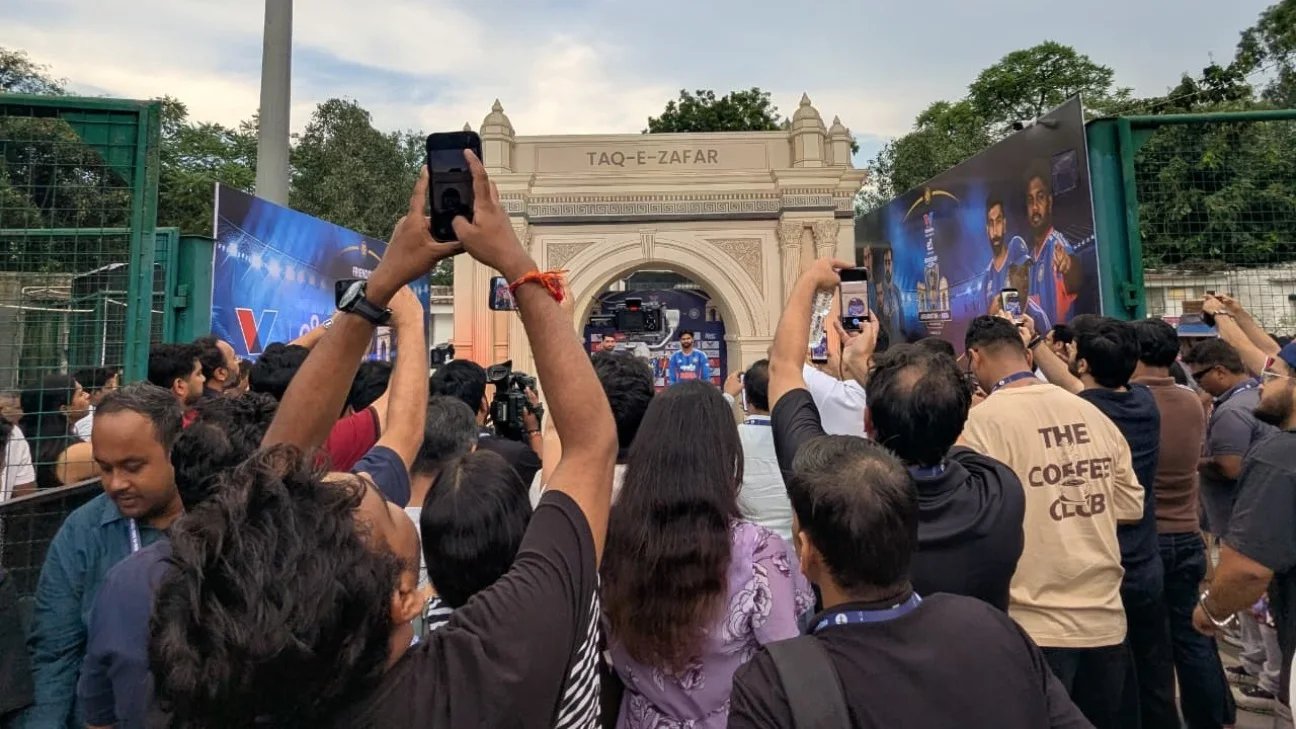
“The main factor [for choosing Delhi for this series] was capacity,” Menhajuddin Raz, Afghanistan’s international cricket manager – and their event manager for this series – told Cricinfo. “If we had hosted this series at smaller venues, accommodating the crowd would have been a struggle… The Indian team draws huge numbers.”
“There are other good facilities across India as well, but Delhi is also somewhere where connectivity from Afghanistan is quite direct and easy,” Raz said. “In addition, there is a notable Afghan community settled within Delhi.”
Rohan Jaitley, the DDCA president, pointed out that there was another reason for the switch to Delhi: “[It] was an ICC recommendation… that it could happen in Delhi, especially after what happened in Greater Noida [in 2024]”.
For the DDCA, it was familiar territory, just a two-way deal as opposed to a three-way deal.
However, these neighbourhoods have seen a steep decline in their Afghan population in recent years, both because of visa renewal issues as well as immigration to other countries. As a result, the presence of Afghan jerseys and flags was markedly reduced during this series, though individuals and small groups from around the city streamed in as usual.
Cricinfo understands that fewer than ten ACB officials from the media and marketing team could come to Delhi because of their domestic cricket obligations, as well as the lack of direct flights to Delhi on the weekend of the BRICS Summit – a multi-nation political conference hosted in the capital – which coincided with the first T20I on the evening of September 13.
The DDCA, meanwhile, had primary responsibility for on-ground execution.
“Everything except broadcast and telecast [fell] within our domain of the arrangement,” Jaitley said. “Getting a hospitality partner, security agencies, or getting the local administration, Delhi Police, and other departments on board would have been a task [for the ACB]. Since we do this on a regular basis a few times a year, we were aiding and helping them with the execution.”
During the first T20I, because of the heightened security deployment in the city for the summit, the Sashastra Seema Bal, an Indian border-security force, took over security in and around the stadium. For the remaining two matches, the local police was in charge.
While the summit complicated the logistics, the ACB wanted the series to be big, and not just because it was at a Test venue, another first for them in India.
“Setting aside the cricket results – where one team wins and the other loses – the tournament was delivered smoothly… If we get the opportunity to host more fixtures here, we would be glad to do so”
Menhajuddin Raz, Afghanistan’s international cricket manager
“The advertising split stood at roughly 60% Afghan advertisers and 40% Indian advertisers,” Paktian said. To accommodate the demand for space, the DDCA debuted a new three-tier, eco-friendly LED system.
The revenue-sharing model between the DDCA and the ACB was also agreed upon in advance. “Since the government of India is keen and very closely bilaterally aligned with Afghanistan, and the BCCI wants to support them – and the ICC is also helping them in a similar manner – we have structured it on a reverse [financial] model,” Jaitley said. “Our clear framework is that whatever our overhead cost is for running operations, we deduct that from the larger parcel of revenue generation, keep a hosting fee for our overhead expenses, and the remainder gets transferred [to ACB].”
On September 16, a day before the final T20I of the series, both the cricket teams, as well as BCCI, DDCA and ACB officials, turned up for a media dinner at a hotel in central Delhi. The officials flanked the stage for pictures with the squad members.
All the players and coaching personnel from the two sides were present. The “Friendship Cup”, after all, has been a maximum-effort exercise in bilateral relations between the two cricket boards, and by extension, the two countries.
“With major events, there are always routine operational ups and downs, but what matters is delivering the event successfully at the end of the day,” Raz said. “Setting aside the cricket results – where one team wins and the other loses – the tournament was delivered smoothly… If we get the opportunity to host more fixtures here, we would be glad to do so.”
If Afghanistan want to host more cricket in the capital, then this change in the city’s routine – the DDCA handing the reins to the ACB, then helping them run the show – could be the start of good things for Afghanistan, and fans of international cricket in the city, whether Afghan or Indian.
Abhijato Sensarma and Daya Sagar are sub-editors at Cricinfo