
The dressing rooms will be temporary. So will a large chunk of the seating. The three permanent stands at the ground hold a little over 500 people. There are no permanent showers for the players, and the Japan Cricket Association (JCA) is bringing in temporary facilities for the occasion. Extra stands should push the seated capacity towards about 2000. Tuesday is also a holiday since it is sandwiched between holidays on Sunday, Monday (Respect for the Aged Day) and Wednesday (Autumnal Equinox Day).
The new square went down in March. Invitations went out to Full Members, and the JCA had further conversations around the ICC’s annual conference. Somewhere along the way, Japan added another question to its initial offer of just a training base. “Fancy playing us?” the JCA asked.
India said yes.
For the Japanese players who will walk out against India, that “yes” has brought a standard of cricket they have spent years trying to reach unusually close.
The Japan Premier League (JPL) has brought some of that experience home. Overseas professionals including Dimuth Karunaratne, Josh Brown and Will Bosisto have shared dressing rooms with local players. Taniyama, who watches the IPL, BBL and “almost anything if I can find the time,” says having those players beside him has offered something television cannot.
“It showed us the level that these top players are at and held up a mirror for us to realise the work we still have to do,” Taniyama says. “We do not have players of that level in domestic cricket for the rest of the year, so the JPL is something I really look forward to. The chance to ask these players questions and see their mindset up close during a game is amazing.”
Much of that growth has happened far beyond Sano, but the city remains Japanese cricket’s most visible home. It became the JCA’s first “City of Cricket” in 2008, an attempt to give the sport a recognisable base in a country where it still only occupies a small corner of the sporting landscape.
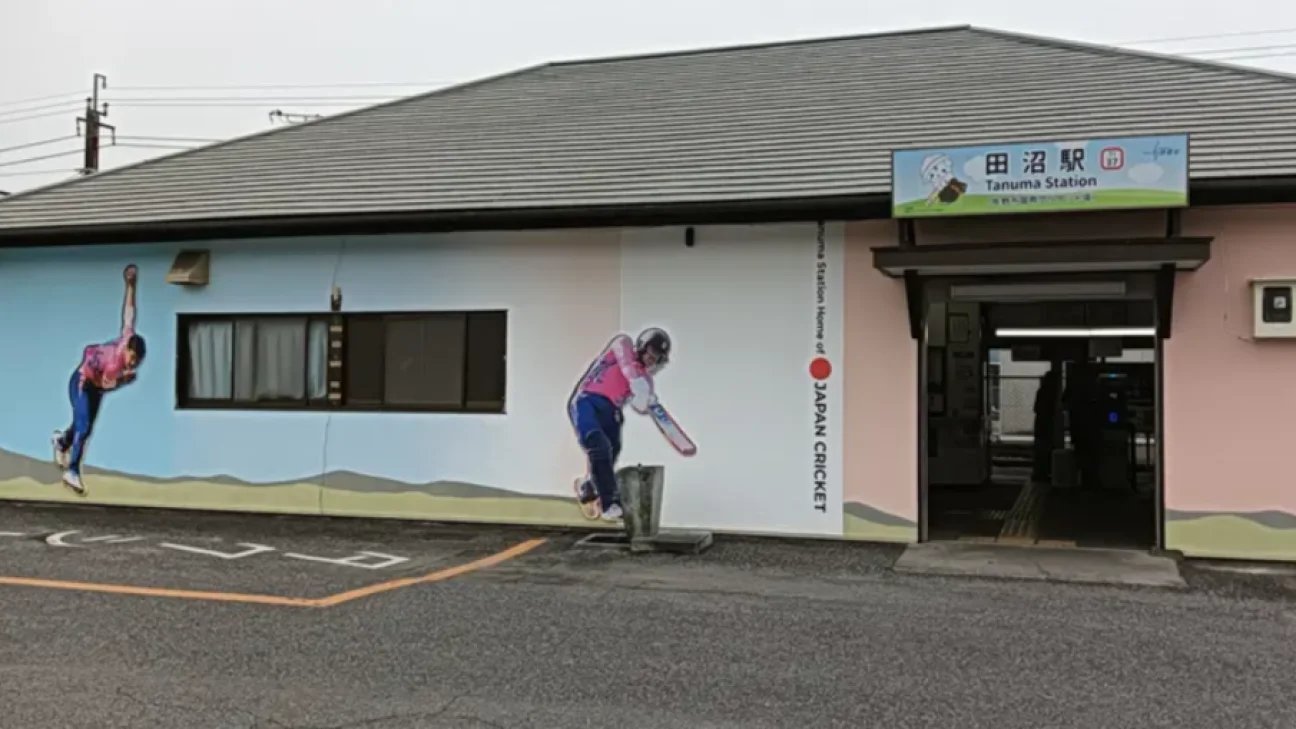
These days, signs of that identity have begun to appear beyond the ground. There is Sanomaru, Sano’s official mascot, who wears a ramen bowl as a hat, with noodles forming his fringe, and has appeared at Tanuma Station holding a cricket bat like a samurai sword. The station, used by spectators travelling to the cricket ground, was given a cricket-themed makeover last year and now carries the title “Home of Japan Cricket”. Local residents helped with the transformation; the walls carry cricket imagery and displays explaining the game’s history in Japan and how Sano became its base.
Elsewhere in the city, cricket has quite literally made it onto the streets. Five manhole covers feature cricket-playing characters from the anime Black Butler, an unlikely connection that grew from the JCA advising the series on its cricket scenes.
The player pathway has expanded too. Japan have an A team below the senior men’s side and have added an Under-16 side, while greater access to age-group competition through the Asian Cricket Council (ACC) has allowed the JCA to identify players earlier. Seven or eight members of their most recent Under-19 World Cup squad remain eligible for the next cycle.
The women’s pathway has expanded as well. Japan formed an Under-19 women’s team this year and sent them into international competition at the ACC Women’s Under-19 Premier Cup. The senior women’s set-up has also sought opportunities abroad, with players receiving exposure to professional environments outside Japan.
Curr has noticed another change in the scrutiny around the men’s team. When Japan announced their Asian Games squad, people online were debating selections and asking why certain players had been left out. For a cricket set-up that has spent years trying to attract attention, having its selections picked apart is a relatively new development.
At senior level, last year’s Asia-East-Asia-Pacific Regional Final in Oman put Japan up against Nepal and UAE and brought them close to the next stage of T20 World Cup qualifying.
Professional cricket remains some distance away. Even the JPL, for all the access it provides, still requires Japanese players to cover some of their own costs to take part. Curr would eventually like that relationship reversed, with players being paid to play.
Cricket’s inclusion in the LA 2028 Olympics has increased the support available to the national teams. This has largely come through access to personnel and expertise rather than a sudden injection of money. Japan now have a full-time strength-and-conditioning coach as well as a part-time analyst.
In Japan, Curr describes the approach as the “Japan way,” with changes made gradually and sustainably. Taniyama hopes cricket can eventually become a professional option in the country, while Kubota wants children to encounter the sport early enough that playing for Japan becomes something they can grow up wanting to do.
Only a few months ago, the idea of India playing Japan here would itself have sounded improbable. “Things can move pretty quickly,” Curr says. “And dreams can become reality pretty fast.”
“Whatever the result, we have to accept it,” Miyauchi adds. “We have a Samurai spirit that doesn’t give up easily.”
By Tuesday evening, Japan should know a little more about how far they have come, and how far they still have to go.
Sreshth Shah is a sub-editor at Cricinfo. @sreshthx