
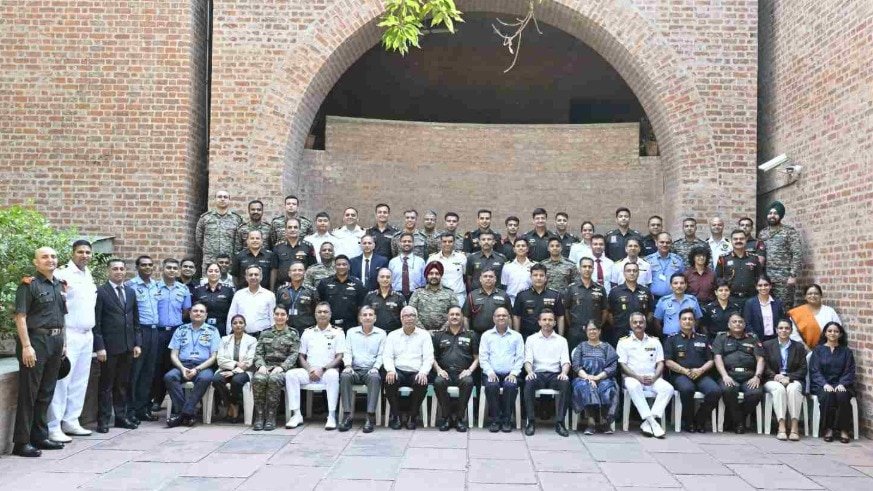
Sixty-two officers of the Indian Armed Forces have entered the portals of IIM Ahmedabad, joining the 20th batch of its Armed Forces Programme (AFP), as they prepare for a second career beyond military service. The six-month residential course, held from October to March, seeks to furnish officers with the knowledge of management and commerce required in the corporate world.
For armed forces personnel long versed in command, operations and the ordering of large organisations, the new lessons are those of finance, strategy, marketing, analytics and business.
The programme is intended to carry the officers’ experience of leadership, human resources, infrastructure and project management into the language of modern enterprise, preparing them for the professional life that follows the uniform.
A DIFFERENT KIND OF COMMAND
The programme proceeds upon a simple premise: the experience acquired in uniform need not end with retirement.
Military officers arrive with years of exposure to operations, leadership, human-resource management, strategy, infrastructure and project management, besides organisational behaviour. IIM Ahmedabad’s task is to place this accumulated experience against the framework of contemporary management.
The intention is not merely to introduce officers to the corporate vocabulary, but to sharpen their analytical and managerial abilities and give them an enterprise-wide understanding of organisations.
For officers contemplating their “second innings”, this transition can be consequential. Large companies may have roles suited to the experience of former military personnel, but the requirements and expectations of the corporate sector are not always familiar territory to those whose professional lives have been shaped by the armed forces.
The AFP seeks to bridge precisely that divide.
FROM STRATEGY TO STATISTICS
The classroom at IIM Ahmedabad offers a markedly different theatre from the military establishment.
The curriculum encompasses corporate finance, marketing, business analytics, statistics, economics, entrepreneurship, business law, supply chain management and information systems.
It also includes financial decision-making and healthcare management, alongside accounting, human-resource management, organisational behaviour, strategy, operations and decision sciences.
In this manner, the officers’ established understanding of leadership and organisation is placed alongside the mechanics by which modern businesses are financed, managed and expanded.
THE CASE STUDY METHOD
A considerable part of the learning rests upon IIM Ahmedabad’s case-study-based pedagogy.
Officers examine real-world business situations drawn from different industries and organisations, studying the circumstances in which decisions are made and the consequences that follow.
The classroom is supplemented by industry visits, expert lectures and interactions with corporate professionals, providing exposure beyond academic instruction.
The design reflects an effort to acquaint officers not merely with individual business functions, but with the wider workings of corporate institutions and global business culture.
For a military officer, retirement can mark the close of one career without necessarily marking the end of professional ambition. The AFP is built around that transition.
Its stated objectives include improving professional competence, developing an enterprise-wide perspective, understanding global corporate culture and facilitating a smoother movement from military service into the corporate sector.
Thus, at Ahmedabad, the men and women accustomed to command, discipline and responsibility find themselves before a different examination, one in which the questions concern markets, finance, strategy, people and enterprise.
The uniform may ultimately be exchanged for the suit of the corporate world. But the leadership forged in the first innings is now being recast for the second.
– Ends