
Indian companies are exploring smart wearables for uses ranging from voice-based artificial intelligence (AI) assistance and digital payments to education and accessibility, as the market expands beyond fitness tracking and smartphone notifications.
Reliance Jio is preparing to launch AI-powered wearable devices in India, while India’s assistive technology startup Torchit is developing smart glasses for visually impaired users. US-based chip maker Qualcomm, which has worked with Jio and Lenskart on wearable devices, sees glasses emerging as an early growth segment, with local applications in payments, education and productivity.
Jio explores voice-led AI wearables for India
Reliance Intelligence’s AI wearables division is developing devices that will allow users to access its AI services through different form factors, including glasses and audio devices. The company said it expected to launch its wearables in India around November or December 2026.
The devices are being developed to support live translation, AI-powered note-taking, scan-and-pay, music playback, hands-free calling and live cricket commentary. Users will be able to activate the assistant through the voice command “Hello, Jio”, allowing them to access these features without taking out their smartphones.
Indian language support is a key part of the offering. At the time of the interaction, the company said the devices supported eight languages: Hindi, English, Marathi, Gujarati, Bengali, Telugu, Tamil and Malayalam. It also planned to add four more languages.
Jio is working with multiple vendors to develop the devices and is exploring different configurations, including audio-only frames, camera-equipped frames and true wireless stereo (TWS) headsets. The company did not disclose the final prices but said it intended to make the devices affordable for Indian consumers.
Torchit develops smart glasses for accessibility
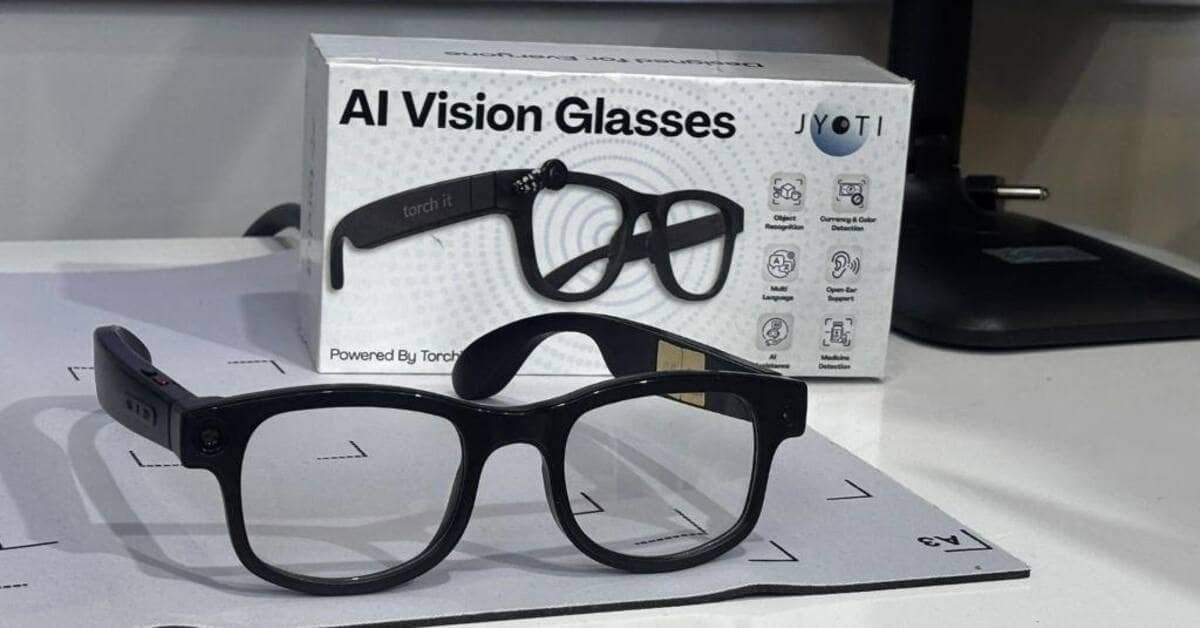
Ahmedabad-based assistive technology company Torchit is approaching smart wearables through accessibility and education, with its Jyoti ecosystem of smart glasses designed primarily for visually impaired users.
The glasses offer six modes: Explore, Read, Medicine, Colour, Currency, and Food and Grocery. Users can switch between modes using a red button and activate the selected function through a second button.
In Explore mode, the glasses describe what their camera captures, including details about a person’s clothing. The other modes help users access information about written material, medicines, colours, currency and everyday items.
Hema Khatri, chief growth and partnership officer at Torchit, said the company wanted visually impaired students to have access to educational opportunities comparable to those available to sighted students.
The latest version of the glasses, launched in July 2026, is wireless, replacing an earlier wired model. Khatri said Torchit’s products had reached more than 40,000 users across India. The company is also working on an AI assistant for the glasses.
Qualcomm sees payments and education as local use cases
Qualcomm, which has worked with Jio and Lenskart on smart glasses, sees scope for India-specific applications as local companies and startups develop wearable devices.
Sumit Sonal, head of marketing at Qualcomm India, said the company had demonstrated a glasses-based payment solution with Lenskart in collaboration with the National Payments Corporation of India (NPCI). The demonstration showed how users could make payments through glasses, with voice or fingerprint authentication.
“Things like these, like live translation or transcribe, are now becoming regular use cases,” Sonal said. He added that the next stage would involve developing applications that require multiple partners to work together, citing payments as one example.
Qualcomm has an extended reality (XR) team in India that studies local requirements and works on developing solutions with partners. Sonal said education and productivity were other areas where the company expected to see applications emerge.
He cited an education and upskilling solution developed by Asus with Qualcomm as an example of how wearable technology could be used beyond consumer entertainment. He also said automotive companies had approached Qualcomm about using glasses and displays for navigation and communication, including applications that could reduce the need for two-wheeler riders to look down at their phones.
For Indian developers and device makers, local engineering support is another part of the process. Sonal said Qualcomm’s engineering teams in India work with companies to develop solutions and take them to market.